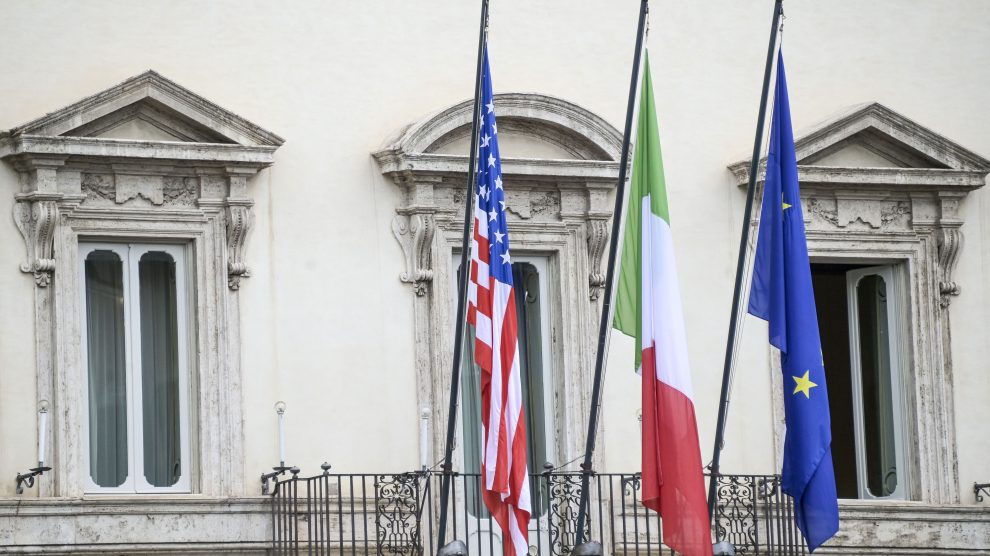
“Italy’s decision to join Pax Silica is strategically important.” That’s the assessment from Martijn Rasser, Vice President for Tech Leadership at the Special Competitive Studies Project (SCSP), framing with Decode39 the significance of the signing Italy carries out Friday in Brindisi.
Why it matters: This isn’t ceremonial. It’s a choice of sides within the architecture of technology alliances the United States is building around the value chain that ties together semiconductors, artificial intelligence and critical minerals — just as the center of gravity in AI competition shifts from the capabilities of individual models to control over the ecosystems that sustain them.
The details: Signing the Pax Silica Declaration will be Ambassador Armando Varricchio, Special Envoy for Innovation and New Technologies to Foreign Minister Antonio Tajani, and U.S. Ambassador to Italy Tilman Fertitta, with Puglia’s regional institutions in attendance.
- The move follows Varricchio’s own signature on the Joint Statement on AI Opportunity, presented at last month’s Pax Silica summit in Washington.
- It comes shortly after Italy joined the Call to Action for 6G Leadership and Security, the U.S.-led coalition on sixth-generation network security.
- And it follows Foreign Minister Antonio Tajani’s participation, in early February, in the first Critical Minerals Summit hosted in Washington by Secretary of State Marco Rubio — where Italy announced its intention to join “at Minister Tajani’s initiative,” per the Foreign Ministry.
Between the lines: These are formally separate initiatives, but they run on the same logic — trusted supply chains, shared standards, coordination among aligned partners before the market sets the rules on its own. The European Commission has already signed the declaration for matters within EU competence.
What the Foreign Ministry says: the area of focus is “in particular semiconductors, artificial intelligence and the critical minerals needed for their development,” with the goal of “promoting an ecosystem favorable to the advancement of these sectors and reducing dependence on individual exporting countries.”
- Against that backdrop, the dialogue on “Trusted Technologies” that Italy and the U.S. have been running takes on added significance. It’s promoted by the Krach Institute for Tech Diplomacy and the SERICS Foundation, and organized by Roberto Baldoni, now Senior Advisor on Technology and Cybersecurity Policy to Italy’s ambassador in Washington — a concrete example of tech diplomacy aimed at building shared, rather than self-sufficient, supply chains.
The big picture: Launched by the State Department in late 2025 and expanded at the second Washington summit last June, Pax Silica now brings together more than 20 countries — Japan and India in the Indo-Pacific, Germany and the EU, plus partners from the Gulf and Latin America — around the concept of “innovation sovereignty” laid out by the initiative’s architect, Under Secretary Jacob Helberg.
- Technological sovereignty, in this framing, doesn’t come from replicating the entire AI stack within one’s own borders, but from contributing complementary pieces to a shared architecture among trusted allies: one country brings semiconductor manufacturing, another critical minerals, another research capacity or advanced manufacturing.
- Early operational tools: the Joint Statement on AI Opportunity, signed at June’s summit by nearly 30 countries; a pilot project with Panama on digital credentialing for the secure movement of semiconductors and minerals; and a Foundry School launched with Stanford.
The other side: It’s an alternative model, and a direct rival, to the one Beijing is pushing. In July, China used the World AI Conference in Shanghai to launch the World AI Cooperation Organization (WAICO), signed by 29 countries.
- Xi Jinping laid out four priorities — openness and cooperation, equitable access, AI safety under human control, UN-centered coordination — paired with a package of initiatives: 5,000 training slots, application-cooperation centers, and the MAZU weather-monitoring system rolled out across 30 countries.
- It’s a strategy of “selective shaping”: Beijing isn’t trying to rewrite global AI governance wholesale, but to concentrate on the areas — technical standards, capacity-building, open-weight ecosystems — where it can exert real influence, offering access and infrastructure to developing countries while gradually embedding its own standards.
The crux: The difference between the two architectures isn’t just one of method. Washington gates access by trust tier; Beijing ties it to its own technology offer while presenting that as openness — but it’s openness to the spread of Chinese capabilities, not equal access to infrastructure, markets and governance.
- For a country like Italy, with a semiconductor and advanced-manufacturing industry already exposed to state-backed Chinese competition, there is no viable third way: hedging between the two would still mean ending up inside someone else’s supply chain — likely the one offering more attractive terms in the short run, i.e. China’s — without any say over the standards governing it in the long run.
What Rasser is saying: “The initiative [Pax Silica] remains nascent, and the test will be whether its members translate political alignment into coordinated action. But the underlying logic is sound: no country can secure the AI value chain on its own,” said Rasser.
- The collective capacity — technological, industrial and financial — of the United States and its allies “is an unmatched strategic advantage. Italy’s participation strengthens that network and reinforces the durability of transatlantic technology cooperation.”
- The SCSP vice president, among the world’s leading experts on tech competition, adds a note for Rome on execution: “Italy is moving in the right direction, but much more remains to be done. De-risking should not mean indiscriminate decoupling from China. It should mean identifying unacceptable dependencies, protecting critical technologies and know-how, diversifying supply chains, and investing in domestic capacity.”
- For Rasser, Italy has significant strengths in semiconductors and advanced manufacturing, “but those capabilities face growing pressure from Chinese state-backed competition. The window for action is closing.”
Bottom line: This isn’t an ideological stance — it’s a bet that staying inside the U.S.-led network buys more room to maneuver, industrially and diplomatically, now and in the future, than standing outside it.
- As Tajani said: “With its accession to Pax Silica, Italy confirms the political will to work with the United States and other partners to advance the development of production technologies. A collaboration that will have a strong positive impact on our businesses and will strengthen our security and the unity of the West.”