Italian immigrants from the Kingdom of the Two Sicilies formed the economic backbone of Odessa during the early years following its foundation in 1794, while the French Revolution was transforming Europe. They had been drawn to the Black Sea by the military commander José de Ribas, a Neapolitan nobleman of Spanish origin, who desperately needed an experienced administrative class and skilled workforce to realise an ambitious vision: the creation of a great commercial port. Around that port, the city of Odessa would emerge.
Today, through the acquisition of a 51% stake in TIS Group, the leading private operator at the port of Yuzhny (Pivdennyi in Ukrainian) in the Odessa region, the Mediterranean Shipping Company (MSC), founded by shipping magnate Gianluigi Aponte, is restoring Italy to a prominent economic role in Odessa. The transaction represents the most significant infrastructure investment in Ukraine’s port sector in recent years.
MSC is the world’s largest shipping company and the global leader in container transport. Although headquartered in Geneva, it remains owned by the Aponte family from Campania. The company was already operating in the port of Odessa through its local subsidiary. Despite the ongoing war with Russia, however, the Neapolitan group has chosen to embark on a series of major investments in Ukraine.
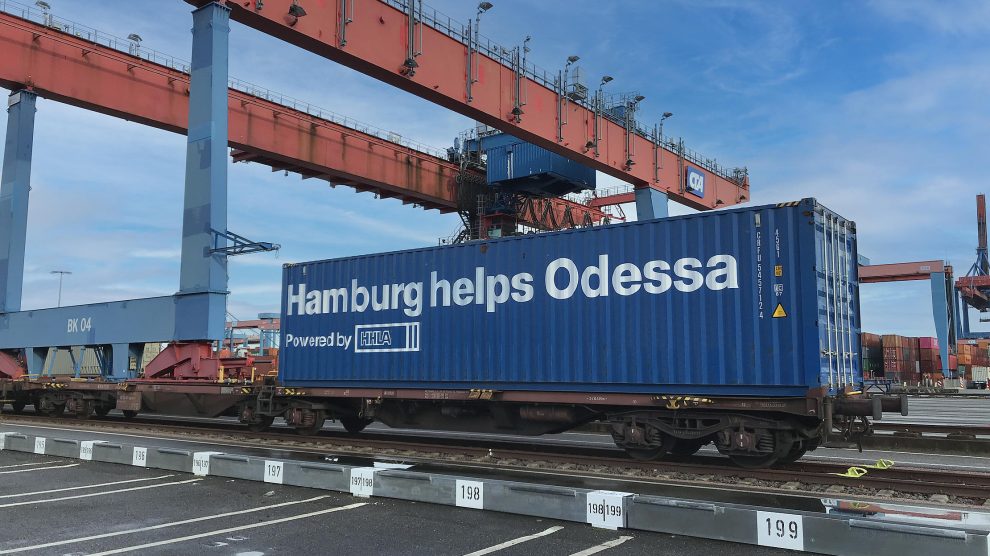
- The first step came in November 2024, when MSC acquired a 49.9% stake in the German container logistics leader HHLA, which is majority-owned by the City of Hamburg. HHLA operates container terminals in Hamburg, Tallinn, Trieste and Odessa. Through this transaction, MSC gained an indirect presence in Container Terminal Odessa (CTO), managed by HHLA since 2001 and Ukraine’s principal container hub, allowing it to integrate its maritime network with HHLA Group’s Metrans rail infrastructure and logistics hubs across Central and Eastern Europe.
- In May 2025, MSC took a further step by acquiring, through its Swiss subsidiary Medlog SA, a 50% stake in the Ukrainian logistics company N’UNIT and a 25% share in the Mostyskaintermodal terminal, near the Polish border. According to Forbes, the investment was valued at between €15 million and €30 million. It represented the largest investment in Ukraine’s railway infrastructure by an international investor since the beginning of Russia’s full-scale invasion.
N’UNIT operates a network of intermodal terminals in Vyshneve, in the Kyiv metropolitan area, as well as in Kharkiv, Dnipro and the Lviv region. Its facilities include integrated grain storage warehouses and are strategically positioned along the country’s main economic corridors, combining road and rail freight transport.
- Mostyska is an intermodal hub located between Lviv and the Medyka border crossing with Poland. It specialises in transferring containers between Ukraine’s broad-gauge railway network, inherited from the Soviet era, and the European standard-gauge system, making it a key asset for cross-border rail freight. The terminal’s other shareholder is Lemtrans, part of SCM Group, owned by Ukrainian businessman Rinat Akhmetov. The strategic objective is to establish an integrated transport corridor linking Ukraine’s Black Sea ports with the European Union’s rail networks. Following the same strategy, HHLA acquired a 60% stake in Eurobridge Intermodal Terminal LLC at Batiovo, near the Hungarian border, in June 2025.
At the end of May 2026, MSC completed the acquisition of a 51% stake in TIS, located at the port of Pivdennyi, Ukraine’s most advanced deep-water port and the only one capable of accommodating the largest container vessels thanks to its deep-water berths, with depths ranging from 15 to 19 metres.
- The stake was acquired from DP World, the Dubai-based global logistics group, which decided to redirect its investment strategy towards Russia, participating in the development of Arctic shipping routes in partnership with the state nuclear corporation Rosatom. As a result, the company divested its Ukrainian port assets.
- TIS Group (Trans Invest Service) is Ukraine’s largest port operator by cargo throughput. The company manages six specialised port terminals and operates its own tugboat fleet. Its container terminal features a 600-metre quay and an annual handling capacity of 400,000 TEU. Overall, TIS handles more than 20% of Ukraine’s total cargo volumes and is the second-largest port terminal on the Black Sea after the Port of Constanța in Romania. Before the war temporarily disrupted maritime trade, container traffic reached approximately 245,000 TEU in 2020, representing double-digit growth compared with the previous year.
According to YouControl, the Ukrainian corporate registry, Diego and Alexa Aponte — the children of Gianluigi Aponte, who transferred ownership of the MSC Group to them in 2020—have each acquired a 25.5% stake in TIS, giving them a combined controlling interest of 51%. The remaining shares continue to be held by TIS’s longstanding Ukrainian partners: 11.7% by Yegor Grebennikov, 9.7% by Andrey Stavnitser, and 9.2% by Oleg Kutateladze. This reflects MSC’s well-established strategy of acquiring stakes in strategically important ports while maintaining operational partnerships with local shareholders.
As is evident, the acquisition of TIS is not an isolated transaction but the latest stage in a broader strategy that MSC has been methodically developing across Ukraine. These targeted investments in logistics are driven by expectations of a substantial increase in Ukrainian exports during the country’s reconstruction, with a corresponding surge in container traffic. The willingness of an experienced global operator such as MSC to commit significant capital while the war is still ongoing sends a powerful signal of confidence in Ukraine’s long-term economic recovery and growth.
- However, it should not be overlooked that MSC is also a major player in the cruise and passenger shipping industry. As Diego Aponte has stated, the group’s mission is to “connect the world’s oceans, roads and railways.” The consolidation of MSC’s presence in the Black Sea therefore raises the prospect of future investments extending beyond freight logistics into tourism and passenger transport.
Odessa is widely expected to emerge as one of the region’s leading tourist destinations once peace returns, not least because the war has brought unprecedented international attention to the city. The world has discovered that Odessa is far more than a commercial port and seaside resort: it is also a city of remarkable museums, elegant architecture and home to Ukraine’s finest opera house.
MSC’s willingness to invest despite the exceptionally high political and financial risks may well encourage other international groups to follow suit. In many respects, it would echo the city’s own history. When Italian entrepreneurs first settled on the shores of the Black Sea, they paved the way for French, German, British, Greek, Polish and Jewish merchants and investors. Together, they built a cosmopolitan city that became known as the Pearl of the Black Sea.
The author of this analysis is Ugo Poletti, director of The Odessa Journal