
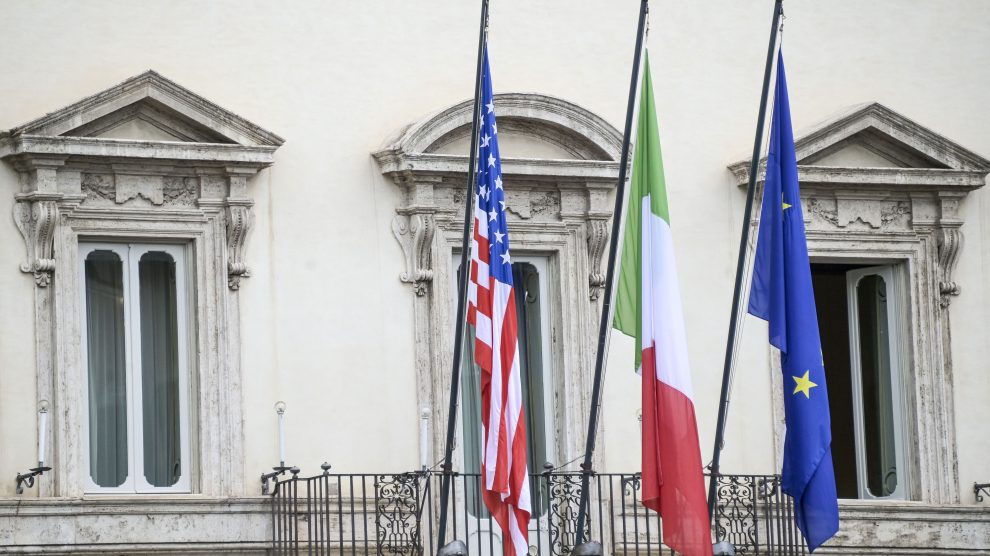
Italian Foreign Minister Antonio Tajani and U.S. Secretary of State Marco Rubio are putting another piece in place in the emerging transatlantic architecture for critical minerals and technology supply chains.
The two ministers are signing a Memorandum of Understanding on cooperation in critical minerals in New York today, on the sidelines of the United Nations General Assembly.
Why it matters: The agreement moves the Italy-U.S. conversation beyond the political commitment to diversify critical-mineral supplies.
- The MoU establishes an Italy-U.S. technical working group tasked with giving operational follow-up to bilateral cooperation. It also provides for information and expertise sharing and, more significantly, for the mobilization of public and private resources to support investment in extraction, processing and recycling.
- For Italy, the latter is particularly relevant: recycling is one segment of the critical-minerals value chain where the country already has companies with significant industrial expertise.
The bigger picture: Critical minerals sit upstream of defence production, semiconductors, batteries, energy systems, data centres and artificial intelligence. Securing their supply is therefore increasingly inseparable from the broader question of who controls the industrial foundations of technological power.
- That makes diversification from China more complicated than simply finding new sources of raw materials. It requires investment across the entire chain — from extraction to processing, refining and recycling — as well as sufficient demand and financial support to make alternative supply commercially viable.
- The new Italy-U.S. framework is designed to operate precisely across these different stages.
Follow the money — and the price: One particularly important provision concerns the way critical minerals are priced.
- According to the Italian Foreign Ministry, Rome and Washington intend to work with international partners to develop “fairer” pricing mechanisms for critical raw materials.
- The issue goes to the heart of Western attempts to build alternative supply chains. New mining and processing projects must compete in markets where China has accumulated enormous scale and significant influence over both supply and prices. Diversification therefore depends not only on identifying deposits, but on creating economic conditions under which non-Chinese projects can attract capital and remain commercially sustainable.
Tajani had made that objective explicit ahead of the meeting. “With Rubio, we will first sign the agreement on raw materials to make supplies more secure. It also includes the so-called Pax Silica, which was already signed by Ambassadors Varricchio and Fertitta in Brindisi,” he said.
- He described the emerging framework as “a strategic partnership on critical minerals such as rare earths, to create an alternative market where China no longer dictates prices,” adding that Italy has already concluded a similar agreement with Argentina.
The backstory: New York is the latest stage of a process that has accelerated throughout 2026.
- In February, Tajani travelled to Washington for the ministerial launch of FORGE — the Forum on Resource Geostrategic Engagement — the U.S. initiative aimed at deepening international cooperation on critical minerals.
- The meeting placed mineral security firmly within the economic-security agenda shared by Washington and its partners. Italy, in turn, presented itself as a potential bridge between U.S. initiatives and European efforts to reduce strategic dependencies.
- That positioning matters because the bilateral MoU is not designed as an alternative to European policy. According to the Italian government, it will complement the similar EU-U.S. agreement signed in April and support coordination through multilateral frameworks, including the G7 Alliance for Resilient and Production.
Enter Pax Silica: The same logic has already expanded beyond minerals. On July 31, Italy joined Pax Silica, the U.S.-led initiative aimed at securing the supply chains underpinning artificial intelligence and semiconductors.
- The connection is increasingly straightforward. AI supply-chain security does not begin with algorithms or data centres. It begins further upstream, with the minerals, energy, semiconductor materials and industrial capacity required to build the physical infrastructure on which the technology runs.
The sequence is therefore revealing: FORGE established the critical-minerals framework; Pax Silica extended the logic into AI and semiconductor supply chains; the New York MoU now creates a bilateral mechanism for implementation.
Zoom out: raw-materials. What is taking shape is less a conventional raw-materials agreement than an attempt to build an industrial ecosystem among trusted partners.
- The Italian-U.S. framework covers information, expertise, capital, extraction, processing, recycling and market mechanisms. That breadth reflects the lesson Washington and its partners have drawn from their exposure to concentrated supply chains: strategic resilience cannot be achieved at only one point in the production process.
- Italy does not enter this competition as a major mining power. Its potential value lies elsewhere — in advanced manufacturing, recycling, industrial know-how and its position inside both the European single market and the transatlantic economy.
The political message: Tajani has framed the agreement as “a concrete, mutually beneficial industrial and trade policy agreement.” But he also placed it within a broader definition of the relationship with Washington.
- “With the U.S., where we agree, the dialogue is continuous and structured. Then, when there are things on which we disagree, we say so clearly. But America remains our main ally,” he said.
- That distinction is important: Rome is presenting deeper industrial and technological integration with the United States not as automatic political alignment on every issue, but as a strategic choice in sectors where economic dependencies have increasingly become security vulnerabilities.
Tajani connected that argument directly to the debate over autonomy. Italy, he recalled, opposed any prospect of U.S. annexation of Greenland. Yet he pushed back against the idea that greater independence can simply mean distancing Europe from Washington while resisting higher spending on defence and security.
- “If you want to be a credible interlocutor, you have to be autonomous,” he said.
The bottom line: The Tajani-Rubio MoU gives institutional machinery to a strategy that has been taking shape for months.
- FORGE provides the critical-minerals framework. Pax Silica connects it to AI and semiconductors. The EU-U.S. agreement and G7 initiatives provide the wider multilateral layer. The new bilateral working group gives Rome and Washington a mechanism to turn those principles into projects and investment.
- The real test will be implementation: whether public and private capital can produce commercially sustainable alternatives across extraction, processing and recycling — and whether new pricing mechanisms can make those supply chains competitive at scale.
- Because reducing strategic dependence is ultimately not a diplomatic exercise. It is an industrial one.