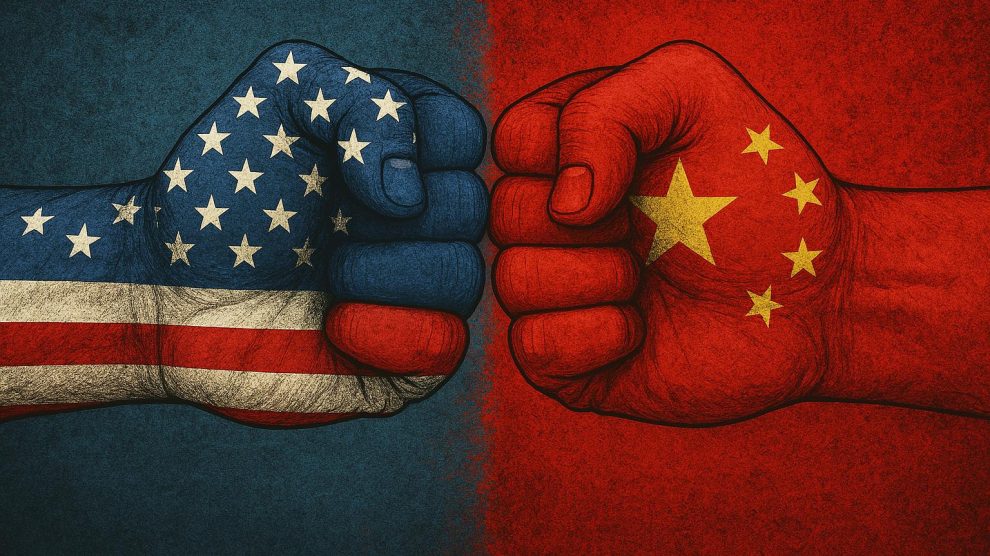
Washington and Beijing are moving toward a new era of cooperation: managed competition – where and when, it is possible.
Why it matters: The more realistic goal is narrower — building enough economic predictability to keep competing without repeatedly triggering crises that damage both sides.
- For Trump, that means tangible wins on rare earths, Chinese purchases of U.S. goods and potentially tariffs.
- For Xi, the bigger prize is time: a durable trade truce that reduces economic uncertainty as China approaches the next Communist Party Congress.
- Underneath both calculations lies a much harder contest over AI, technology, supply chains and military power.
Decoding the news: Trump is expected to personally greet Xi at Joint Base Andrews when the Chinese leader arrives Wednesday — an unusual presidential gesture that captures the importance the White House is placing on the visit.
- The choreography will be extensive: a White House ceremony and bilateral meeting, a military review in the Rose Garden, a state dinner attended by some of America’s most powerful technology executives, and even a private tea between the two presidential couples on Friday.
- Yes but.. The ceremony may be more ambitious than the substance. Expectations for a grand bargain capable of fundamentally resetting U.S.-China relations remain low – if not zero.
The big picture: What looks more achievable is a collection of smaller agreements that could extend the current détente and establish some guardrails around the world’s most consequential bilateral competition.
- There is also a more immediate political consideration for Trump: The U.S. midterm elections are less than two months away. A renewed trade confrontation capable of disrupting supply chains, increasing input costs or unsettling markets would be particularly unwelcome for Republicans already facing a difficult electoral environment.
Zoom in: Rare earths are Trump’s immediate problem. Washington’s most pressing concern is China’s dominance over rare earth supply chains — an issue on which the U.S. is also expected to sign an agreement with Italy in the coming days.
- Beijing controls roughly 70% of global rare earth mining and around 90% of rare earth magnet production, according to widely cited industry estimates.
- China’s restrictions during the latest trade escalation demonstrated how quickly that dominance can become geopolitical leverage.
- The consequences extend far beyond U.S. manufacturers: America’s industrial vulnerabilities are deeply intertwined with those of its Western allies.
- Trump therefore wants stronger guarantees that Beijing will honor existing commitments on rare earth supplies.
The other side: Washington also wants China to buy more American products.
- Agriculture, energy and other commodities offer Trump something strategically complicated negotiations over technology cannot: numbers that can be presented to voters.
- More U.S. exports mean a smaller trade imbalance, benefits for American producers and a politically marketable result before the midterms.
Xi wants something different: time. Beijing’s priority is less about individual purchases than about the duration of the truce.
- China is seeking to extend the current trade truce through the end of Trump’s term, while Washington currently favors a much shorter extension of roughly six months.
Between the lines: The disagreement over timing reveals the different strategic calculations behind the summit.
- For Xi: A long truce would provide economic and political predictability as China’s political system moves toward the next Communist Party Congress in 2027.
- It would also allow Beijing to exploit Trump’s transactional approach to China, which places less emphasis on the ideological dimension that featured more prominently under previous U.S. administrations, particularly Joe Biden’s.
- For Trump: A shorter deal preserves leverage. Washington can keep pressure on Beijing — especially over rare earth exports — while reopening negotiations later if it believes better terms are available.
What we’re watching: The two leaders may therefore leave Washington without settling the duration of the truce.
- There is little urgency. The current arrangement does not expire until Nov. 10, giving both governments an incentive to preserve bargaining power.
Small deals could matter more than a grand bargain. Tariffs may offer more room for progress. Washington and Beijing have discussed reducing duties on categories of goods deemed non-strategic, while major concessions on U.S. technology export controls appear much less likely.
The catch: Defining “non-strategic” is increasingly difficult in an economy where data itself has strategic value.
- Toys, clothing and footwear are relatively straightforward. Industrial inputs, connected appliances, electric vehicles and components embedded in technologically sophisticated systems are not.
- Washington therefore faces a balancing act:
- Lower the cost of some Chinese inputs for American manufacturers.
- Avoid dismantling the economic-security architecture surrounding sensitive technologies.
- Prevent tariff relief from creating new strategic dependencies.
- Beijing, naturally, would prefer the exemptions to go further.
The emerging logic: Reduce friction where the economic cost of competition exceeds the strategic benefit — while maintaining restrictions wherever Washington believes national security is involved.
EVs could become the test case. Trump has publicly opened the door to Chinese automakers manufacturing in the United States if they employ American workers. But allowing major Chinese EV manufacturers directly into the U.S. market remains politically and strategically difficult.
- There may be a narrower route: Chinese battery giant CATL has developed new battery technologies suitable for American pickup trucks and could license technology to U.S. manufacturers, building on models already used with Ford and Tesla.
Think of it as controlled integration: Chinese technology, American manufacturing — without necessarily opening the U.S. market to Chinese-assembled EVs from companies increasingly dominating global competition.
- That model could become a laboratory for the next phase of U.S.-China economic relations.
- Neither full integration nor complete decoupling. Instead, Washington and Beijing would negotiate sector by sector which dependencies are tolerable and which are considered security risks.
Energy can buy stability. Energy offers another relatively straightforward bargaining chip.
- Lower Chinese barriers to U.S. liquefied natural gas could simultaneously:
- Increase American energy exports.
- Help Beijing diversify supplies exposed to geopolitical disruptions, from Russia’s war in Ukraine to continuing instability across the Indo-Mediterranean, including around the Strait of Hormuz.
- Give Trump another measurable commercial win.
- Combined with agricultural purchases, LNG could provide enough economic substance for the White House to present the summit as a trade success even without a sweeping agreement.
Then comes AI — and things get harder. The strategic dossiers are much less amenable to transactional bargaining.
- Artificial intelligence is officially on the agenda, and Washington has signaled willingness to discuss certain “shared risks” with Beijing.
- But expectations should remain modest.
Reality check: Any agreement is more likely to produce political declarations or formal communication mechanisms than meaningful constraints on technological competition — and the effectiveness of those mechanisms would still have to be demonstrated.
- AI leadership is now inseparable from economic power, military capabilities and national security.
- That is why the guest list for the state dinner matters:Jensen Huang, Sam Altman, Elon Musk, Sundar Pichai, Jeff Bezos, Michael Dell and Tim Cook are expected to be among the technology leaders attending.
- Their presence alongside Trump and Xi almost physically illustrates what this relationship has become: U.S.-China competition is no longer primarily about tariffs and trade balances. Increasingly, it is about who controls the technologies that will underpin economic and military power.
Taiwan is the hard limit. Military talks may produce another modest but useful result: stronger communication channels designed to reduce the possibility that an incident — particularly in the Indo-Pacific — escalates unintentionally.
- Taiwan is different: Beijing wants Washington to restrain arms sales to the island and, more broadly, wants assurances that concessions reached during the current summit cycle will not immediately be followed by new U.S. measures.
- Those are assurances Washington will find far harder to provide than commitments on LNG, agriculture or tariffs.
The bottom line: The most important outcome of the Trump-Xi summit may therefore be precisely what it does notproduce.
- There is unlikely to be a grand bargain ending the strategic competition between the United States and China.
- Washington is not preparing to abandon technology controls, protection of strategic industries or its Indo-Pacific role. Beijing is not giving up its technological ambitions, its leverage over critical supply chains or its claims over Taiwan.
- But both governments have reasons to prevent every disagreement from becoming an escalation.
- Rare earths, LNG, agriculture, batteries and consumer goods matter because they provide spaces where deals remain possible without requiring either side to resolve the strategic conflict underneath.
What they’re really negotiating: Not a new era of U.S.-China cooperation, but something potentially more realistic — the rules for continuing to compete without breaking the relationship.