
The trade agreement between the European Union and India has taken another step towards entering into force. Last week, the European Commission formally submitted its proposals to the Council to authorise the agreement’s signature and conclusion, moving towards implementation a negotiation launched almost two decades ago and concluded in January this year.
The scale of the agreement also explains its geopolitical significance. Together, the EU and India account for roughly a quarter of global GDP and a combined population of two billion people.
- Trade in goods and services already exceeds €180 billion a year and supports almost 800,000 jobs in the EU. Brussels also estimates that the agreement could increase annual European exports of goods and services to India by €58 billion, while tariff reductions would save EU exporters around €4 billion every year.
But the deal matters beyond these figures. The Commission explicitly places supply diversification within the broader framework of European economic security.
- In an international system increasingly shaped by geopolitical competition, trade tensions and the need to reduce strategic dependencies, the agreement with New Delhi is also part of Europe’s effort to broaden its network of consequential economic partnerships.
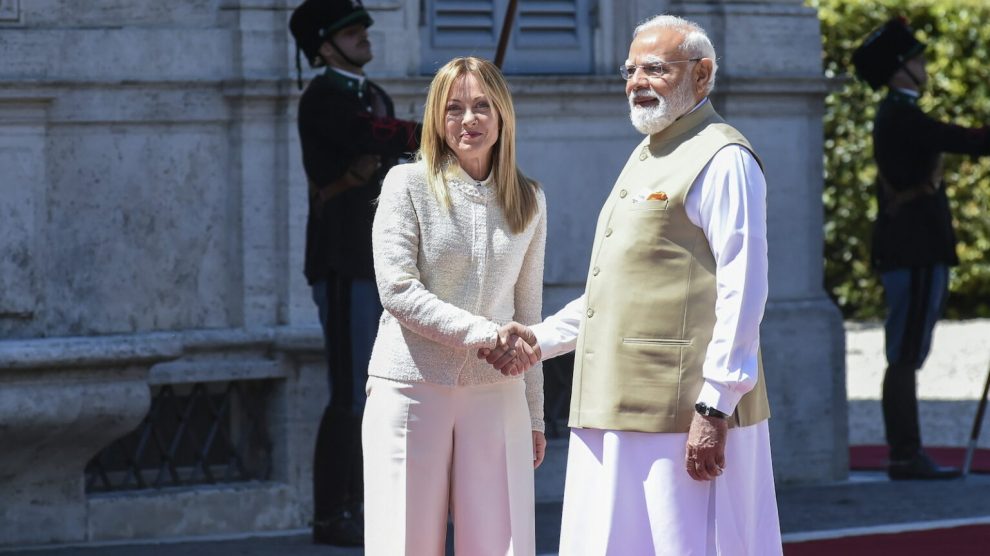
The Italian angle. For Italy, this European acceleration intersects with a bilateral relationship that has changed pace rapidly in recent years. As recently as yesterday, while travelling to Oslo for the first institutional visit by an Italian prime minister to Norway in years, Giorgia Meloni found time for a less institutional anniversary, one more closely associated with the #Melodi trend: on X, she wished Indian Prime Minister Narendra Modi a happy birthday.
- “Happy birthday my friend,” Meloni wrote, wishing “health, energy and success” to the Indian leader, who was engaged in hosting the annual BRICS meeting. “Italy and India continue to strengthen their deep bond of friendship, building together a future of cooperation and prosperity for our nations,” she added.
- Rome and New Delhi established a Strategic Partnership in 2023, adopted a Joint Strategic Action Plan for 2025–2029 the following year and, during Modi’s visit to Rome last May, elevated their relationship to a Special Strategic Partnership. The new framework also provides for a foreign ministers-led mechanism to monitor implementation of the Action Plan and provide strategic guidance to the relationship.
- The question, therefore, is changing. It is no longer primarily whether Italy and India want to move closer, but whether they can translate the political architecture built over the past few years into economic, industrial and strategic outcomes.
The €20 billion test. Trade provides the most immediate benchmark. Italy and India have set a target of bringing annual bilateral trade to €20 billion by 2029. The EU–India agreement could make that target more achievable by lowering tariffs and reducing some of the regulatory frictions that continue to constrain access to their respective markets.
- But a free trade agreement cannot substitute for the bilateral work required to make full use of the opportunities it creates.
The event. This was one of the themes explored this week at the first Italy–India Track 1.5 Dialogue, organised by the Guarini Institute for Public Affairs at John Cabot University (JCU) in Rome, with Formiche and Decode39 as media partners. The participation of H.E. Vani Rao, Ambassador of India to Italy, was part of the event’s public programme.
- The discussion was held under the Chatham House Rule and examined the evolution of the relationship as the two countries approach the 80th anniversary of diplomatic relations in 2027. In accordance with the Rule, the views and proposals reported below are not attributed to individual participants and should not be understood as representing the positions of any specific person or institution.
- The JCU’s event highlighted an economic relationship whose potential still exceeds the infrastructure supporting it. Investment flows remain asymmetric, financial institutions have room to play a greater role in facilitating bilateral commerce, while non-tariff barriers and regulatory divergence continue to hamper deeper integration. At the same time, sectors such as automotive components, semiconductors and digitalisation offer significant scope for industrial cooperation.
- This is an important distinction: The next phase of Italy–India economic relations will be measured not only by how much the two countries sell to one another, but increasingly by what their companies are able to build together.
Security enters the relationship. A similar transition is taking place in defence. Cooperation now encompasses procurement, industrial partnerships, research and development, and personnel exchanges. Naval visits and training activities are already part of the relationship, while a regular framework for joint military exercises has yet to be established.
- The issue is not simply about selling military systems. India is simultaneously seeking to diversify its sources of procurement and expand domestic defence production. For Italy, this creates room for forms of cooperation based on co-development, research and industrial partnerships rather than a conventional supplier-client relationship.
- Maritime security adds another layer. Italy and India sit at opposite ends of a maritime system connecting the Indo-Pacific, the Middle East and Europe. Protecting the routes running through this space is therefore an economic interest as much as a security one. Among the issues discussed in Rome were information-sharing and possible forms of closer security cooperation, another indication of how the agenda could progressively extend beyond industrial ties.
The geography between India and Italy. It is within this framework that the India–Middle East–Europe Economic Corridor (IMEC) also becomes relevant. Its significance lies precisely in its potential to connect several agendas on which Italy and India are already working: trade, ports and logistics, energy infrastructure, digital connectivity and supply-chain resilience.
- For Rome, the corridor also provides a geographic link between its growing engagement in the Indo-Pacific and its traditional Mediterranean projection, giving shape to the concept of the “Indo-Mediterranean”, which has now entered the strategic vocabulary of political leaders — as demonstrated by the op-ed co-authored by Modi and Meloni in May.
- For New Delhi, it offers another avenue for strengthening connections with European markets through the Gulf and the Mediterranean.
Instability in the Middle East, compounded by the renewed crisis triggered by the Houthis in the Red Sea, has exposed the vulnerabilities surrounding this ambition without erasing its underlying logic. At the same time, China’s increasingly assertive posture from the Indo-Pacific to the Mediterranean and Africa contributes to shaping the strategic environment in which both countries operate.
- There is, however, a fundamental distinction in how India approaches this environment. New Delhi’s foreign policy continues to be grounded in strategic autonomy and the diversification of partnerships rather than formal alignment. A closer relationship with Italy, or with Europe more broadly, therefore does not amount to India simply moving into a Western geopolitical bloc.
- The more interesting question is whether Italy and India can identify a sufficiently broad set of converging interests to enable deeper cooperation without requiring complete strategic convergence.
The road to 80. It is also from this perspective that the development of a Track 1.5 dimension acquires significance. Government-to-government relations have advanced more quickly than the infrastructure needed to sustain them: a mature strategic partnership also requires businesses capable of investing in both markets, universities and research institutions able to build lasting networks, and greater mobility between the two societies.
- Academic exchanges, internships and language training are part of this process, as are the conditions of the Indian diaspora in Italy and the need to maintain attention on labour conditions and the mechanisms designed to monitor them.
The 80th anniversary of diplomatic relations and the year dedicated to cultural tourism, both in 2027, will offer an opportunity to broaden these foundations further. The Guarini Institute intends to build on the first Track 1.5 dialogue with a larger initiative at John Cabot University next year.
- The point, however, extends beyond commemoration: with a Special Strategic Partnership, an Action Plan running through 2029, a €20 billion trade target, growing defence cooperation, the European FTA and IMEC in the background, the challenge is now to turn this architecture into results.
- Eighty years after diplomatic relations began, Rome and New Delhi no longer need simply to reaffirm their desire for closer friendship: they need to define what, in practice, a Special Strategic Partnership can deliver.