
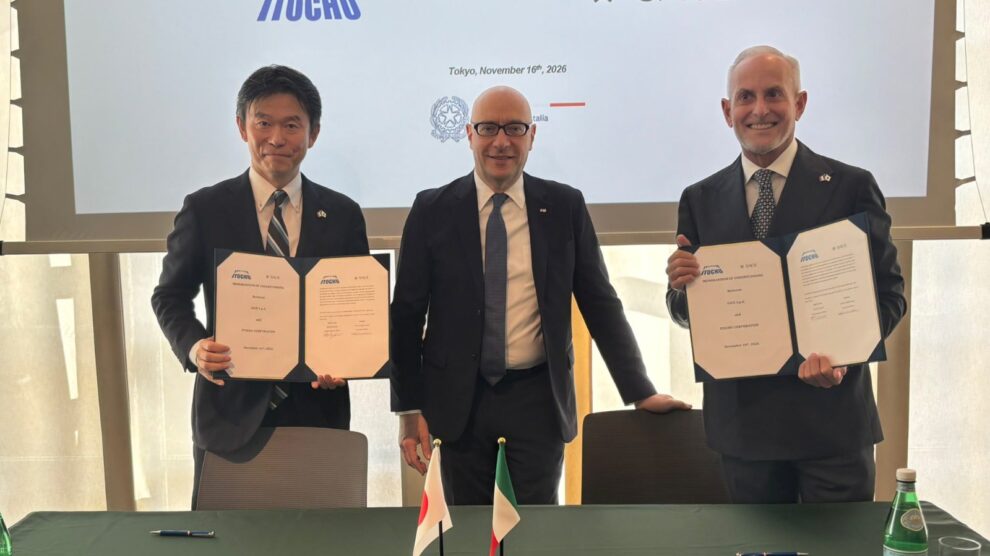
Italy’s export credit agency SACE has concluded a week-long mission to Japan and South Korea, securing three cooperation agreements with major Japanese industrial and financial institutions and opening discussions with South Korean companies.
The agreements aim to connect Italian companies with Asian industrial networks and facilitate joint projects in third countries, turning bilateral economic relationships into broader opportunities for strategic cooperation and establishing frameworks for future cooperation.
Led by CEO Michele Pignotti, the mission targeted two of Asia’s most advanced economies, which together account for €14.4 billion in Italian exports: €8.4 billion to Japan and €6 billion to South Korea.
Why it matters: The initiative illustrates how Italy is increasingly using financial instruments and industrial partnerships to reinforce its economic relationships with strategic Indo-Pacific partners.
- Beyond facilitating Italian exports, SACE aims to help domestic companies participate in international supply chains and major infrastructure projects alongside Japanese and South Korean counterparts.
- The approach reflects a broader understanding of economic cooperation in which trade, investment and supply chain resilience contribute to shared economic security.
Three agreements in Japan. The Tokyo leg produced three memoranda of understanding involving institutions with complementary capabilities.
- Itochu Corporation. The agreement with the Japanese trading and industrial conglomerate aims to develop financing, procurement and commercial opportunities, connecting Italian industrial supply chains with Itochu’s international business network. The partnership also envisages cooperation on projects in third countries.
- Japan Bank for International Cooperation (JBIC). The agreement focuses on strategic infrastructure, energy transition and supply chain resilience, with the two institutions exploring financial support for projects involving Italian and Japanese companies in international markets.
- Nippon Export and Investment Insurance (NEXI). The two export credit agencies will explore joint financial arrangements supporting exports, strategic imports of critical raw materials and energy resources, and greater integration between Italian and Japanese supply chains. Cooperation could extend to projects in Asia, Australia and Africa.
The South Korea dimension. Following the Japanese meetings, the SACE delegation travelled to South Korea for discussions with major industrial players.
- The talks explored opportunities in machinery, electrical equipment, energy and construction, alongside traditional Made in Italy sectors such as fashion, leather goods, food and beverages.
- South Korea represents a €6 billion export market for Italy, with potential for further cooperation across advanced manufacturing and industrial supply chains.
- Although no comparable agreements were announced during the Korean leg, the meetings broadened SACE’s engagement with another important Indo-Pacific industrial partner.
The big picture: The mission comes as economic security becomes an increasingly important component of Italy’s international partnerships, particularly with Japan.
- As University of Tokyo expert Akira Igata recently explained to Decode39, economic security extends beyond diversifying access to critical minerals. It requires a comprehensive approach to industrial vulnerabilities, strategic technologies and supply chain resilience, while recognising the limits of national self-sufficiency.
- The SACE agreements offer a practical example of how international cooperation can support that broader objective, combining financial instruments, industrial networks and shared interests in more resilient supply chains.
- They also build on the growing economic security partnership between Rome and Tokyo, which increasingly complements bilateral cooperation in defense, advanced technologies and regional security.
The bottom line. Italy’s Indo-Pacific economic strategy is increasingly extending beyond export promotion towards industrial and financial cooperation with strategically important partners.
- The agreements secured by SACE in Japan, alongside its engagement in South Korea, provide additional instruments to connect Italian businesses with international value chains.
- Their longer-term significance will depend on whether these frameworks translate into concrete projects, investment and more resilient economic partnerships.
(Photo: X, @ItalyinJapan)