
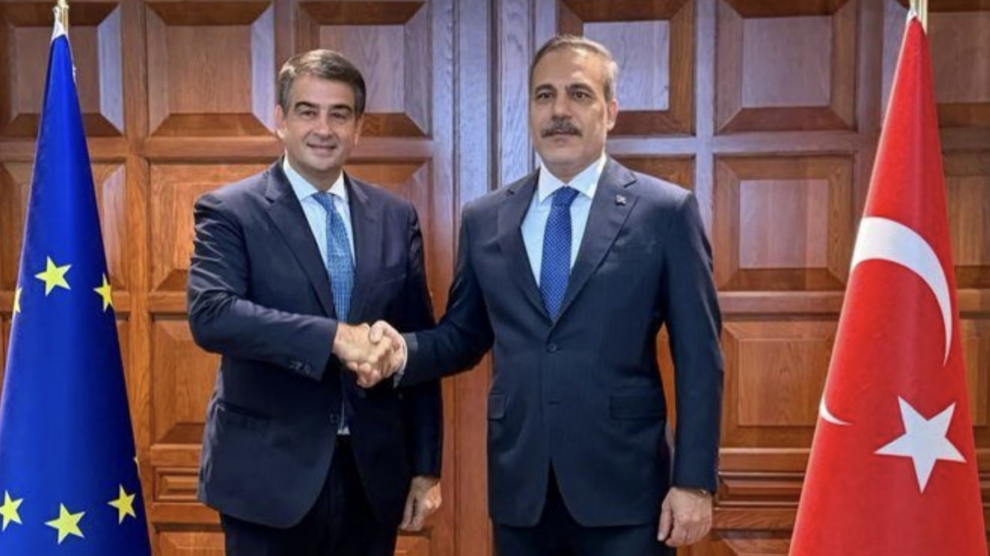
The European Union is testing whether renewed engagement with Turkey can help revive diplomatic efforts to resolve one of the Eastern Mediterranean’s most enduring disputes. European Commission Executive Vice-President Raffaele Fitto travelled to Ankara for talks with Turkish Foreign Minister Hakan Fidan, bringing together two closely connected issues: the future of Cyprus and the prospects for deeper economic relations between Brussels and Ankara.
The visit follows months of diplomatic contacts undertaken by Fitto, who has been entrusted with the Cyprus dossier, and comes ahead of a prospective UN-led meeting involving Secretary-General António Guterres, Cypriot President Nikos Christodoulides and Turkish Cypriot leader Tufan Erhürman.
Why it matters. The Cyprus dispute remains a structural obstacle to closer EU-Turkey relations, with consequences extending well beyond the island.
- A renewed political process could contribute to greater stability in the Eastern Mediterranean, where unresolved territorial questions, competing maritime claims and energy interests have repeatedly complicated regional cooperation.
- For Brussels, the challenge is to encourage constructive Turkish participation without weakening its commitments to Cyprus, an EU member state. For Ankara, the priority is to prevent the dispute from continuing to determine the broader trajectory of its relationship with Europe.
- Fitto’s mission sits precisely at the intersection of these competing interests.
The diplomatic groundwork. The Ankara meeting forms part of efforts to restore a negotiating process that has remained stalled since the collapse of reunification talks in 2017. The prospect of renewed engagement under United Nations auspices offers a diplomatic framework, although substantial differences between the parties remain unresolved.
- Fitto’s involvement reflects an attempt to build political conditions for dialogue through sustained contacts with the relevant actors. His presence in Ankara gives that effort greater visibility and provides an opportunity to assess whether the positions of Turkey and the EU can be brought closer.
- The immediate objective is therefore less an imminent settlement than the gradual restoration of a credible negotiating environment.
Ankara’s position. Turkey has made clear that it opposes linking progress in its relations with the European Union to developments over Cyprus. According to Turkish sources, Fidan told Fitto that relations with Brussels should not become hostage to the Greek Cypriot administration, arguing that disagreements over the island should not prevent cooperation in areas of mutual economic interest.
- Ankara is particularly interested in modernising the existing EU-Turkey customs union and securing access to the European Union’s planned “Made in EU” industrial framework.
- From the Turkish perspective, these issues should be pursued on their own merits, independently of the political negotiations over Cyprus.
- Fidan nevertheless welcomed Fitto’s constructive engagement and expressed appreciation for efforts to strengthen cooperation between Turkey and the European Union.
Brussels’ leverage. The European Commission approaches the relationship from a different perspective. While recognising the economic importance of cooperation with Turkey, Brussels considers progress on Cyprus an essential element of a broader improvement in bilateral relations.
- Within the Commission, there is an understanding that movement on the customs union and Turkey’s participation in European industrial initiatives could become possible if Ankara demonstrates a constructive commitment to restarting negotiations.
- Fitto himself recently emphasised the importance the EU attaches to the resumption of talks aimed at resolving the Cyprus dispute and to Turkey’s contribution to that process.
- The distinction is politically significant: Ankara seeks to separate economic cooperation from the Cyprus question, while Brussels sees the two tracks as mutually relevant. This difference does not necessarily preclude diplomatic progress. It does, however, define the negotiating space in which Fitto is operating.
The Eastern Mediterranean equation. Cyprus remains a particularly sensitive issue because its political division intersects with broader questions of regional security and energy. The presence of substantial natural gas resources in the Eastern Mediterranean has added another dimension to the longstanding disagreements between Ankara and Nicosia, reinforcing the strategic importance of maritime boundaries and regional cooperation.
- Any meaningful improvement in the Cyprus process could therefore have implications for the wider Mediterranean, including the relationship between Turkey and the EU and the prospects for more stable regional arrangements.
- Yet the obstacles remain considerable. The competing positions of the parties, the legacy of previous unsuccessful negotiations and the wider geopolitical environment make a rapid settlement unlikely. The diplomatic value of the current initiative lies in its potential to create room for sustained engagement despite those differences.
The bottom line. Fitto’s visit to Ankara highlights a more active European effort to manage the relationship between the Cyprus dispute and the EU’s economic partnership with Turkey. The Italian commissioner’s work over recent months has helped maintain channels of dialogue on a dossier where political sensitivities remain acute and progress has historically proved difficult.
- Whether that engagement can translate into substantive negotiations will depend on the willingness of the parties to move beyond their established positions. For the European Union, however, the stakes are already clear. A more stable Eastern Mediterranean would strengthen its regional security environment and potentially improve relations with a strategically important neighbour.
- Fitto’s diplomatic initiative is an attempt to create the conditions for that outcome, even as the distance between renewed dialogue and a political settlement remains considerable.