
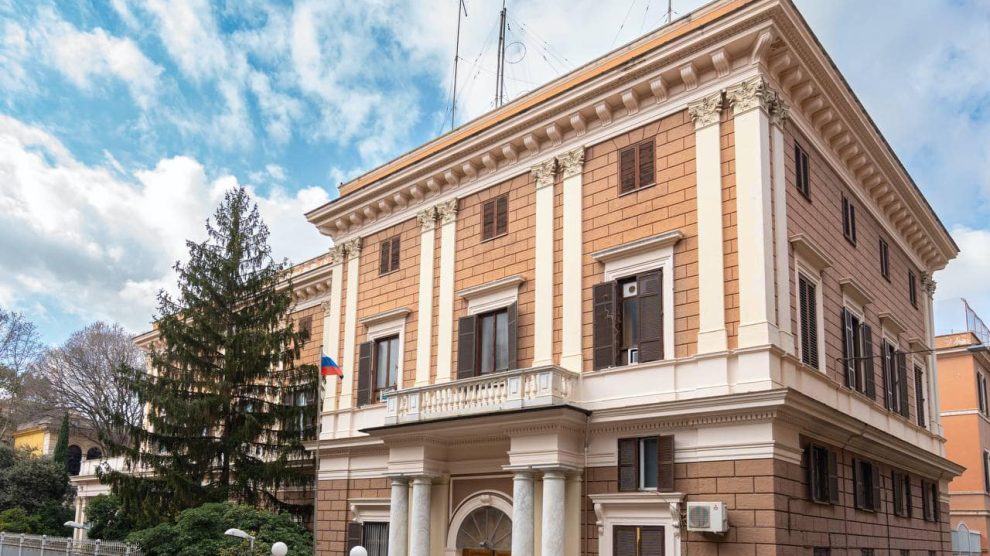
ROME — Russia’s ambassador to Italy, Alexey Paramonov, says he has been speaking with Italian political figures who oppose Rome’s support for Ukraine. He won’t reveal their names — a calculated ambiguity that puts Moscow’s narrative at the center of an increasingly sensitive Italian electoral debate.
Driving the news: In an interview with Russian state news agency TASS, Paramonov claimed Moscow was listening to “the other Italy,” including opposition politicians, activists and civil society representatives who reject what he described as “Italy’s involvement in a war against Russia.”
- The ambassador presented Italy’s support for Ukraine’s resistance against Russian large scale invasione as a form of participation in a conflict against Moscow, echoing a longstanding Kremlin narrative that portrays Western assistance to Kyiv as direct confrontation with Russia.
- He also urged Italian political forces to rediscover the country’s “Eurasian dimension,” invoking Marco Polo and advocating closer cooperation with emerging centers of power across Eurasia.
Why it matters: Paramonov is intervening in one of Italy’s most divisive foreign policy debates: whether Rome should continue providing military and political assistance to Ukraine as the country prepares for its next general election.
The political fault line: Ukraine policy divides both major Italian political camps.
- On the center-left, the Democratic Party remains broadly committed to supporting Kyiv, while the Five Star Movement, led by former Prime Minister Giuseppe Conte, strongly opposes further arms deliveries.
- On the right, Prime Minister Giorgia Meloni has maintained Italy’s alignment with NATO, the EU and the United States on Ukraine, despite resistance within her coalition, particularly from Deputy Prime Minister Matteo Salvini’s League.
The bigger picture: Moscow’s messaging seeks to exploit the overlap between political divisions and public frustration over the economic and social costs of the war.
- Calls to end military assistance to Ukraine have become a recurring theme among pacifist, anti-establishment and anti-Western movements. These constituencies are not necessarily aligned with Russia, but their arguments can provide fertile ground for Kremlin narratives portraying continued support for Kyiv as dangerous escalation rather than assistance to a country resisting invasion.
The information play: By claiming to have unnamed Italian interlocutors, Paramonov introduces an additional element of uncertainty into the debate.
- His refusal to identify them invites speculation about which politicians might be engaging with Moscow.
- The resulting controversy can amplify the ambassador’s message, keeping Russian talking points in circulation even without evidence of any coordinated political operation.
The bottom line: Paramonov’s intervention illustrates how Russian diplomatic messaging can leverage Italy’s domestic political divisions at a delicate electoral moment. The identities of his alleged interlocutors remain unknown, but the public debate generated by that uncertainty already gives Moscow’s narrative additional visibility.