MISRATA – Italy is looking at Libya as more than a destination for investment. At a business forum in Misrata, Italian and Libyan officials and companies outlined a broader ambition: turning the North African country’s Mediterranean position into a commercial gateway connecting Europe with markets across the African continent.
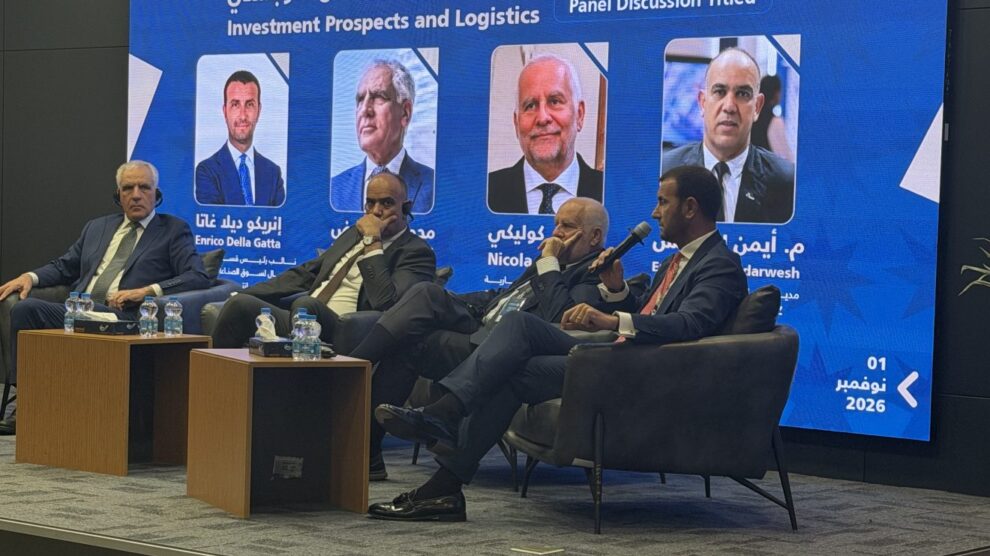
The Italian-Libyan Business and Investment Forum, hosted at the Misrata Free Zone, brought together approximately 60 Italian and 250 Libyan companies. Organized by the Italian-Libyan Chamber of Commerce, the Italian Embassy in Tripoli and Unioncamere, with support from the Misrata Free Zone, the business mission will continue until November 4.
Why it matters: The initiative reflects an effort to give Italy’s economic engagement with Libya a wider geographical and strategic dimension. Rather than focusing exclusively on bilateral trade, the emerging agenda links Mediterranean ports, transport infrastructure, industrial partnerships and access to landlocked African markets.
- The approach also fits into Rome’s Mattei Plan, which seeks to strengthen economic cooperation with African countries through investment and mutually beneficial partnerships.
The big picture: Misrata’s geographical advantage. After previous initiatives in Tripoli and Benghazi, the focus has shifted to Misrata, one of Libya’s main industrial centers and a potential logistics hub connecting the Mediterranean with sub-Saharan Africa.
- Nicola Colicchi, president of the Italian-Libyan Chamber of Commerce, described the city as a future major communications and logistics hub between Europe and Africa.
- His argument rests on the possibility of transforming geographical proximity into sustained economic integration.
- The growth of Libyan businesses could create opportunities for Italian companies seeking a stronger presence in North Africa.
- Long-term commercial relationships would allow cooperation to extend beyond individual contracts.
- A permanent office of the Italian-Libyan Chamber of Commerce in Misrata is expected to help Italian companies navigate the local business environment and develop partnerships.
- The planned office follows an initiative held in Rome on July 9 to present investment opportunities in the Misrata Free Zone.
The underlying objective: Establishing a continuous institutional and commercial presence capable of supporting investment beyond individual business missions.
The Mattei Plan connection. Italy’s ambassador to Libya, Gianluca Alberini, placed the initiative within Rome’s broader African economic strategy. In a message to the forum, Alberini recalled Italy’s position as Libya’s leading trading partner and highlighted Misrata’s potential to become a transcontinental logistics hub connecting Italy, Europe and Africa.
- He explicitly linked this ambition to the Mattei Plan. The proposed role of Misrata would extend beyond handling bilateral commercial exchanges. Its infrastructure could become part of wider trade routes connecting European production and distribution networks with African markets.
- The ambassador also identified practical measures needed to support business activity. These include efforts by the Italian Embassy in Tripoli and the Consulate General in Benghazi to facilitate visas for Libyan business operators, alongside work to expand direct air connections to Misrata.
- Such measures may appear secondary compared with major infrastructure projects, but they are essential to maintaining regular commercial exchanges and enabling companies to establish lasting relationships.
The Sahel corridor. The Libyan government sees the country’s geographical position as an opportunity to develop trade routes extending deep into Africa. Transport Minister Mohammed Ashahoubi outlined plans to strengthen connections between Mediterranean ports and inland markets, particularly Chad, Niger, Mali and Burkina Faso.
- Central to this vision is the development of Libya’s southern road infrastructure. A functioning north-south transport corridor could allow goods arriving at Libyan ports to reach landlocked African countries through overland logistics networks.
- But the project requires more than road construction. Ashahoubi identified several interconnected priorities, including the integration of maritime and land transport, improvements to border crossings, more efficient logistics services and the participation of specialised companies.
The economic value of Libya’s geographical position will ultimately depend on whether these elements can operate as part of a coherent transport system.
- Mohsen al-Suqutri, chairman of the Misrata Free Zone, reinforced this perspective, presenting the zone as a platform for attracting Italian companies and connecting them with local partners.
- The longer-term ambition is to strengthen Misrata’s role as a transit point between European markets and African countries without direct access to the sea.
Sicily enters the equation. A key component of the initiative involves strengthening maritime connections between Misrata and Italian ports.
- The business mission includes a planned cooperation agreement between the Misrata Free Zone and the Western Sicilian Sea Port System Authority, headed by Annalisa Tardino.
- The agreement is intended to deepen cooperation with Sicilian ports, including Palermo, Termini Imerese and Trapani, and explore new commercial and logistics connections.
The strategic significance: Closer cooperation between Sicilian and Libyan ports could provide a practical foundation for Mediterranean economic integration.
- Rather than treating individual ports as separate commercial destinations, the initiative envisages stronger connections between infrastructure on both shores of the Mediterranean.
- These links could support trade flows, facilitate business operations and provide continuity to the institutional dialogue between Italy and Libya.
- Ambassador Alberini, who recalled his previous visits to the Misrata Free Zone, also welcomed the prospect of closer port cooperation.
Beyond logistics: A broader investment agenda. The composition of the Italian delegation reflects the range of economic sectors involved in the initiative, extending well beyond maritime transport and port infrastructure.
- Confindustria Assafrica & Mediterraneo is participating alongside three member companies, following a memorandum of understanding signed with the Misrata Free Zone in July.
- The business agenda covers construction, infrastructure, energy, transport, mechanical engineering and healthcare.
- Additional investment opportunities presented during the forum include agrifood production, pharmaceuticals and medical industries, storage facilities, industrial processing, and waste and oil recovery.
The broader opportunity: Misrata’s development could create demand for Italian industrial expertise across several sectors, linking infrastructure investment with manufacturing, logistics and specialized services.
- The diversity of activities under discussion also suggests that the commercial relationship could develop beyond individual infrastructure projects, supporting a more sustained industrial presence and stronger connections between Italian and Libyan production systems.
From political engagement to business results. The political dimension of the initiative was reinforced by Senator Scurria, president of the Italy-Libya parliamentary friendship group.
- In a video message to the forum, he stressed that institutional relationships must be supported by tangible economic cooperation. “Any friendship is based on concrete facts,” he said, pointing to the participation of Italian companies as an indication of the potential for stronger bilateral ties.
- The challenge now is translating the contacts established in Misrata into investment projects, commercial agreements and sustained business activity. That process will also depend on Libya’s domestic operating environment.
The other side of the equation: On the eve of the forum, a meeting at the Misrata Free Zone chaired by Abdulhamid Dbeibah, head of Libya’s Government of National Unity, addressed several issues affecting commercial activity.
- The discussion covered prices, letters of credit, the dollar exchange rate, customs exchange rates and import procedures.
- These are operational matters with direct consequences for supply chains, trade flows and the ability of companies to conduct business predictably.
- Their inclusion in the discussions illustrates the relationship between Libya’s ambitions as a regional logistics platform and the practical requirements of attracting sustained foreign investment.
What’s next: Misrata’s potential as a commercial gateway between Europe and Africa rests on two parallel developments.
- The first is the construction of a connected logistics and industrial network linking Mediterranean ports, Libyan infrastructure and markets across the Sahel.
- The second is the improvement of the commercial conditions that allow companies to invest, operate and maintain long-term partnerships.
The bottom line: For Italy, the initiative offers an opportunity to connect its established economic relationship with Libya to a broader African strategy under the Mattei Plan. For Libya, it presents a possible route towards translating geographical advantages into greater economic connectivity.
- Whether Misrata can fulfill that ambition will depend on how effectively infrastructure projects, industrial cooperation and improvements to the business environment move forward together.