
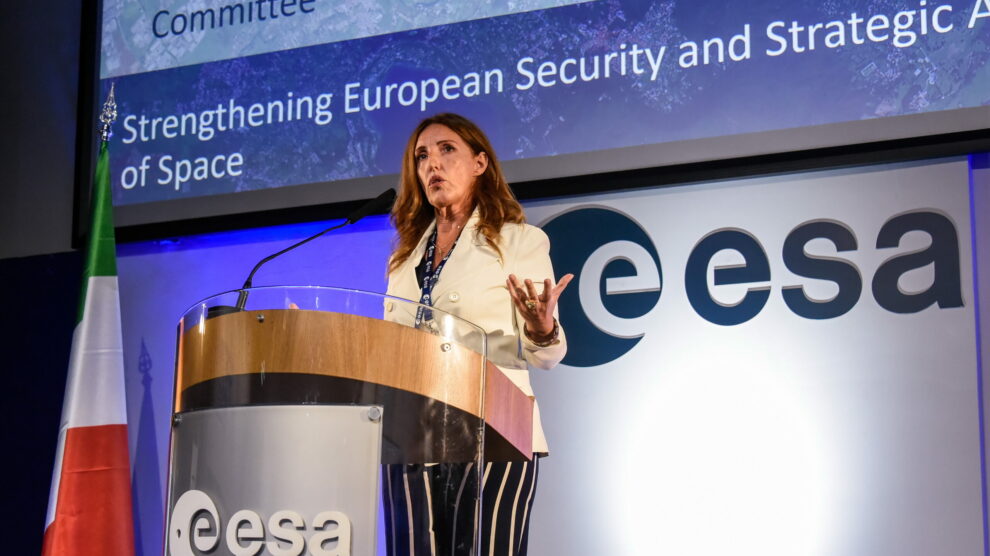
Europe has a long tradition of space research and technological innovation, but has struggled to translate these strengths into industrial value. According to Elena Donazzan, an Italian Member of the European Parliament from the European Conservatives and Reformists (ECR) group and Prime Minister Giorgia Meloni’s Fratelli d’Italia party, the proposed EU Space Act could help address that gap.
The European Parliament’s Committee on Industry, Research and Energy (ITRE) approved amendments to the proposed regulation by 72 votes to one, with two abstentions. Donazzan, who served as rapporteur, sees the legislation as an opportunity to reinforce Europe’s industrial base and its ability to compete with the United States and China.
Why she matters. Donazzan has been closely involved in shaping the European Parliament’s position on the Space Act. A former regional minister in Veneto for twenty years, she brings an industrial-policy perspective to a sector increasingly connected to defence, trade and economic security. She also argues that Italy’s aerospace industry and the Meloni government’s political stability have strengthened Rome’s influence in Brussels.
Q: How will the first European space law change the landscape, and why is this a historic day for Europe?
A: It is historic because we have space traditions, in the literal sense of the term, but we have never brought them together into a coherent system. I remember that, when Ursula von der Leyen inaugurated her mandate, she said she wanted to write the first space law. The underlying message she made explicit was: “We are good at prototyping and research, but we have never managed to translate this into real processes that generate value for European industry.”
- So this regulation, which we strongly supported, myself personally together with Commissioner Kubilius, creates the capacity to generate industrial and economic value. I would add that this is the first law of its kind produced by a wealthy market.
Q: What do you mean by that?
A: Europe is still a wealthy market because it has a very significant public sector and remains an area of interest for those involved in the commercialisation of space. In the EU, we have 450 million people who represent an attractive market because we have an industrial fabric made up of highly advanced companies that need to become stronger.
- So the second objective is to defend our European industrial and productive system, alongside strengthening our production and processing supply chains.
- In this specific case, I would point out that every industrial characteristic can be applied to space. Certainly, this regulation places emphasis on the ability to defend our system.
Q: How does the fact that this legislative file was entrusted to an Italian MEP affect Italy’s overall influence, and how will it enhance the Italian government’s space initiatives?
A: My colleagues from Fratelli d’Italia and I came to the European Parliament with a precise mandate, the same one that brought us so much electoral support: we are going to change Europe. That was also the first slogan of our election campaign. The second was that we are credible because we have a stable government with clear ideas.
- I start from this point to answer your question: space is the most economically significant sector of all. For us, space has political and strategic value.
- Today we talk about space diplomacy, space control and space dominance, which have to do with trade, defence and the economy.
- So the fact that Italians are helping govern this process and that the rapporteur came from the ECR/Fratelli d’Italia conservatives was a political choice that we worked hard to achieve.
- As is well known, legislative files are allocated through a bidding process, and from the very first day I asked to be assigned this file. Our colleagues in the conservative group believed in it and entrusted it to us.
- It was natural that the rapporteur should be Italian, because we were the first to put this file on the table, also because our government has had a very clear strategy on space.
Q: What makes you say that?
A: From the very beginning, the government identified this as an important dossier, and Palazzo Chigi established coordination among ministries and ministers, assigning leadership to Minister Urso.
- Meloni entrusted technical coordination to her military adviser, General Federici. She wanted her government to distinguish itself in this sector, understanding its absolute strategic importance and Italy’s history in space, something that is recognised at both European and global level.
- We have a history of research, a history of research institutes, a history of universities and academia, and a very significant history, still today, of national champions such as Leonardo and Telespazio.
- We should also remember another uniquely Italian characteristic: our 17 aerospace districts, from the wealthiest one in Piedmont to the district in Lazio.
- All this puts us in a position to claim that we are the country with the strongest credentials in this field. For me, therefore, this was a strategic choice from the very beginning.
Q: The EU Space Act comes alongside initiatives on critical raw materials and Global Gateway. Is Europe changing?
A: I believe specific credit should be given to the ideas constantly put forward in Brussels by the Meloni government, which has distinguished itself through a clear and consistent political will, focused on the substance of its proposals.
- In the recent past, as everyone knows, Europe weakened itself without understanding where the rest of the world was heading, and it deluded itself into believing that it was the centre of the world.
- For me, the centre of my world is certainly my society, my civilisation and my nation. But what we saw days ago in China, in what has been dubbed “Yalta Two”, tells us that an international arrangement without Europe causes damage.
- It is also true that previous governments were too fragile. Ministers changed every year, and Rome was unable to sit at European negotiating tables with sufficient weight.
- But then something changed. The Meloni government has been strategically important because it is stable and because it has invested in sectors in which we excel.
- I served as a regional minister for twenty years, dealing with industrial crises in Veneto, and I learned that if you are not sovereign in terms of economic well-being, you cannot have a healthy society. And so, placing emphasis on European industry also leads us to consider issues related to critical raw materials.
- Here, once again, the Meloni government’s determination to put forward Porto Marghera as a storage site stands out. Who would have bet on that just five years ago? We were awarded it in just a few months because this government demonstrated a global vision, also based on small and medium-sized enterprises. But that is not all.
Q: What else?
A: Next week, here at the European Parliament, European trade unions will hold a demonstration to demand the protection of jobs. I hope they will come to demand the abolition of the Green Deal because, if they are consistent, they will have to acknowledge that this ideological measure is the cause of layoffs and lost orders.
- By contrast, a sector such as space brings benefits to our industry and creates more jobs. So today, for me, the natural alliance must be based on cementing the relationship between the world of work and workers.