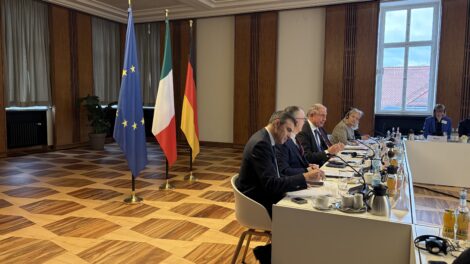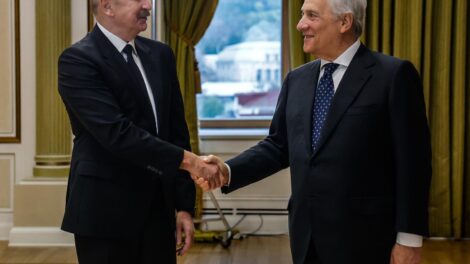

The fifth edition of the Transatlantic Policy Dialogues returned to a question first posed in 2024: how can countries whose security and international influence have long been closely connected to the United States respond when American leadership becomes less predictable? When the question was first raised, it was framed against the prospect of the 2024 US presidential election.
By November 2026, it had acquired a more immediate significance. The disruption in transatlantic relations, Russia’s continuing war against Ukraine, China’s growing international influence, and the increased visibility of the Global South have sharpened debate about the distribution of power and the future of the rules-based international order.
The transatlantic question, revisited. Opening the discussion, John Cabot University President Antonia Maioni emphasised that the uncertainty surrounding Washington should not be understood in isolation. It reflects deeper transformations: domestic political polarisation in the United States, the emergence of new centres of economic and political influence, and renewed challenges to the territorial and institutional foundations of the post-war order. The consequences extend beyond relations between governments. A weakening of international leadership can affect the capacity of multilateral institutions to address global health, economic stability, regional crises, and questions of peace and security.
- The event therefore approached transatlantic cooperation as more than a question of whether Europe can compensate for a changing United States. It asked whether democratic partners can preserve effective forms of collective action while adapting to a more contested international environment. The contributions revealed a debate not simply about the amount of defence spending or the format of diplomatic alliances, but about the institutions, economic structures, and social commitments that make cooperation possible.
Preserving the order while adapting to change. In his keynote address, British Ambassador to Italy and San Marino Stephen Hickey argued against treating the present moment as either entirely unprecedented or evidence that multilateralism has come to an end. Several current tensions—including the American strategic focus on the Asia-Pacific and pressure on European allies to assume greater responsibility for defence—have roots in earlier administrations. Recent developments have intensified these trends, but they should also be understood as part of a longer adjustment in the international system.
- For Hickey, the multilateral architecture remains too extensive and deeply embedded to be dismissed. The United Nations, the World Trade Organization, international humanitarian law, and the network of specialised agencies continue to provide essential frameworks for cooperation, even as major-power actions place them under strain. The appropriate response, he suggested, is to preserve and reform these structures rather than abandon them in favour of an uncertain alternative.
- His practical recommendations centred on closer coordination among democracies, a stronger European contribution within NATO, greater resilience in energy and critical-mineral supply chains, and renewed economic competitiveness. He stressed that defence investment will have limited strategic value if European countries continue to pursue fragmented procurement and fail to develop more integrated industrial capabilities. Equally, Europe’s strength in research and higher education must translate more effectively into commercial innovation and economic growth. On institutional reform, Hickey favoured updating the composition of the UN Security Council while acknowledging the political obstacles to abolishing the veto. He also defended smaller diplomatic formats when they can deliver results, provided they complement rather than displace broader institutions.
- The debate is not between preserving the existing order unchanged and replacing it wholesale. It is about adapting institutions and partnerships without losing the rules, legitimacy, and continuity that make multilateral cooperation possible.
Middle powers: Agency, resilience and their limits. The roundtable, moderated by Professor Michael Driessen, explored what greater cooperation among middle powers might look like in practice—and whether it can strengthen the international system without fragmenting it. Ambassador Jeremy Adler, Deputy Head of Mission at the Embassy of Canada to Italy, presented middle-power diplomacy as a longstanding element of Canada’s foreign policy. For a state that cannot shape international outcomes alone, influence has often depended on building bridges, forming coalitions, reconciling interests, and turning shared principles into practical initiatives. What has changed, Adler argued, is the urgency of doing so.
- Adler placed resilience at the centre of Canada’s response. He described the relationship between domestic and international policy as “intermestic”: national sovereignty increasingly depends on the ability to withstand economic, technological, and security pressures. At home, this means addressing internal trade barriers, raising productivity, developing natural resources responsibly, and investing in infrastructure. Abroad, it means diversifying networks with reliable partners across Europe, the Indo-Pacific, Africa, and the Americas. Energy, critical minerals, clean technology, digital infrastructure, and defence production are not separate policy files; they are connected components of economic and national security.
- Within this approach, the Canada–EU partnership offers a practical framework for cooperation. Adler highlighted opportunities in trade and regulatory coordination, energy and raw materials, digital technologies, research, financial services, security preparedness, and mobility for students and workers. He also pointed to existing industrial links between Canadian and Italian companies. The objective, as he presented it, is not to construct an alternative to the United States, but to make Canada and its partners more capable, resilient, and effective within their existing alliances.
Flexible coalitions. Roderick Parkes of the NATO Defense College offered a more critical perspective on the language of middle-power cooperation and European strategic autonomy. He acknowledged that NATO has become more European in important respects, including through the accession of Finland and Sweden, increased defence investment, and a stronger emphasis on territorial defence. Yet he questioned whether these developments have been matched by a sufficiently serious political debate about what Europe would actually do if required to defend itself. Autonomy cannot simply mean purchasing or reproducing American capabilities. It requires a clearer understanding of the kind of conflict Europe might face, the doctrine and intelligence structures needed to respond, and the political willingness to defend other European states.
- Parkes also challenged the assumption that smaller coalitions necessarily strengthen multilateralism. Such groupings can be useful when larger institutions struggle to reach agreement, but they can also draw political attention and authority away from common structures. He warned that repeated reliance on exclusive formats risks hollowing out institutions such as the European External Action Service or NATO, creating a cycle in which institutional weakness generates still more informal groupings. Referring to the 1955 Bandung Conference, he further cautioned against presenting middle-power cooperation as a new Western idea or assuming that middle powers are inherently moderate, inclusive, or benign.
- Flexible coalitions can help states act when consensus is difficult. Their value, however, depends on whether they reinforce shared institutions or gradually become substitutes for them.
The domestic politics of security. Professor Simone Tholens shifted the discussion from the architecture of international cooperation to the political and social consequences of the current turn towards defence. She traced a change in the way external engagement is justified. In earlier periods, military and strategic interventions were frequently framed through humanitarian action, peacebuilding, and state-building, however contested those practices may have been. Increasingly, she argued, relationships are organised around more material forms of security assistance: weapons, equipment, training, and military support. This does not necessarily make international engagement less political; rather, it changes the language through which it is explained and legitimised.
- Tholens connected this shift to the growing prominence of resilience and “total defence” in Europe. Security is no longer presented solely as the responsibility of governments and armed forces. The possibility of conflict is increasingly brought into domestic life, with citizens, households, and public institutions asked to prepare for disruption. This transformation raises questions about the relationship between the state and society, the expectations placed on citizens, and the extent to which the public accepts a more security-oriented political agenda.
- The discussion became particularly pointed when Parkes questioned the tendency to present defence spending as an uncomplicated route to economic renewal. He argued that some governments risk invoking security imperatives to mobilise resources while overlooking the costs of cuts to development assistance, humanitarian aid, diplomacy, intelligence, and welfare. These areas are not peripheral to security: they can help prevent conflict, sustain social cohesion, and ensure that societies remain capable of withstanding crises. In his formulation, the lesson of the Cold War should not be reduced to a choice between welfare and warfare. A society preparing for conflict also needs functioning health systems, public services, and a credible social contract.
- Tholens brought this argument back to democratic legitimacy and generational politics. Younger citizens are being asked to accept new security priorities, but often without a compelling account of the future those priorities are intended to protect. A political vocabulary dominated by national interest, strategic necessity, and the preservation of existing arrangements may struggle to inspire public commitment. If democratic institutions do not articulate a meaningful future vision, she warned, the space may be occupied by populist movements offering simpler—and potentially more exclusionary—answers.
- Defence capability is only one dimension of resilience. Public consent, social cohesion, functioning services, and a credible democratic vision are also part of a society’s capacity to withstand threats.
Questions that remain open. The audience discussion brought these tensions into sharper focus. Questions addressed the relationship between military preparedness and other forms of democratic cooperation, the capacity of NATO to maintain unity when disagreements persist among its members, and the role of smaller arrangements such as intelligence-sharing partnerships. Participants also asked how younger generations could be persuaded to support new security commitments amid concerns about economic opportunity and social mobility.
- The responses revealed no single solution. Adler argued that renewed attention to hard power need not displace the democratic and soft-power assets of open societies, and that issue-based coalitions can provide useful flexibility while leaving NATO and the United Nations at the centre of the wider architecture. Parkes, by contrast, stressed the institutional costs that may accompany such flexibility and warned against allowing defence priorities to become a justification for shifting responsibility from governments onto citizens. Tholens returned to the need for a persuasive political vision capable of connecting security policy to the aspirations and expectations of younger generations.
- These exchanges also underscored the difficulty of maintaining alliance cohesion when members hold competing interests or disagree over the interpretation of international law and the use of force. The debate did not resolve these questions, but it made clear that institutional unity cannot be sustained by shared threat perceptions alone. It also requires trust, political accountability, and a common understanding of the purposes and limits of collective action.
A broader foundation for transatlantic solidarity. Closing the event, Ambassador Armando Varricchio, Senior Transatlantic Fellow at John Cabot University, placed the discussion within a longer historical perspective. He argued that the transatlantic relationship predates NATO and cannot be understood solely through the framework of collective defence. Its foundations also lie in historical connections and a shared political identity. For that reason, he urged participants to resist a narrow definition of security centred exclusively on military threats.
- Varricchio called for a comprehensive understanding of security that includes democratic resilience, environmental protection, public health, and the values underpinning open societies. Europe’s relative position in the international system may be changing, but this does not make the continent irrelevant or require it to act alone. He distinguished alliances grounded in shared commitments from temporary convergences of interest, presenting NATO as a political community as well as a defence organisation. His closing message was that Europe must become more capable and resilient while continuing to invest in the transatlantic relationships that give its international engagement wider purpose.
The bottom line: Taken together, the evening’s contributions suggested that the future of transatlantic cooperation will depend on managing several relationships at once: between national sovereignty and interdependence; flexible coalitions and durable institutions; defence investment and social welfare; and strategic necessity and democratic legitimacy. The speakers differed in their assessments of how these tensions should be managed. That difference was central to the value of the discussion. Rather than offering a single prescription, the fifth edition of the Transatlantic Policy Dialogues highlighted the political choices that democratic partners must confront if they are to adapt to geopolitical change without surrendering the institutional and social foundations of cooperation.