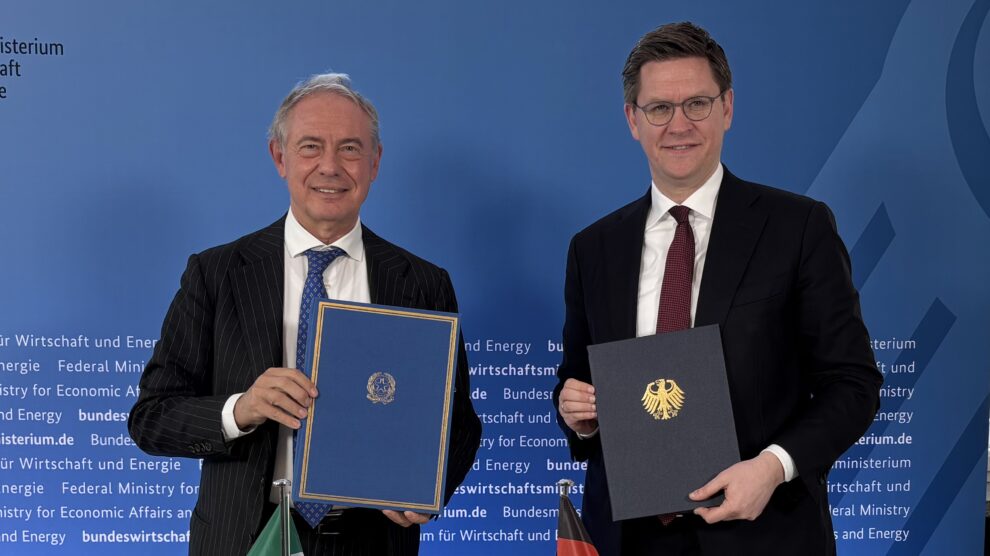
Italian Industry Minister Adolfo Urso and German Economy Minister Katherina Reiche signed a joint declaration in Berlin on November 23, setting out common industrial priorities for 2027. The agreement, adopted during the third Italy-Germany Ministerial Forum, strengthens bilateral coordination on European competitiveness, strategic technologies, defense and economic security.
The declaration builds on the bilateral action plan renewed in January 2026 and brings together political priorities and existing industrial partnerships between two of Europe’s leading manufacturing economies.
Why it matters: Rome and Berlin are seeking to turn their industrial interdependence into greater influence over European policymaking. Together, their manufacturing ecosystems account for approximately 40% of European industry, according to Urso, giving their coordinated positions considerable weight in debates over competitiveness and industrial regulation.
- The initiative reinforces the political alignment established during the January intergovernmental summit in Rome, when Prime Minister Giorgia Meloni and Chancellor Friedrich Merz agreed to strengthen cooperation on competitiveness, defense, energy and strategic supply chains.
- The Berlin declaration moves that agenda towards specific EU legislative and industrial priorities for 2027.
Reshaping Europe’s industrial rules. Italy and Germany are calling for substantial regulatory simplification, fewer obstacles within the Single Market and more effective European industrial instruments.
- Particular attention goes to the Industrial Accelerator Act, which both governments want to strengthen demand and resilience in strategic sectors without generating additional administrative burdens. The declaration also calls for coordination to avoid excessive regulation of foreign direct investment.
- Automotive remains a central concern. Rome and Berlin support technological neutrality and greater flexibility in the sector’s decarbonization pathway, including timely recognition of vehicles powered exclusively by eligible renewable and low-carbon fuels.
- The two governments also favor reforming the EU Emissions Trading System to combine climate ambition with industrial competitiveness, including more flexible arrangements and effective protection against carbon leakage.
- For Urso, the stakes extend beyond individual industries. Europe needs to preserve its productive capacity while creating conditions for globally competitive European industrial champions.
AI, semiconductors and technological sovereignty. The technological agenda is particularly ambitious. Italy and Germany intend to deepen cooperation through Important Projects of Common European Interest (IPCEIs), connecting their manufacturing capabilities with European innovation and investment frameworks.
- The proposed IPCEI on industrial artificial intelligence seeks to exploit Europe’s manufacturing data and strengthen industrial AI applications. Rome and Berlin also support the development of trusted industrial data ecosystems and cloud infrastructure.
- In semiconductors, both countries back the proposed Chips Act 2.0 and its rapid adoption in 2027. They support stronger governance, economically grounded criteria for selecting strategic projects and continued international cooperation with reliable partners.
- The two governments are also promoting the IPCEI on advanced semiconductor technologies, alongside 15 other EU member states, and the Compute Infrastructure Continuum initiative, designed to develop sovereign, distributed and interoperable European computing capabilities.
- These priorities address the vulnerabilities highlighted in Decode39’s reporting on Europe’s semiconductor dependencies, where technological resilience increasingly depends on secure supply chains and cooperation with trusted international partners.
Defense cooperation and European industrial champions. The forum also highlighted existing partnerships between Italian and German companies across defense, security and advanced technologies.
- Participating companies included Leonardo and Diehl Defence, Fincantieri and thyssenkrupp Marine Systems, and ELT Group and Rohde & Schwarz. In digital technologies and microelectronics, discussions involved SAP and Reply, Infineon Technologies and STMicroelectronics, Deutsche Telekom IoT and Exein, and Synapticon and Generative Bionics.
- The declaration identifies underwater capabilities, artillery solutions and electromagnetic warfare as areas of successful industrial cooperation. Rome and Berlin aim to develop shared requirements that could create further opportunities for collaboration, strengthening the European defense-industrial base. The objective is to build on existing partnerships and industrial complementarities rather than announce new corporate integrations.
The big picture: The declaration also addresses the security of critical raw materials, with both governments committing to diversify supplies and coordinate their positions on the further development of the Critical Raw Materials Act.
- This cooperation comes as Italy strengthens its national approach to economic security, including the recently approved European strategic critical-minerals storage hub in Porto Marghera.
- The Berlin forum forms part of a broader effort to make Italian-German industrial cooperation a more consistent feature of EU policymaking. Earlier this year, Rome and Berlin had already moved to coordinate their positions ahead of European competitiveness discussions, particularly on the Single Market, regulation and investment.
- The latest agreement gives that cooperation a more detailed technological and industrial agenda, while linking it to EU legislative decisions expected in 2027.
The bottom line. Italy and Germany are positioning their industrial partnership as a vehicle for shaping Europe’s economic and technological future. Their common agenda combines regulatory reform, strategic supply-chain resilience and closer cooperation across advanced technologies and defense.
- The effectiveness of this approach will depend on whether their political convergence translates into EU decisions, coordinated investments and industrial projects capable of strengthening Europe’s competitiveness on global markets.