
The expansion of offshore energy exploration around Greece is reopening questions about maritime sovereignty, regional security and the competing interests of Eastern Mediterranean powers.
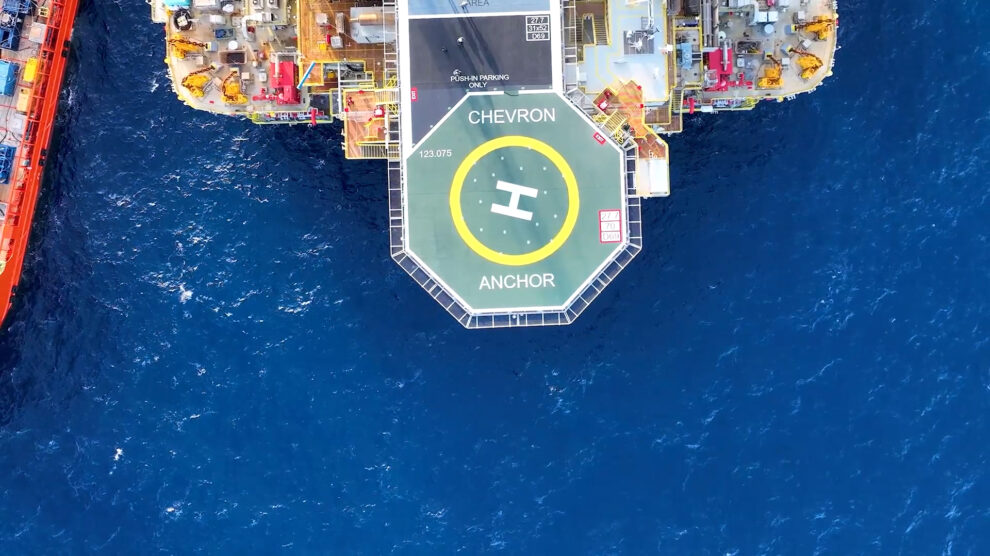
The Chevron–HELLENiQ ENERGY consortium is advancing its exploration programme in Greek waters, with the seismic survey vessel Ramform Tethys arriving in the Ionian Sea to conduct surveys south of the Peloponnese. The operations form part of a broader effort to assess Greece’s offshore hydrocarbon potential, including areas south of Crete.
Yet the geographical expansion of energy exploration brings new geopolitical uncertainties. Maritime boundaries involving Greece, Turkey and Libya remain contested, while energy infrastructure projects linking Greece, Cyprus and Israel continue to face political and security challenges.
Greek international relations scholar Iorgos Tzogopoulos discusses the strategic implications of these developments and the limits of diplomatic progress in the region.
Why he matters. Iorgos Tzogopoulos is a lecturer in international relations at the Democritus University of Thrace, a Senior Fellow at the Hellenic Foundation for European and Foreign Policy (ELIAMEP), and a Fellow at the Begin-Sadat Center for Strategic Studies (BESA).
- He also contributes to ISPI and directs EU–China programmes at the Centre International de Formation Européenne (CIFE) in Nice.
- His research focuses on international relations, European foreign policy and the geopolitical dynamics of the Eastern Mediterranean.
Q: How do the exploration activities in the Ionian Sea and off Crete, conducted by the Chevron–HELLENiQ ENERGY consortium, alter the geopolitical and energy security landscape in the Mediterranean?
A: Greece hopes to discover natural gas, which is why it is beginning to explore the possibility of extraction. For now, we have to wait for the results.
- From a geopolitical perspective, exploration south of Crete is more important because it may take place in waters contested by Libya. Greece will have to demonstrate that it can protect its energy interests and sovereign rights against the claims of other countries, particularly Libya and Turkey.
Q: How is Greece’s political influence evolving?
A: Greece is modernizing its armed forces and strengthening cooperation with countries such as the United States, Italy and France. As a result, its power is growing.
- However, Greece has still not delimited its maritime zones with Turkey and Libya. This remains an extremely complicated and difficult issue in the Eastern Mediterranean. Maritime delimitation disputes cannot be easily resolved.
- Italy, for example, faces a similar problem with Algeria.
Q: How do the electrical interconnector with Cyprus and the proposed Cyprus–Israel gas pipeline fit into the current situation?
A: For now, preliminary work on the electricity interconnector is progressing. This suggests that Greece and Turkey, together with the French companies involved in the project, have reached arrangements that could pave the way for its successful implementation.
- However, we still have to wait and see whether Israel will join. It is too early to draw conclusions, particularly because Israel remains engaged in regional wars.
Q: Is a period of heightened tension with Turkey, potentially concerning the Exclusive Economic Zone (EEZ) in Libya, to be expected?
A: I see no progress on maritime delimitation. I expect Turkey and Libya to cooperate in opposing exploration activities in waters they claim under the Turkish–Libyan maritime memorandum.
- However, we need to wait and see exactly where the exploration activities will take place. That is not yet clear.
Q: European Commission Vice-President Raffaele Fitto is working on the Cyprus dossier and has recently met with Turkish Foreign Minister Hakan Fidan. How might this issue be resolved?
A: I do not believe there will be progress on the Cyprus question. History suggests otherwise.
- Turkey continues to insist on a two-state solution, which is rejected by the international community.
- It is possible that the United Nations will initiate new talks on Cyprus, but it will be difficult for those discussions to produce a concrete outcome.
- The European Union plays only a secondary role in this process.