
Italy has pushed for a shift in the European Union’s climate agenda, emphasising that decarbonisation must go hand in hand with industrial competitiveness and social fairness. The recently struck EU climate agreement represents more than a political win for the Italian government: it reflects Rome’s insistence that sustainability cannot ignore the fate of workers and enterprises in the automotive and energy sectors.
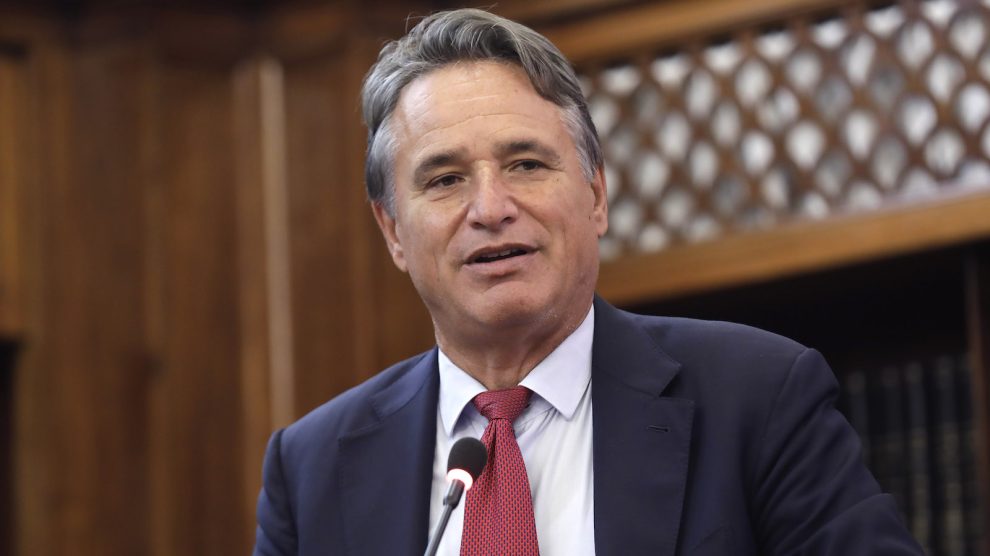
Why he matters: Luca Squeri is a Member of the Italian Chamber of Deputies for Forza Italia and the party’s national head of energy policies, playing a key role in shaping Italy’s negotiating position in Brussels.
Q: The European climate agreement has been hailed as a success by Environment and Energy Security Minister Gilberto Pichetto Fratin. Do you share that reading?
A: Yes, I share it. It is an important step forward, even if not definitive. It is an agreement that corrects a path that needed modification. We face a complex but significant result: finally, in Europe, the need for a more balanced approach is beginning to be recognised, which holds together environmental, economic and social sustainability.
Q: In what sense do you speak of a “course correction”?
A: Because until now the European Union has often pursued environmental goals without adequately considering the economic effects. The agreement introduces elements of pragmatism. I think, for example, of the extension of ETS 2 implementation, which concerns mobility: a measure that avoids shifting immediate costs onto citizens. The first ETS has already created problems for energy-intensive companies; ETS 2 could have caused new ones for families. The extension allows time to be gained and avoids, so to speak, a summary execution of the productive system and of consumers.
Q: One of the most debated points is the target of a 90 % emissions cut by 2040. How do you judge it?
A: It is an ambitious target, but not unattainable, provided it is accompanied by realism and flexibility. Fixing objectives is important, but you have to understand how to reach them without destroying the European economic fabric. The 90% reduction will have to be achieved through different technologies: electric, biofuels, hydrogen, and CO₂ capture. And it is precisely here that technological neutrality becomes decisive. If Europe can valorise all solutions, 2040 could be a possible goal. If, on the other hand, it continues to favour a single path, we risk losing competitiveness and jobs.
Q: Another central point concerns the opening to biofuels. Why is it so significant?
A: Because it finally enshrines the principle of technological neutrality, which until now had merely been evoked. It is not a matter of denying the role of electricity, but of recognising that the transition cannot be monolithic. The use of biofuels opens an alternative path that provides oxygen to the automotive sector and meets the demands of many companies, including Italian ones. It is a paradigm shift: no longer a single imposed technology, but more solutions to achieve the same objective. Among other things, placing us, at least in part, beyond the aggressive Chinese policy in the electric sector.
Q: What fundamental role did Italy have in this European negotiation?
A: Italy’s strength was precisely that of carrying forward the thesis of technological neutrality, but with a pragmatic approach. We showed that sustainability must also be economic and social, not only environmental. To make this line pass within the Council, a critical mass was needed, and we were able to build important alliances. Today we can say that the Italian line has passed, and that Europe is moving closer to a more balanced vision of the transition.
Q: The agreement also speaks of biomass. This is a topic often neglected in the public debate. Is the one contained in the agreement a strategic choice?
A: Exactly: biomass represents a precious resource, especially for a country such as ours. Until now, they have been almost considered a second-class source, but in the agreement, their contribution to renewability is recognised. In Italy, we use about 20% of agro-forest residues, while in Europe the figure reaches 75%. There is thus an enormous margin for improvement and for valuing a supply chain that can generate clean energy and local employment.
Q: What kind of practical impact do you expect from this agreement?
A: “I expect that a more realistic phase of the transition will open. A course that takes into account economic sustainability and industrial competitiveness. In other words, a European model that defends our companies and our citizens without bending to external influences, especially those of China. It is a step forward towards a fairer balance: less ideology, more concreteness.”
The bottom line: Italy has successfully pushed the EU’s climate agenda toward a more pragmatic, technologically neutral framework that aligns decarbonisation with industrial policy. Whether this shift will be reflected in tangible outcomes for Italian business and workers depends on implementation—but Rome has clearly set the tone.