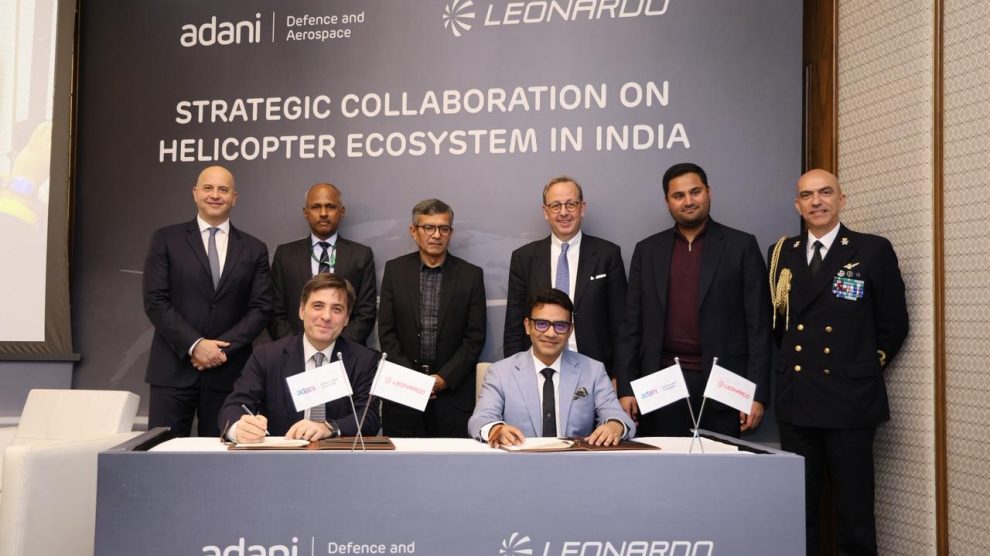
Decoding the news: The MoU between Italy’s Leonardo and Adani Defence & Aerospace is not just an industrial deal. It fits squarely into India’s strategy to turn military demand into domestic manufacturing capacity—and into a broader Italy–India strategic partnership.
The big picture: The agreement signed in New Delhi aims to build an integrated helicopter ecosystem in India, covering manufacturing, maintenance, repair and overhaul, and pilot training.
- Beyond specific platforms — including Leonardo’s AW169M and AW109 TrekkerM — the focus is on embedding industrial capabilities locally, in line with India’s “Aatmanirbhar Bharat Abhiyan” doctrine of strategic self-reliance.
- New Delhi’s approach is selective rather than isolationist. India is seeking industrial partnerships with like‑minded countries, reducing past over‑dependencies — notably on Russia — while anchoring technology transfer, skills development and supply chains at home.
Why India needs this: India’s armed forces are expected to require more than 1,000 helicopters over the next decade, amid accelerated modernisation and rising geopolitical pressure along both land and maritime borders.
- Relying on imports alone is no longer politically or economically viable.
- The strategic bet is to convert defence procurement into a lever for building a globally competitive manufacturing base, with spillovers into the civilian market and international supply chains.
What they’re saying: Ashish Rajvanshi, CEO of Adani Defence & Aerospace, explicitly ties the partnership to this structural demand.
- “With a projected requirement of more than 1,000 helicopters by the Indian armed forces over the next decade, this partnership realises our vision of achieving autonomous production capabilities,” he said.
- He added that the collaboration will enable progressive localisation, strengthen the supply chain, and position India as a global-scale manufacturing base.
- From Leonardo’s side, Helicopters Managing Director Gian Piero Cutillo frames the deal as a long‑term industrial commitment.
- “Joining forces with Adani allows us to contribute concretely to the progressive strengthening of India’s rotary‑wing aircraft industry,” he said, pointing to the combination of advanced technologies, operational capabilities and engineering know‑how as key to supporting the sector’s evolution and India’s strategic needs.
The diplomatic context: Italy’s ambassador to India, Antonio Enrico Bartoli, situates the MoU within a broader bilateral framework. He describes it as “a piece of a larger story” between the two countries.
- According to Bartoli, the agreement builds on the 2023 defence cooperation pact and the Joint Strategic Action Plan adopted by the two prime ministers, which places defence and space at the core of Italy–India collaboration.
- In this reading, the Leonardo–Adani partnership marries “technologies and know‑how from Europe” with “India’s industrial scale and production capacity,” combining a reliable local partner with the engineering strength of a global defence player.
Bottom line: The outcome is not guaranteed. Much will depend on the depth of technology transfer and the effective integration of local firms into the supply chain.
- But the signal is clear: India no longer wants to be just a major defence customer — it aims to be a credible producer.
- Leonardo, in turn, is betting that deeper industrial integration and localisation have become key enablers of relevance in the world’s most strategic growth markets.