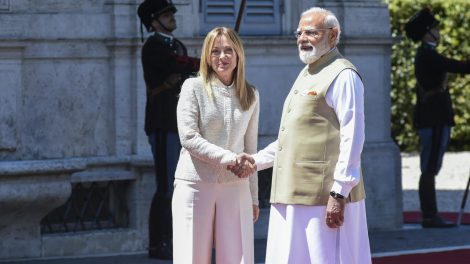
Why it matters: In a moment of widespread political volatility across Western parliamentary democracies, Italy and Japan are emerging as rare cases of electoral stability backed by popular legitimacy. Rome’s reaction to Tokyo’s vote — unusually warm, personal and strategic — highlights a deeper political alignment between the two countries.
What happened: After the snap election that gave Sanae Takaichi a decisive supermajority and full popular mandate, Italian Prime Minister Giorgia Meloni was among the first international leaders to publicly congratulate her.
What Meloni said: “Heartfelt congratulations to Prime Minister Takaichi on the significant success achieved in the elections for the renewal of Japan’s House of Representatives,” said Meloni.
- “Our nations are united by a deep friendship and a strategic partnership that continues to grow stronger thanks to the relationship of sincere trust and constructive cooperation that our governments have built over the years.”
- I still carry in my eyes and in my heart the extraordinary welcome I received during my January visit, which further strengthened the bond between our nations.”
- According Meloni, Italy will continue, “with conviction,” to walk alongside Japan to jointly address global challenges, promote growth, security, and stability, and further deepen the relationship that unites us.
- “Best wishes for your work to my dear friend Sanae and to the new Japanese Parliament.”
Between the lines:
- This was not a standard diplomatic note. The language of personal trust (“cara amica”), continuity and shared strategic purpose points to a relationship that goes beyond protocol.
- The reference to Meloni’s January visit to Japan underlines an already active political channel, not a reactive one.
- By explicitly linking cooperation to growth, security and stability, Rome frames the Italy–Japan partnership as part of a broader response to global fragmentation.
The bigger picture:
- Meloni and Takaichi are currently the only two women leading G7 governments — a symbolic but politically relevant parallel.
- Both leaders come from long internal party trajectories and represent a form of national conservatism rooted in parliamentary systems, not outsider populism.
- Their electoral strength contrasts with the fragile mandates and short political cycles affecting many other advanced democracies.
Why Italy–Japan matters now:
- Japan’s post-election stability reassures markets and allies alike; Italy positions itself as a natural European partner for Tokyo.
- For Rome, alignment with a politically consolidated Japan strengthens its Indo-Pacific profile.
- For Tokyo, Italy offers a reliable EU interlocutor that can ensure strategic continuity.
The bottom line: Meloni’s reaction to Takaichi’s victory signals more than congratulations. It reflects a shared political condition — stability through popular mandate — that has become increasingly rare, as well as a bilateral relationship that is quietly gaining strategic weight within the G7.