

Why it matters: The political and communicative attack launched on Telegram by the pro-Russian hacker group Noname057(16) against Foreign Minister Antonio Tajani marks a new level of hybrid pressure on Italy.
- It is a claim of responsibility and a rhetorical escalation accompanying cyber operations targeting Italian infrastructure and services, aimed at exerting pressure on the political and diplomatic levels at a moment of heightened international exposure for the country.
What’s happening? On its Telegram channel, Noname057(16) stepped up verbal attacks and operational claims against Tajani, explicitly referring to statements by the Russian Embassy in Rome following the minister’s public denunciation of cyberattacks against Italian embassy websites worldwide and facilities linked to the Milan–Cortina Winter Olympics.
- The group claims to have targeted, among others, websites connected to the Olympic committees of Spain, Lithuania, and Poland, the tourism portal of Cortina d’Ampezzo, and the website of Milan Malpensa International Airport.
- Circulated in a coordinated manner, the statement appears designed to amplify the political dimension of the action rather than its technical impact.
Between the lines: Cyber operations linked to the Olympic context are not merely a matter of digital security. Major international events amplify visibility and, in turn, the symbolic value of disruption, especially when such actions intersect with clear, public political positioning on the international stage.
- Italy has also been facing other forms of sabotage in recent days, carried out by anti-government operational groups that are often influenced by hostile narratives, propaganda and other hybrid activities, including those aligned with the malign interests of state actors rival to Rome.
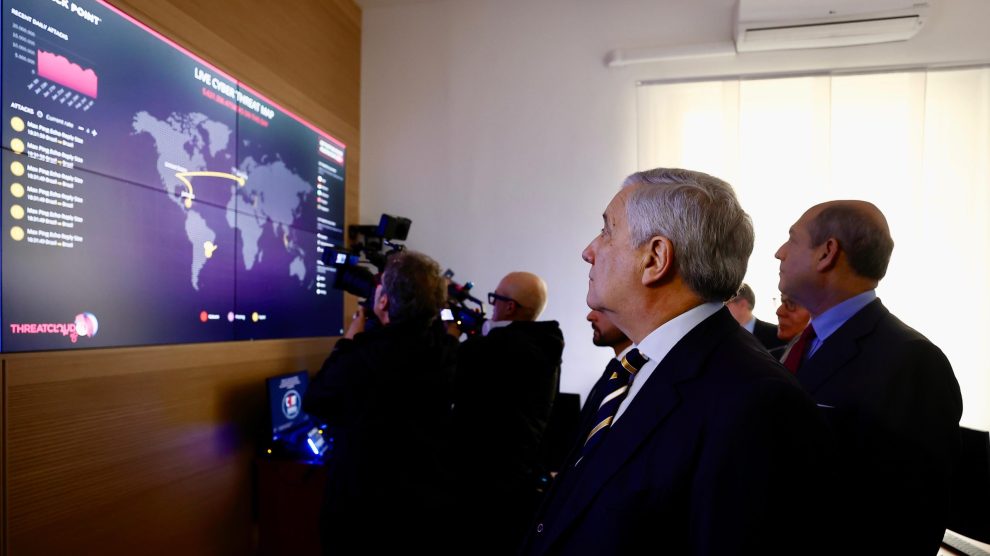
The response. On the same day, Tajani inaugurated the new CSIRT (Computer Security Incident Response Team) operations room at the Foreign Ministry — an infrastructure dedicated to monitoring, analysing, and responding to cyber incidents affecting the administration.
- The so-called Cyber Room enables the structured management of incidents that could compromise the ministry’s information systems, from vulnerability detection to the coordination of technical countermeasures.
- The facility operates 24 hours a day, 365 days a year, and is integrated into the national cybersecurity network led by Italy’s National Cybersecurity Agency (ACN).
By the numbers. From January 1, 2026, to date, the operations room has handled more than 150,000 hostile events, including around 30 distributed denial-of-service (DDoS) attacks against ministerial websites and web services.
- The most frequent threats include phishing, spear phishing, and spam campaigns, with roughly 150,000 malicious messages intercepted and more than 10 million communications originating from hostile sources.
What Tajani said: “We are living in times of hybrid warfare. Thanks to the work of the Cyber Room officials, last week’s attack on the websites of around 120 offices, including the Embassy in Washington, was neutralized without disruption,” said Tajani.
- “In this way, we are protecting our offices, the portal for consular services abroad, and even systems connected to the Milan-Cortina Olympics.”
- “We will continue to address cyber challenges both in terms of protecting the national interest and in the context of international cooperation and the promotion of Italian companies in the sector, which are always involved in the business forums we organize.”
The bigger picture. The sequence of events — political attack, cyber claim of responsibility, and the strengthening of defensive capabilities — shows how the digital domain has become an integral part of strategic confrontation.
- Italy’s response points to a permanent operational capacity and to closer integration among national security, diplomacy, and international cooperation.
The bottom line. The attack against Tajani is not an isolated episode but a signal of targeted pressure.
- The Foreign Ministry’s response suggests that Rome does not view cyber threats as episodic emergencies but as a structural domain that requires constant, systematic protection.
(Photo: Italy’s Foreign Ministry)