
In recent years, the partnership between Italy and India has taken on an increasingly structured dimension in the fields of defense and security. From industrial and technological cooperation to dialogue between the armed forces, and from maritime security to the protection of critical infrastructure along the Indo-Mediterranean axis, Rome and New Delhi are consolidating a relationship that reflects broader geopolitical shifts connecting Europe, the Middle East, and the Indo-Pacific—an environment currently destabilized by the war surrounding Iran.
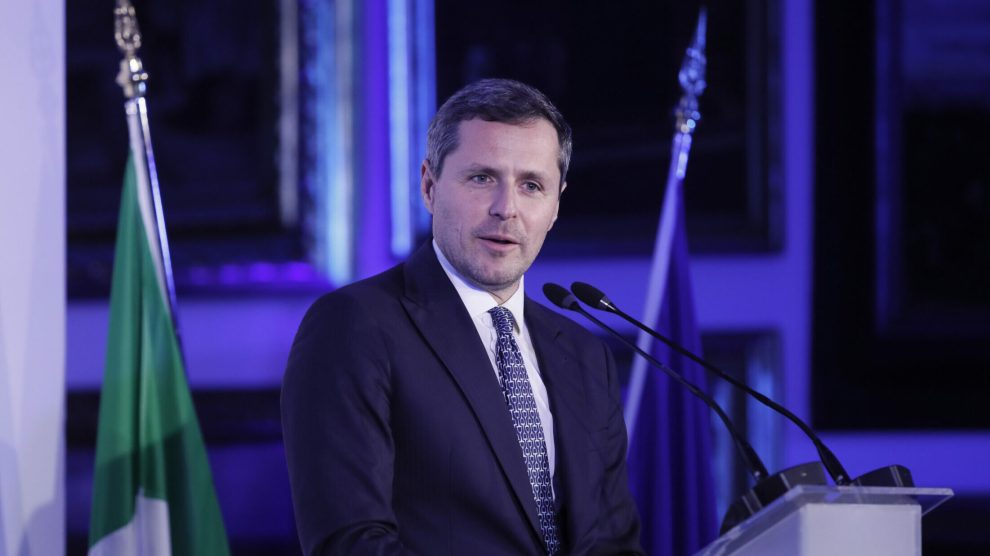
In this interview, Undersecretary of Defense Matteo Perego di Cremnago assesses the current state of bilateral cooperation and outlines the strategic opportunities likely to emerge in the coming years.
Q: Your meeting with the Secretary for Defence Production, along with parallel initiatives such as the Italy-India Industry Forum, seems to signal a phase of growing integration between Rome and New Delhi across military, industrial, and technological domains, including interoperability and joint development projects. Based on your direct knowledge of India’s strategic ambitions and the evolution of bilateral ties, how would you describe the current state of defense and security cooperation between Italy and India?
A: The meeting with the Secretary for Defence Production, Shri Sanjeev Kumar, and the other related initiatives do not represent an isolated episode but rather a very concrete step in the maturation of the strategic partnership between our two nations. The Defense Cooperation Agreement has also provided a stable framework to strengthen interoperability between our armed forces, increase joint training activities, and, above all, promote the development of shared industrial projects.
- This is therefore not merely about commercial exchanges or individual manufacturing opportunities. It is a strategic dialogue that involves governments, armed forces, and industries within a medium-to-long-term vision.
Q: How can the dialogue between the respective defense industries and armed forces translate into shared operational capabilities and concrete initiatives in the coming years?
A: India is the world’s most populous country, with a very young demographic profile and clear objectives regarding the strengthening of its industrial and technological base, including in the defense and security sectors.
- Italy, for its part, possesses a highly specialized industrial sector recognized worldwide, capable of offering advanced solutions in naval, aerospace, electronic, and cyber domains. The meeting of these two trajectories can generate value for both sides.
- Dialogue between armed forces and industries is not a secondary element—it is the engine that transforms political understanding into operational capabilities.
- Common standards, interoperable systems, integrated supply chains, and joint research translate into greater operational readiness and stronger deterrence, particularly in a geopolitical and operational context that is constantly evolving, where challenges can only be addressed through synergy.
Q: In recent days, the meeting of European naval operations at the Centocelle base highlighted the need to strengthen information sharing and cooperation across the broader Mediterranean—an area that increasingly extends toward the Indian Ocean and is often described as an Indo-Mediterranean strategic continuum. This basin—from the Red Sea to the Persian Gulf and the Arabian Sea, along the routes connecting Asia and Europe—represents a vital area of interest for India as well, particularly in terms of maritime security and geoeconomic connectivity. How does Italy-India cooperation fit into this broader framework, and how is security—especially maritime and infrastructural security—becoming a point of strategic convergence between the two countries?
A: Without structured information sharing, interoperability among assets, and constant coordination, it is impossible to guarantee stability in an operational environment that is becoming increasingly complex. Today the maritime domain—together with the underwater dimension—is at the center of defense and security dynamics.
- This is the principle that inspired the recent meeting at Centocelle, and it is within this framework that relations between Rome and New Delhi acquire an even deeper significance.
- Italy is the leading contributor in personnel among Western and European Union countries to United Nations peacekeeping operations and plays a central role in the wider Mediterranean.
- It is also an active participant in European missions aimed at safeguarding freedom of navigation, such as Operation Aspides, in which we have been involved since the beginning.
- Maritime security is a fundamental area of cooperation because it goes beyond the purely military dimension. It directly affects the economy, energy flows, and critical infrastructure.
- Strengthening dialogue between our armed forces, sharing operational experiences, and developing advanced technologies for the surveillance and protection of sea lanes—including the underwater domain—means contributing to the stability of a space that is already, and will increasingly become, one of the central arenas of global competition.
Q: Looking further ahead, the IMEC project and the broader strengthening of connections between India, the Middle East, and Europe point to the emergence of a new geopolitical and economic architecture of the Indo-Mediterranean, where infrastructure, security, and industrial cooperation advance together. In your view, what role can Italy-India cooperation play in ensuring that these corridors are not only economically viable but also secure and resilient? And to what extent can stronger defense ties act as a strategic enabler for broader cooperation between Europe and India in this increasingly global Mediterranean?
A: The India-Middle East-Europe Economic Corridor (IMEC) represents the expression of a geopolitical vision that redefines connections and strategic priorities between India, the Middle East, and Europe.
- It does not simply outline new trade routes; it integrates transport, energy, digital infrastructure, and industrial cooperation into a single architecture of interdependence. However, no corridor can be truly sustainable without solid foundations.
- Once again, strengthening ties in the fields of defense and security means ensuring the level of stability that makes investment, long-term planning, and trust among partners possible. Without security and defense, nothing else can exist.
- The protection of maritime routes, the safeguarding of critical infrastructure, and the resilience of supply chains are not secondary variables but essential conditions for the credibility and continuity of the project.
The bottom line: “Italy can contribute its experience in the wider Mediterranean, the professionalism of its defense personnel, a highly specialized technological industrial system, and a geographical position that makes it a natural hub toward Europe,” Perego says.
- “India, with its projection in the Indo-Pacific, its economic growth, and its growing geopolitical centrality, is an indispensable partner in building this new architecture of connectivity.”