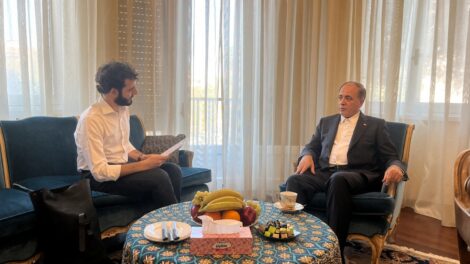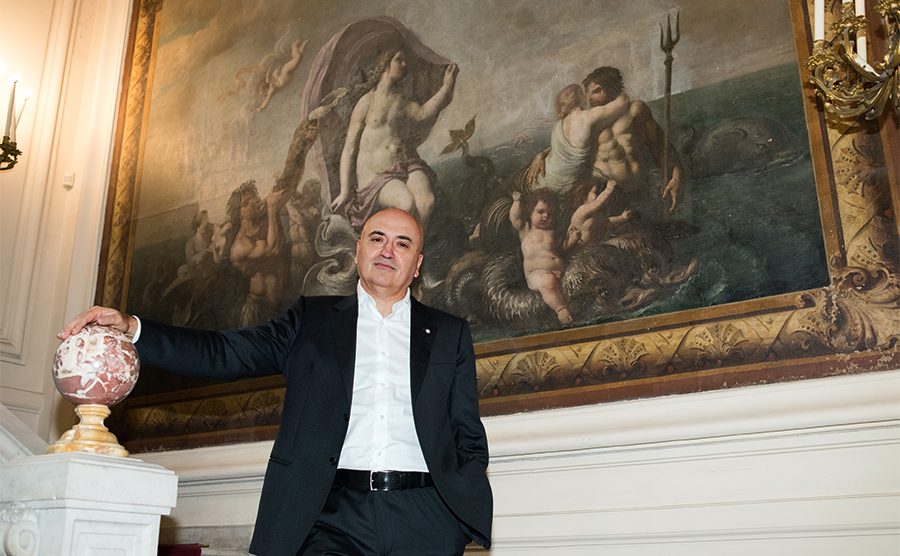
At a time of growing tension between the United States, Israel and Iran, understanding the resilience of the Iranian system and the transformations underway in the Islamic world requires a perspective that goes beyond the strictly military dimension. It is within this framework that the analysis of Roberto Tottoli — full professor of Islamic Studies since 2011 and rector of the University of Naples L’Orientale since 2020, and one of Europe’s leading experts on the history of Islamic civilization — finds its place.
Why he matters: Prof. Tottoli’s perspective allows us to bring together three levels of analysis. On the one hand, the internal resilience of the Islamic Republic, suspended between ideology, control of power and national identity.
- On the other, the redefinition of regional balances, where the ongoing confrontation appears as a possible reckoning over Iranian influence in the Arab world. Finally, the lens widens to the Asian Islamic world, where the effects of the conflict appear more nuanced and less central to local dynamics.
Q: In the context of the current confrontation between the United States, Israel and Iran, to what extent does the ideological framework of the Islamic Republic continue to represent a source of internal cohesion and legitimacy? Is there a predominance of the ideological dimension, or a gradual pragmatic adaptation to external pressures?
A: It is difficult to say how much of this reflects the resilience of the ideological framework and how much instead derives from a pervasive capacity for control by the ruling power. Iran is a large country, with a complex reality that goes beyond Tehran and the main urban areas.
- On the one hand, it is evident that the tight grip of the Shiite religious regime struggles to coexist with especially urban aspirations, and with a system of control over society that can also be corrupt; on the other hand, one should not overlook that the ability to reform the previous system under the Shah, together with a greater circulation of goods and opportunities—for instance in education—has generated a certain level of support for the regime in many contexts.
- At this stage, based on what we know, a strong cultural identity seems to prevail: an Islamic Iran, but also one rooted in a national tradition that predates Islam. In the face of external attack, this tends to consolidate the country, especially outside the capital and major cities.
- Faced with this attack, there are undoubtedly those who believe it could open the possibility of the regime’s collapse, although this is made difficult by the lack of an organized opposition and a clear leadership, with the most influential figures either imprisoned or in exile. At the same time, there is also alignment among those who support government policies and embrace its ideological framework.
Q: What transformations is this conflict producing in the regional Islamic space, beyond the military dimension? Do current dynamics reinforce existing fault lines—particularly along confessional and political lines—or do they foster the emergence of new configurations of power and legitimacy?
A: In some respects, the conflict represents a reckoning aimed at reducing Shiite influence in the region, with the tacit approval of Sunni regional powers (Saudi Arabia, Egypt, and to a lesser extent Turkey). The sequence of developments is in many ways evident: Israel in Lebanon; a “pacified” Syria no longer under Alawite Assad rule; Iraq, after three decades of devastation, now in a fragile but seemingly stable equilibrium and less subject to Iranian influence; and Iran itself under attack.
- The so-called Shiite crescent had extended Iranian influence all the way to the Mediterranean through Hezbollah, combining political influence with a direct military presence. Today the picture is somewhat different, although in American and Israeli planning it all appeared more straightforward (but to the military, things often look easier on paper).
- If the Iranian regime were to be weakened, or even collapse, the overall regional configuration would inevitably change, and the last major adversary of Israel—and of a broader regional stabilization—would be defeated. It goes without saying that those paying the highest price for this reconfiguration are the Palestinians in Gaza and the West Bank.
Q: In light of current dynamics, what implications can be identified for the Asian Islamic world? How might a conflict centered on the Middle East affect political, identity and religious balances in contexts such as the Indian subcontinent and Southeast Asia?
A: I do not believe it will change much, except in terms of a rebalancing of influence involving Russia and China in the region. Although the gravity of what is happening is undeniable, conflicts and crises in Europe (such as Ukraine) or in the broader Mediterranean (Israel, Palestine, Iran) are not necessarily perceived in countries like India or Indonesia as central to their own internal dynamics.
- We must, perhaps reluctantly, accept that Europe and the Mediterranean represent only a small part of global balances, which are increasingly oriented elsewhere. Certainly, Iran shifts attention eastward and compels countries such as Pakistan to pay closer attention, but Pakistan remains—as always—more concerned with instability and issues related to Afghanistan than with confrontation involving the United States and Israel.
- Islamic solidarity in these countries is relatively limited: at times symbolic, at times subdued—also due to tight central control—but it does not appear to be a central factor in the internal political realities of the various Islamic countries in Asia.