Finland’s entry into the Pax Silica initiative marks a shift that goes well beyond the expansion of a US-led framework.
A new technological order takes shape. It reflects the consolidation of a technological order in which economic security and national security are increasingly intertwined, and where access to frontier technologies is determined by alignment, capability and trust.
- With this move, Helsinki becomes the first EU member to formally join the initiative — aside from the structural role of the Netherlands through ASML — positioning itself within an ecosystem designed to secure the foundations of the artificial intelligence era.
- Launched by the United States in December 2025, Pax Silica brings together a selected group of countries around the coordinated control and development of AI value chains: semiconductors, advanced computing infrastructure, energy, logistics and critical minerals.
- Technological leadership is now defined along these supply chains. Those who control key nodes shape both the pace and the direction of innovation.
The material foundations of AI competition. Artificial intelligence is acting as a power multiplier, reshaping the global distribution of economic and strategic influence.
- As a result, competition is shifting towards the material base that sustains it: silicon, rare earths, energy capacity, manufacturing and digital infrastructure.
- Supply chains are emerging as the primary arena of competition among major powers. Control over these segments allows states to influence not only technological output, but also the broader trajectory of growth and security in the 21st century.
Italy’s positioning: minerals and transatlantic alignment. Italy’s posture must be read within this evolving landscape.
- Speaking at the Wilson Center in Washington, during an event co-organised with Decode39, Italy’s Economy Minister Giancarlo Giorgetti outlined a clear strategic convergence with the United States: “Italy and the United States share an interest in reducing critical dependencies and strengthening reliable and transparent supply chains in key sectors such as energy, semiconductors, pharmaceuticals and critical minerals.”
- His conclusion was unequivocal: “Supply chain resilience is now a central component of national security.”
- This position is backed by recent diplomatic engagement.
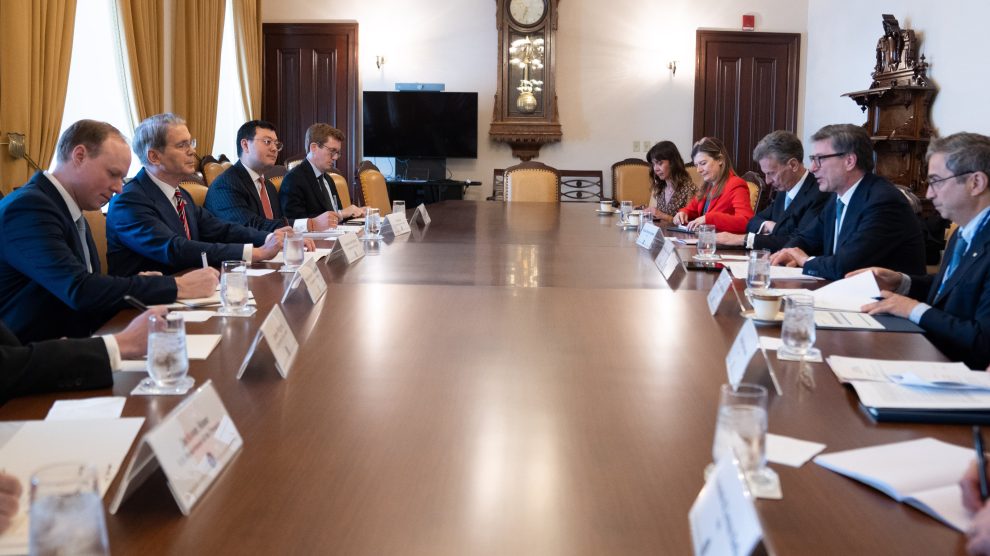
- In meetings in Washington with Treasury Secretary Scott Bessent and other senior officials, Giorgetti addressed cooperation on critical minerals within a broader agenda spanning energy, geopolitical tensions and economic stability.
- References were also made to IMEC, the India–Middle East–Europe Economic Corridor, whose connectivity architecture could become part of a wider technological and industrial network linking Europe and the Indo-Pacific through the Indo-Mediterranean.
- The critical minerals dossier has become increasingly central. In February, Foreign Minister Antonio Tajani took part in the Critical Minerals Summit, calling for closer coordination among allies in managing competition with China.
- Prime minister Giorgia Meloni has consistently stressed the need to preserve transatlantic convergence, even amid political frictions. Critical minerals offer a tangible basis for rebuilding a new form of Transatlantic cohesion grounded in shared strategic interests and priorities.
Europe between alignment and marginalisation. Italy’s move fits into a broader European dynamic. France has opened discussions with Washington, while criticising the exclusion of the European Union as an institution. Sweden and Greece have already signed up individually to the Pax Silica declaration.
- Last month, EU countries failed to approve the European Commission’s request to initiate formal talks with the U.S. State Department regarding the potential membership of the EU.
- Italy was among the countries advocating for the EU’s accession to Pax Silica; France was against.
- The signal is twofold: urgency in remaining embedded within strategic supply chains, and a gradual shift away from EU-level coordination towards intergovernmental arrangements.
A transactional architecture of power. Pax Silica reflects a distinctly transactional approach to international relations. It is a coalition of capabilities built around a trusted technological “stack”.
- Access to frontier technologies is reserved for fully integrated members, while others operate on a regulated, conditional market basis. The resulting structure resembles a closed loop, with clear hierarchies between partners and clients.
The China factor. This architecture responds to a structural constraint. China retains a dominant position in extraction and processing of critical minerals, turning industrial dependence into geopolitical leverage.
- The security of AI value chains runs through these chokepoints. If critical minerals underpin frontier technologies, and those technologies underpin economic security, control over supply chains becomes a question of power.
A strategic choice for Italy. Pax Silica should be understood as a framework that organises inclusion, exclusion and interdependence in the global AI economy.
- For Italy, entering this perimeter is not merely about industrial policy or access to investment. It defines the country’s positioning within a competition between rival technological ecosystems — one that is set to shape the balance of power in the years ahead.
(Photo: X, @SecScottoBessent)