The fragile truce between Washington and Tehran has done little to reduce the strategic pressure on Europe. If anything, it has clarified the terms of a dilemma that European capitals can no longer postpone: how to contribute to stability in the Middle East without being drawn into a US strategy they neither shaped nor fully support.
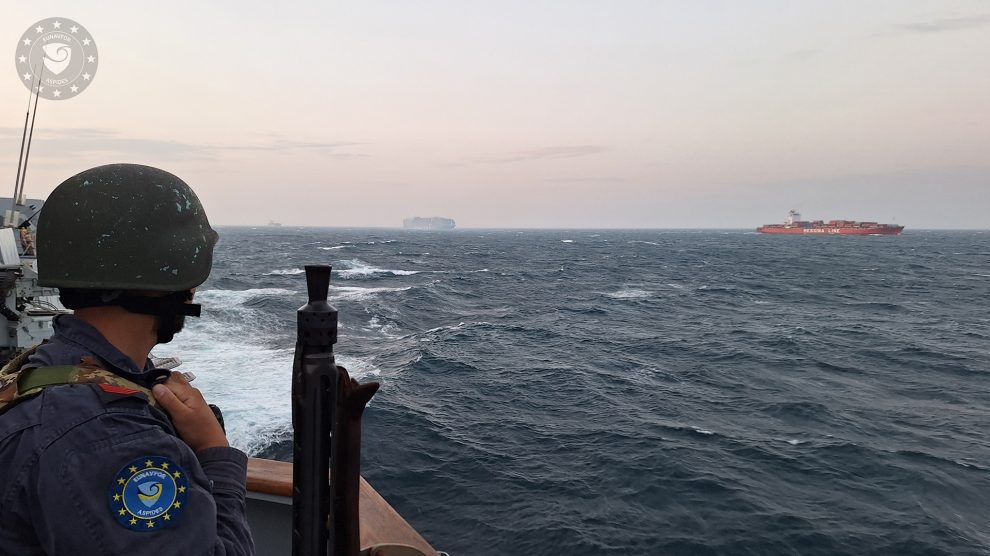
Hormuz at the centre of the crisis. In the short term, the issue is operational. The Strait of Hormuz — through which a significant share of energy bound for Europe flows — remains unstable, with Iran maintaining de facto control over access and signalling its leverage.
- President Donald Trump has long made clear that any ceasefire framework must include the full reopening of the passage. But he has also raised the pressure on allies, demanding concrete military contributions within days and openly questioning the value of NATO.
- “NATO wasn’t there when we needed them, and they won’t be there if we need them again,” he wrote on Truth, capturing a broader shift: from transactional frustration to strategic mistrust.
- The message follows weeks of criticism, threats to redeploy US forces and renewed tensions over issues such as Greenland — all signals of an increasingly conditional transatlantic relationship.
NATO under pressure. The pressure is being channelled through the alliance. Mark Rutte has conveyed Washington’s demands to European capitals, urging rapid commitments to secure Hormuz. Several countries have indicated a willingness in principle, but under specific conditions: a durable ceasefire, a clear legal mandate and guarantees for the safety of European assets.
- This gap between American urgency — grounded in the operational reality on the ground — and European caution reflects more than procedural divergence. It points to a fundamental difference in approach to the Middle East.
- The US intervention against Iran — carried out alongside Israel but outside a NATO framework — has reinforced European concerns about being drawn into open-ended military commitments without adequate political coordination.
Europe’s calibrated response. European capitals have responded cautiously.
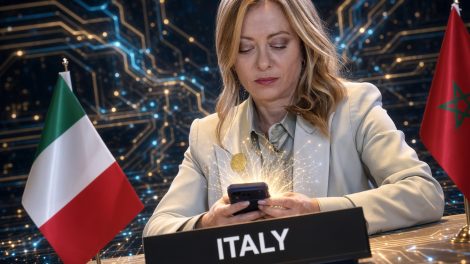
- From Rome, Prime Minister Giorgia Meloni has framed the priority in legal and economic terms: restoring freedom of navigation as a global public good, essential for stabilising energy markets and supply chains.
- Italy is working within the UK-led maritime security coalition, but with a predominantly diplomatic approach.
- The European Commission has also reiterated that international law does not allow for tolls or restrictions on transit through the Strait.
The limits of public support. Europe’s room for manoeuvre is constrained not only externally, but internally. A recent Politico survey across six major EU countries highlights a significant shift in public perception: the United States is now seen as a threat by a larger share of respondents than China.
- At the same time, there is broad support for strengthening European defence capabilities and deepening military integration. Yet this support weakens when it implies concrete costs. Europeans broadly support security — but without personal or fiscal sacrifice, a contradiction that complicates any rapid escalation of military engagement.
- This tension is already visible in debates over Ukraine and defence spending, and now extends to the Middle East. Governments are being asked to respond to US demands while managing fragile and uneven domestic consensus.
- In Italy, for instance, a significant share of public opinion already considers defence spending too high, despite relatively limited contributions to Kyiv. How would a new mission in Hormuz be perceived?
A strategy of selective engagement. In this context, the most likely trajectory is one of selective engagement. Europe will seek to play a stabilising role in the Gulf, but through coalitions, legal frameworks and incremental commitments rather than direct, large-scale military intervention. The objective is to secure critical routes without fuelling escalation dynamics.
- The result is a posture that may appear hesitant from Washington’s perspective, but reflects structural constraints. Europe is not disengaging from the Middle East. It is redefining the terms of its presence — balancing alliance commitments with strategic autonomy, and external pressure with internal limits.
Varvelli: between constraints and opportunity. As Arturo Varvelli notes, much will depend on how the post-truce phase evolves, particularly around the core issue of Hormuz: “To understand what Europe can do, we need to understand how the situation will evolve. Above all, it is necessary to assess whether Iran will actually be allowed to control the Strait through a toll — a significant precedent on which Europeans seem to have fairly consistent concerns and reservations.”
- At the same time, inaction is not a viable option. “It must be said that, despite all the critical issues involved, coming together to do nothing would lead to no result. There is, for example, the possibility of expanding the scope of a naval mission already operating in that context, and this could be an opportunity to be present, possibly operating independently from US command structures.”
- Such an approach, however, raises political and operational questions — not least how Washington would react. “Yes, there is the obstacle of integration and interoperability,” he observes, pointing to a more flexible alternative: “Another, softer option could be the creation of a ‘coalition of the willing’, where small groups — for example France, Italy, Germany and the United Kingdom — have the capacity to project a naval force for monitoring and deterrence. But even here, it remains unclear what mission they could be assigned.”
Beyond security: the diplomatic track. In the medium term, the focus shifts to a broader political dimension. “I believe that Europe should and can return to having a role, once the war is over and a new phase of dialogue with Iran can begin — but political strength will be required,” Varvelli argues, stressing the need to distinguish between military and diplomatic tracks.
- “However, I also believe it is necessary to keep the maritime security mission in Hormuz separate from the political track, which could, for example, return to negotiating on the nuclear issue, as has been done in the past.”
- In a scenario of de-escalation, he adds, a concrete negotiating space could reopen: “If a climate of détente emerges, Europe — whether as the EU or as a coalition of the willing — could negotiate maritime transit agreements with Tehran, possibly offering in return a reduction of sanctions pressure in specific sectors, because the available options are very limited and an indefinite disruption of the Strait of Hormuz is a major, major problem for Europe.”
(Photo: @EUNAVFORASPIDES)