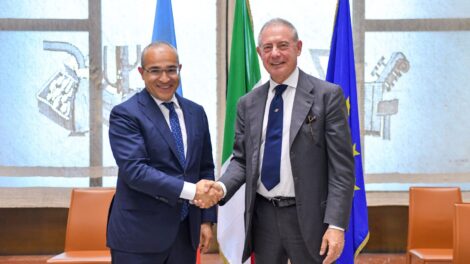
The visit of Italy’s Deputy Prime Minister and Foreign Minister Antonio Tajani to China, although planned well in advance, comes at a politically sensitive moment. Recent tensions between U.S. President Donald Trump and Italian Prime Minister Giorgia Meloni have added complexity to Rome’s international positioning, without formally altering the agenda of the mission — nor Italy’s broader Atlantic posture.
Diplomacy beyond business. In Beijing, Tajani is set to meet Foreign Minister Wang Yi and co-chair, alongside Commerce Minister Wang Wentao, the 16th session of the Italy-China Joint Economic Commission, as well as a business dialogue involving several Italian companies active in the Chinese market.
- “We are working to support our companies so they can increasingly operate in such an interesting market as the Chinese one,” Tajani said in a video released ahead of his departure. “And of course I will ask China and the Chinese government to lend a hand in building peace in the Middle East and also in Ukraine.”
- Beyond economic ties, talks will focus on key international dossiers.
- These include shared concerns over developments linked to the ongoing Israel–U.S. confrontation with Iran, which are affecting regional balances in the Middle East and have direct implications for energy flows passing through the Strait of Hormuz.
- Attention is also directed at mediation efforts led by Islamabad, where negotiators from the Trump administration and the Iranian regime could meet again in the coming days after an initial round — marked by cautious optimism, including from Rome and Beijing — failed to produce concrete results.
- The war in Ukraine will also be on the agenda. Ukrainian President Volodymyr Zelensky was in Rome on Wednesday, where Meloni reiterated Italy’s support and its commitment to exploring pathways towards peace.
- In this context, involving Beijing is seen as increasingly relevant, given the deepening alignment between China and Russia in recent years.
The ambiguity of China’s role. According to Italian sources, Tajani is expected to reiterate the need for a more active Chinese role in supporting a ceasefire and the launch of credible negotiations. This also applies to the Iranian crisis, which is increasingly intertwined with global energy and maritime security.
- At the same time, China’s room for manoeuvre remains under scrutiny.
- Beijing has recently put forward a four-point proposal aimed at stabilising the Gulf and the Strait of Hormuz, positioning itself as a potential mediator. However, reports of technical and intelligence assistance provided to Iran — including satellite systems used to enhance targeting capabilities — point to a more ambiguous Chinese role in the crisis.
- A similar dynamic has been observed in relation to Russia, where China has supplied dual-use technologies that have also supported Moscow’s large-scale invasion of Ukraine, despite Beijing’s narrative of neutrality and its self-described role as a peace-oriented actor.
Trade and market access. On the bilateral front, the more pragmatic dimension of the relationship remains central. Tajani’s mission aims to strengthen economic ties through the implementation of the Italy-China Action Plan for 2024–2027, launched during Meloni’s visit to Beijing to mark the 20th anniversary of the bilateral strategic partnership.
- Key priorities for the Italian government include rebalancing trade and investment flows and removing barriers to market access for Italian companies.
- China remains a key destination for Italian exports. It is Italy’s largest trading partner in Asia and its second-largest outside the European Union — after the United States — with bilateral trade nearing €75bn in 2025, up 11.2 per cent compared to the previous year.
Culture and economic presence. The programme also includes a cultural diplomacy component. In Beijing, Tajani will inaugurate an exhibition at the National Art Museum of China titled “Homage to the Great Masters. From Leonardo to Caravaggio. Masterpieces of the Italian Renaissance”, the first of three exhibitions curated by the Uffizi Galleries.
- The visit will then move to Shanghai, where the minister will open the “Italia Meravigliosa” exhibition on the occasion of Italy’s National Made in Italy Day and meet representatives of the Italian business community in the country.
A relationship in transition. In recent years, Italy–China relations have undergone a significant recalibration. After joining the Belt and Road Initiative in 2019 — becoming the first G7 country to do so — Rome gradually reassessed its position based on national interest considerations, eventually exiting the agreement in 2023 amid underwhelming economic returns and growing strategic concerns over China’s global posture.
- The decision did not mark a rupture, but rather a shift in approach.
- The Italian government has maintained a pragmatic line, focusing on more selective economic cooperation and operational tools such as the 2024–2027 Action Plan, within a framework consistent with its Euro-Atlantic commitments and centred on safeguarding national economic security.
- In this context, Italian sources say Tajani’s mission reflects a broader balancing act: keeping dialogue with Beijing open on trade and global issues, advancing targeted areas of cooperation, while remaining firmly anchored to the transatlantic axis — particularly at a delicate moment in U.S.–Italy relations.