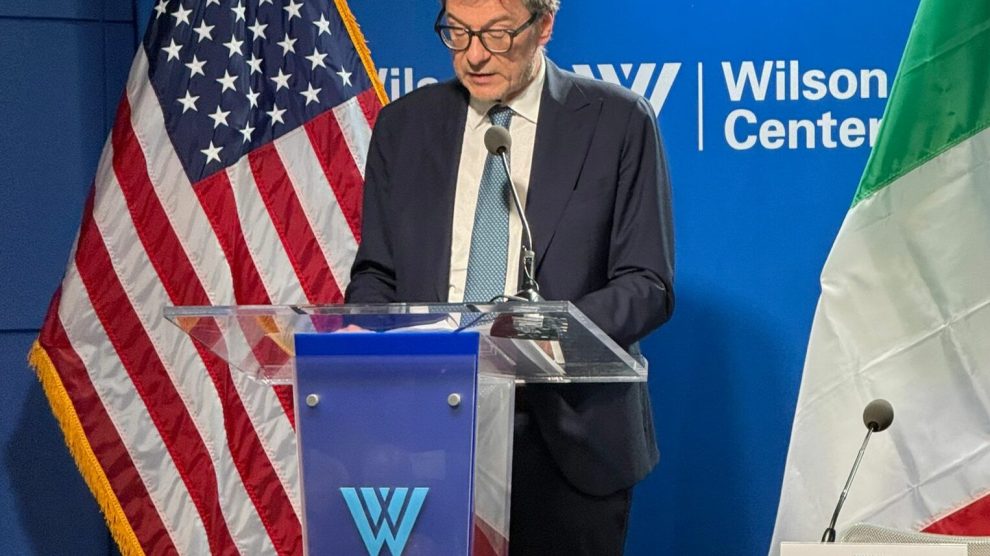
WASHINGTON — It is within the Italy-US context that the event organized by Decode39 and hosted at the Wilson Center takes place, marking 165 years of diplomatic relations between Rome and Washington — an anniversary that coincides with the Semiquincentennial, the 250th anniversary of the founding of the United States.
Just steps away from the White House, policymakers, businesses, and institutional representatives gathered to discuss the future of the transatlantic bond.
Beyond Celebration: A Systemic Perspective. In his remarks, Giorgetti avoided celebratory tones, instead placing the bilateral relationship within the broader systemic transformations underway.
- “Relations between Italy and the United States are longstanding and develop across multiple dimensions: political, economic, cultural, scientific, and security.”
- A relationship that, he noted, has been strengthened precisely through its ability to manage moments of divergence.
- “As in any relationship, we must acknowledge that there are moments of greater alignment, as well as phases in which our perspectives may not be fully shared,” Giorgetti said. “It is precisely the ability to manage these phases that has helped strengthen our partnership over time.”
- Today, this relationship operates within a dynamic and complex global context, marked by geopolitical fragmentation, technological competition, energy transition, and the redefinition of global supply chains.
- For the Italian minister, “in such a scenario, an open and continuous dialogue, including at the economic level, becomes even more essential.”
Political Tensions in the Background. These remarks come at a particularly delicate moment in Rome–Washington relations, with US President Donald Trump once again criticizing Prime Minister Giorgia Meloni in an interview with Fox News, marking a significant rhetorical fracture.
- Trump questioned the relationship with Rome, linking it to the management of the Iran crisis and energy security concerns tied to the Strait of Hormuz, suggesting that a lack of convergence on this dossier could reshape the very terms of the bilateral relationship.
A Deeply Integrated Economic Relationship. Yet it is the data that tells the story of a relationship that, in recent years, has reached a level of integration that is difficult to reverse.
- “Bilateral trade has reached unprecedented levels, exceeding $100 billion last year, with the United States representing the main non-EU destination for Italian exports.”
- The United States is now one of Italy’s leading trade and investment partners, while Italian companies continue to expand their presence in the US market, supporting employment and technology transfer. At the same time, American firms find in Italy an advanced manufacturing ecosystem and a highly competitive industrial base.
Strengthening the Industrial Ecosystem. Within this dynamic industrial cooperation framework, attention also turns to the upcoming “US-Italy Business, Investment, Science and Innovation Forum,” set to take place in Miami next June, bringing together Italian and American companies, policymakers, and research institutions to further strengthen economic, scientific, and technological partnerships.
- It is no coincidence that, during the event organized by Decode39 and the Wilson Center, the industrial component played a central role, with participants including:
- Kenneth J. Braithwaite (Fincantieri Marinette Marine),
- Michele Poggipolini, CEO of the Poggipolini Group;
- Roberto Scaramella, General Manager Transportation and International at Almaviva;
- Rita Balogh, Europe & Canada Lead for International Government Affairs at Google;
- Marco Pistoia, CEO of IonQ Italia.
- The panel is moderated by Decode39’s Valbona Zeneli.
- Alongside the business community, the political panel featured Italian lawmakers. Delve into the political debate.
- The very composition of participants reflects the increasingly hybrid nature of the relationship: politics and industry, security and technology.
Supply Chains and Economic Security. If there is a common thread in Giorgetti’s Washington remarks, it is economic security. In an international system marked by geopolitical fragmentation and technological competition, supply chain resilience becomes a structural pillar of the transatlantic relationship.
- “Geopolitical tensions, technological competition, and disruptions to global trade have highlighted the need for more secure, diversified, and reliable supply networks.”
- Italy and the United States share the goal of reducing critical dependencies and strengthening reliable value chains in key sectors such as energy, semiconductors, pharmaceuticals, and critical raw materials.
- The reference to a coordinated approach among “like-minded” partners, and to the possible involvement of Africa, signals a vision that goes beyond the bilateral dimension, embedding the Italy–US relationship within a broader economic security architecture.
Balancing Security and Openness. The challenge, in the minister’s words, is to strike a balance between potentially diverging needs. On one hand, the necessity to strengthen security and resilience; on the other, the need to preserve openness, efficiency, and competitiveness of economic systems.
- This balance reflects broader tensions within the Western bloc, where the redefinition of value chains proceeds alongside the risk of fragmentation.
A Relationship in Transformation. More than a celebration, the minister’s visit offers a lens through which to observe the evolution of the transatlantic relationship.
- Dialogue — “essential,” in Giorgetti’s words — between governments, businesses, and academia increasingly appears as the driving force of the partnership.
- Yet it is above all the economic and industrial dimension that now defines the trajectory of Italy–US relations, with business anticipating and, in some cases, shaping political decisions.
- “Over the past 165 years, our relationship has gone through phases of varying intensity. The depth and strength of our ties—economic, commercial, and people-to-people—as this event clearly demonstrates, are rooted in shared values that form the solid foundation upon which we have built our partnership,” said the Italian Minister.
- In this sense, Giorgetti’s mission delivers a clear message: the transatlantic relationship remains central, but it is gradually transforming into an alliance driven by economic security—by technology and value chains. In other words, by the very assets that are most deeply shaping this complex historical phase.