
The geography of global connectivity is largely invisible. It does not run through ports or traditional trade routes, but through thousands of kilometres of fibre optic cables laid across the seabed—silent infrastructure that carries more than 95 per cent of intercontinental data traffic and underpins the functioning of the global economy.
An invisible backbone. It is in this context that, during the plenary of the International Cable Protection Committee (ICPC) in Athens, Fabrizio Bozzato, senior research fellow at the Sasakawa Peace Foundation — where he focuses on international policy, security and global governance — and a diplomat of the Sovereign Order of Malta, set out a reading that moves beyond the technical dimension and sits firmly in the strategic domain. His starting point is clear: the future of global connectivity will be determined less by technological innovation than by the ability to govern it.
- “We have reached a level of technological maturity where the real differentiator is no longer the infrastructure itself, but how it is managed,” Bozzato notes. “The risk is no longer just physical or accidental. It is systemic—and it requires governance tools that today remain incomplete or misaligned.”
From infrastructure to strategic asset. In conversation with Formiche.net, Bozzato insists on a key shift: submarine cables are changing in nature. They are no longer merely commercial assets, but strategic infrastructure exposed to increasingly evident geopolitical dynamics.
- “For years, we treated them as invisible, almost neutral infrastructure,” he explains. “That is no longer the case. They are critical nodes in an interdependent global system, and as such they are subject to pressure, competition and, in some cases, interference.”
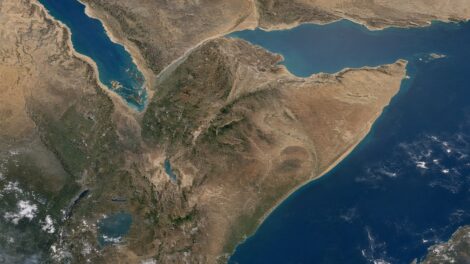
When disruption becomes systemic. The risk is no longer theoretical. In September 2025, in the Red Sea, a ship dragging its anchor is believed to have severed two of the main cables linking Europe and Asia, causing connectivity to drop by up to 60 per cent for some cloud services and leading to full outages in several countries.
- The economic impact was estimated at around $3.5bn. Incidents of this kind—between 150 and 200 each year globally—are often manageable at a regional level, but become systemic when they hit high-density nodes. In Europe, where more than 90 per cent of businesses rely on internet connectivity, a comparable disruption would have significantly broader effects, amplified by growing dependence on cloud, data and artificial intelligence.
- It is precisely this dynamic—the shift from technical vulnerability to systemic risk—that finds its clearest expression in the Mediterranean. With one of the highest concentrations of cables in the world, linking Europe, Africa and the Indo-Pacific, the basin functions as a testing ground for the pressures shaping global connectivity.
A crowded and contested seabed. Mr Bozzato describes an environment where risks are layered. On one side, traditional threats—seismic activity, underwater landslides, fishing and anchoring. On the other, a growing level of complexity driven by hybrid dynamics and grey-zone activities.
- “It is no longer just about cables breaking,” he says. “The issue is that increasingly we do not know why they break. The line between accident and intentional disruption has become blurred—and that complicates the response, both operationally and politically.”
- This ambiguity, he argues, is putting pressure on legal frameworks and coordination mechanisms designed for a different, less competitive and less interconnected environment.
Italy as a test case. Within this context, Italy emerges as a relevant case study. Its geographical position—particularly through Sicily—places it at the centre of data flows between continents. Yet, as Bozzato points out, the Italian response has not been limited to recognising a vulnerability.
- “The point is not only to protect what you have,” he says. “It is to turn geography into strategic advantage. Italy has started doing this by adopting a systemic approach that brings together actors which traditionally operated separately.”
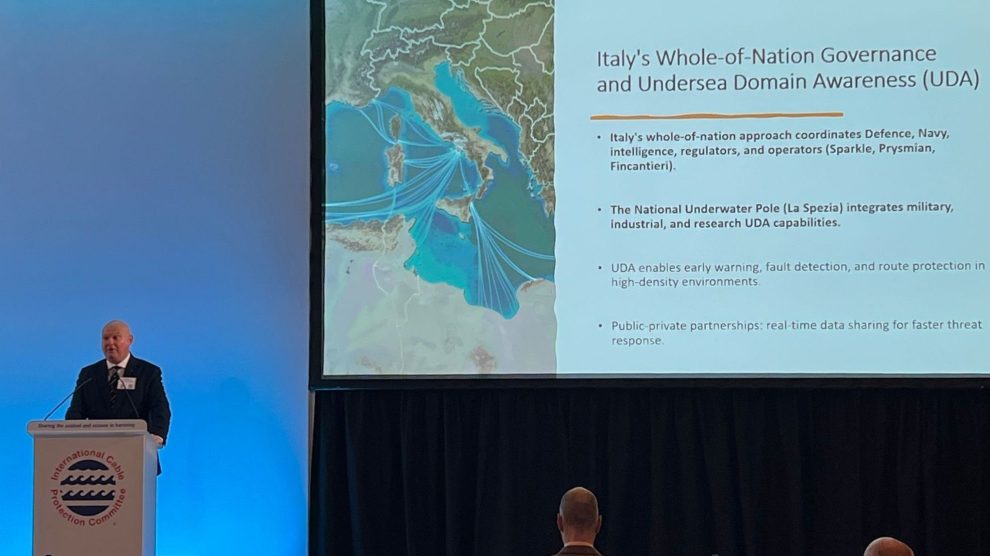
- This so-called “whole-of-nation” approach integrates defence institutions, the navy, intelligence agencies, regulators and private industry within a coordinated framework. But the shift, Bozzato stresses, goes beyond coordination.
- “The real step change is integration,” he explains. “Coordination means putting actors around the same table. Integration means enabling them to operate on a shared information base, with common objectives and the ability to respond in real time.”
The Italian architecture. At the centre of this architecture sits the National Underwater Dimension Hub in La Spezia. Bozzato describes it as a platform capable of connecting military, industrial and scientific domains, building a unified operational picture of the undersea environment.
- “The hub acts as a force multiplier,” he notes. “It allows fragmented data to be turned into operational knowledge—and that knowledge into decision-making. That is what enables the shift from a reactive to a proactive posture.”
- This transition is operationalised through Undersea Domain Awareness (UDA), which introduces capabilities for early warning, fault detection and route protection.
- “We are moving from a model where we intervene after an incident to one where we try to anticipate it,” he says. “It is a fundamental shift—from passive infrastructure to actively managed strategic systems.”
The limits of resilience. Yet even this model faces structural limits. One of the key issues discussed in Athens was the availability of cable repair vessels in the Mediterranean.
- “It is not so much a question of absolute numbers,” Bozzato explains. “It is about simultaneity and distribution. In a high-density environment, multiple incidents occurring within a short timeframe can quickly put the system under strain.”
- The result is delayed restoration, with consequences that are both economic and security-related. This is compounded by another critical factor: regulatory fragmentation. Diverging procedures, slow permitting processes and overlapping jurisdictions all complicate intervention when speed is essential.
- “The problem is not the absence of rules, but their heterogeneity,” he says. “When a cable crosses multiple jurisdictions, differences in processes become a risk factor. And in these cases, time is a strategic variable.”
Closing the policy gap. At this point, Bozzato shifts from diagnosis to prescription. The real gap, he argues, is one of policy.
- “The first step is surprisingly simple: designate cables as critical infrastructure,” he says. “Without that, everything else remains partial.”
- Such designation is not merely symbolic. It triggers concrete operational effects: priority repair regimes, faster permitting, clearer legal mandates and more structured coordination among states.
- “It is an enabling measure,” he adds. “It creates the conditions for everything else to follow.”
- But designation alone is not sufficient. Bozzato outlines a broader framework that includes strengthening existing instruments such as UNCLOS, fostering cross-regional regulatory dialogue and, crucially, building mechanisms for operational information sharing between public and private actors.
Infrastructure diplomacy and interoperability. It is within this framework that he introduces the concept of infrastructure diplomacy. “Critical infrastructure can become a platform for cooperation,” he argues. “In a fragmented geopolitical landscape, it is one of the few areas where collaboration remains both possible and necessary—because it is in everyone’s interest.”
- The goal, however, is not full regulatory harmonisation—an objective he considers unrealistic. “We do not need identical systems,” he says. “We need systems that can work together.”
- This is where interoperability becomes central, understood in operational terms. “Interoperability means sharing information, coordinating responses and acting within compatible timelines,” he explains. “It does not require uniformity, but compatibility. It is a far more pragmatic approach.”
- In this process, organisations such as the International Cable Protection Committee (ICPC) play a key role, enabling operational convergence without imposing rigid standards.
An invisible system, a visible risk. Beneath the technical discussion lies a deeper transformation. Subsea cables are now embedded in great-power competition.
- “Decisions about where cables run, who owns them and how they are protected now carry direct geopolitical implications,” Bozzato notes. “We can no longer separate the economic dimension from the strategic one.”
- Yet for most people, this infrastructure remains largely invisible—and that invisibility, he suggests, is itself a vulnerability.
- “Global connectivity rests on a system that few see and even fewer understand,” he concludes. “But its resilience depends on something highly visible: trust among the actors that govern it.”