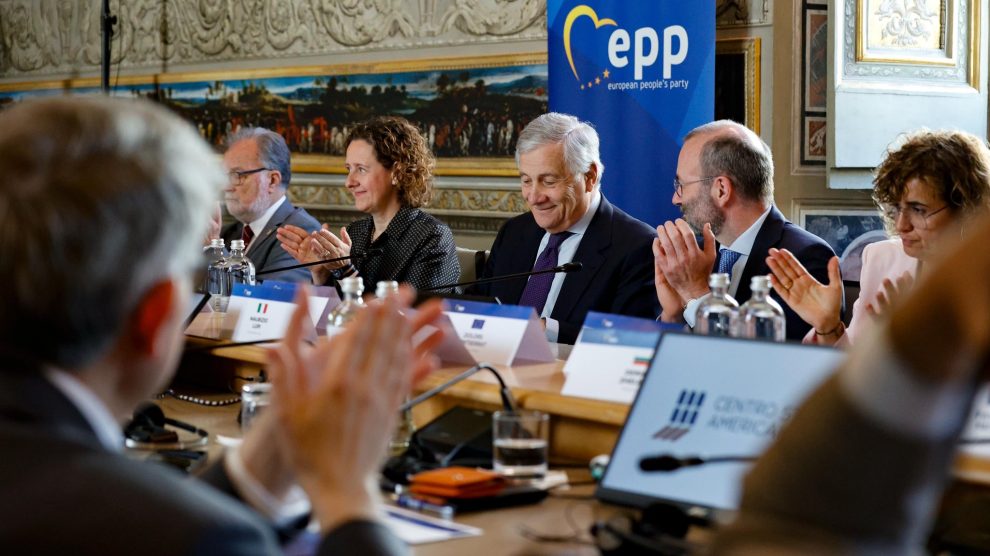
From Rome, Manfred Weber, Roberta Metsola, and Antonio Tajani today relaunch the European People’s Party (EPP), which marks half a century of political life. The international context is undoubtedly complex, yet one fact stands out for Europe’s center-right: the number of EU member states governed by center-right coalitions is growing, as is Italy’s weight within Europe.
Decode39 discussed this with Forza Italia MP Alessandro Cattaneo, who argues that “the veto right must be removed: perhaps the time has also come to think about a two-speed Europe, where those who believe in these values move forward, and those who do not are left behind.”
Q: 50 years of the EPP: what balance can be drawn within the political narrative and the broader European project?
A: Taken as a whole, these 50 years can only be judged positively. They have been decades of peace, growth, and—above all—of a Europe capable of combining economic progress with social rights and a welfare system that has few parallels anywhere in the world, even among major allied democracies such as the United States.
- We often forget how valuable our system of social protection and rights is, and how much it is the result of long-term political work.
Q: Which values of popularism have been most decisive?
A: I belong to the so-called “Erasmus generation,” raised with the assumption that Europe was the natural horizon. At some point, however, the mechanism broke down.
- I identify that turning point in the moment when France rejected the European Constitution. That was when the process seemed to stall. What had appeared almost inevitable until then suddenly came to a halt.
Q: How can it be revived today?
A: We should use this EPP anniversary as a moment to look forward—by relaunching the value of a constructive, pragmatic Europeanism. If citizens have grown more skeptical of Europe, it means they were not given the answers they expected.
- Europe must become leaner, closer to businesses and citizens, and less ideological than it has appeared in recent years—particularly after what I consider serious missteps, such as those linked to Frans Timmermans and the Green Deal.
- We have become ideological, whereas Europe—and the West more broadly—should stand for the opposite: the centrality of the individual, liberal values that foster prosperity and growth. What we need is a less bureaucratic Europe, one that acts as an ecosystem capable of supporting and encouraging growth at all times.
- On this anniversary, we are proud of the history we have built, but also aware of a major responsibility: to relaunch ourselves in order to better interpret the sentiments of Europeans and continue shaping a unique space that guarantees growth.
Q: With the center-right governing in more than half of EU member states, and the EPP leading the Commission and Parliament, is this the moment to modernize European institutions? Would reforms such as a single European president help?
A: I was tasked by Antonio Tajani with drafting the program for the last European elections, and we did so even when it might have been politically more rewarding to adopt a populist opposition stance.
- Instead, we stated clearly that Europe needs a unified political force—one that can move beyond vetoes and toward direct election mechanisms. The vision long advocated by Silvio Berlusconi of a European army implied a common defense, both industrial and political.
- In short, we have clear ideas. The EPP carries significant responsibility as the largest political group. At the same time, we must acknowledge that we do not hold an absolute majority, which means building alliances with those who share this vision. That requires negotiation—this is democracy.
- However, the politics of vetoes produces a slow, inefficient system, with compromises constantly diluted. It is therefore urgent to move toward a more effective democracy, where a majority can decide and a minority is protected but cannot block the process.
Q: How can the veto right be removed?
A: It requires unanimous agreement. I believe the elections in Hungary represented an important “sliding doors” moment, and I hope that from now on there will be fewer reservations.
- Frankly, the time may also have come to consider a two-speed Europe, where those who believe in integration move forward, while others remain behind.
Q: In recent years, under Prime Minister Giorgia Meloni, Italy has reshaped its European posture on key issues such as geopolitics, migration, and defense. How does the EPP’s dialogue with the ECR conservatives evolve?
A: It is essential to continue fostering dialogue between populars and conservatives. Giorgia Meloni has clearly understood how important it is for Italy to be fully embedded within the European framework—participating in decision-making, being inside the “rooms where decisions are made,” and negotiating consistently.
- This requires sustained effort and continuity, often leading to outcomes that may not be optimal but still represent meaningful progress for Italy. And in any case, a decision that is not perfect but workable is always better than one that is endlessly postponed or never taken.
(Photo: X, @antonio_tajani)