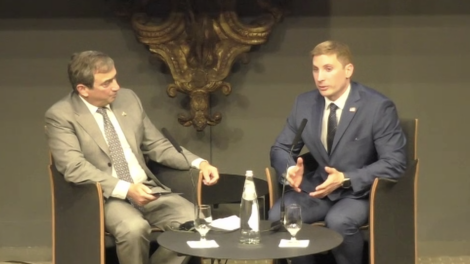
Trusted Tech, Shared Power. Technology is emerging as both a battleground and a binding force among Western allies. That dual role was at the center of the U.S.–Italy Trusted Tech Dialogue, where policymakers and industry leaders framed innovation as a core pillar of transatlantic strategy.
The move: The “U.S.–Italy Trusted Tech Dialogue. Accelerating Transatlantic Innovation,” promoted by the Italian Embassy in Washington alongside the Krach Institute for Tech Diplomacy and Fondazione Serics, brought together senior officials to align on “trusted technologies.”
- Opening the discussion, Ambassador Marco Peronaci warned of a shift from a “Promethean” age of control over technology to a “Faustian” risk where “our data and lives become the object of technology.” His message was clear: tech policy is now foreign policy.
- Roberto Baldoni reinforced this view, arguing that “technology is not neutral,” but reflects power structures and values. At the EU level, Roberto Viola stressed that innovation must “advance freedom” and not “export dependencies,” while calling for faster, simpler governance.
Why it matters: The dialogue highlights how critical technologies—from AI to space—are now central to economic security and geopolitical competition. The framing of “trusted technology” signals a shift away from purely technical standards toward value-based ecosystems.
- This approach positions democratic governance, rule of law, and openness as strategic assets in competition with authoritarian models. It also underscores the urgency: as Viola noted, political decision-making risks lagging behind technological change.
Strategic convergence: A clear alignment emerged across Italian, European, and U.S. stakeholders. Armando Varricchio described trust as “the currency” of modern diplomacy and called for “shared strategic autonomy,” redefining autonomy as interdependence among allies rather than self-sufficiency.
- The concept of “Pax Silica,” evoked by Varricchio, encapsulates this vision—drawing on the historical imagery of Pax Augusta to suggest a stable order built on technological cooperation.
- Keith Krach added an operational dimension, emphasizing execution over rhetoric: “It’s not the big that beat the small, but the fast that beat the slow.” His reference to the Clean Network Initiative highlighted how coordinated action can scale quickly when aligned politically.
The bigger picture: The discussion reflects a broader transatlantic effort to secure supply chains, coordinate industrial policy, and set global standards in emerging technologies. It also mirrors growing concern over China’s technological rise and the risks of fragmentation among democracies.
- Darío Gil of the U.S. Department of Energy pointed to infrastructure—especially computational capacity—as the decisive factor in scaling innovation. Without it, strategic ambitions risk remaining theoretical.
- “It has moved from a supporting role to a pillar of national security and economic power.” The issue, however, is not identifying priorities: “Everyone knows which technologies matter. The difference lies in execution.” And above all in scale and speed: “The real challenge is building adequate infrastructure, because without computational capacity you cannot scale innovation.”
- In this context, Darío Gil also pointed to the “Genesis mission,” designed to transform how research is conducted and accelerate scientific discovery, stressing the need to work with “a limited number of trusted partners” on joint investments in AI, supercomputing, and quantum — an opening that includes allies such Italy.
What it signals: The dialogue signals a maturation of transatlantic tech cooperation, moving from principles to execution. The challenge ahead lies in matching political alignment with industrial scale and speed.
- If successful, initiatives like this could turn technological cooperation into a long-term pillar of Western cohesion. If not, the window to shape the global tech order may close faster than policymakers can respond.