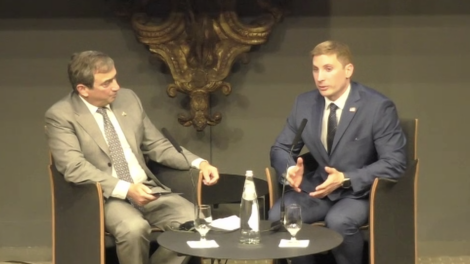

The presentation of the volume The Challenge of Environmental Security in the Euro-Mediterranean Region, published by Springer with the support of the NATO Science for Peace and Security (SPS) Programme, marked the culmination of a research effort launched in 2024 in cooperation with the Ministry of Foreign Affairs of the Hashemite Kingdom of Jordan and the Istituto Nazionale di Geofisica e Vulcanologia (INGV).
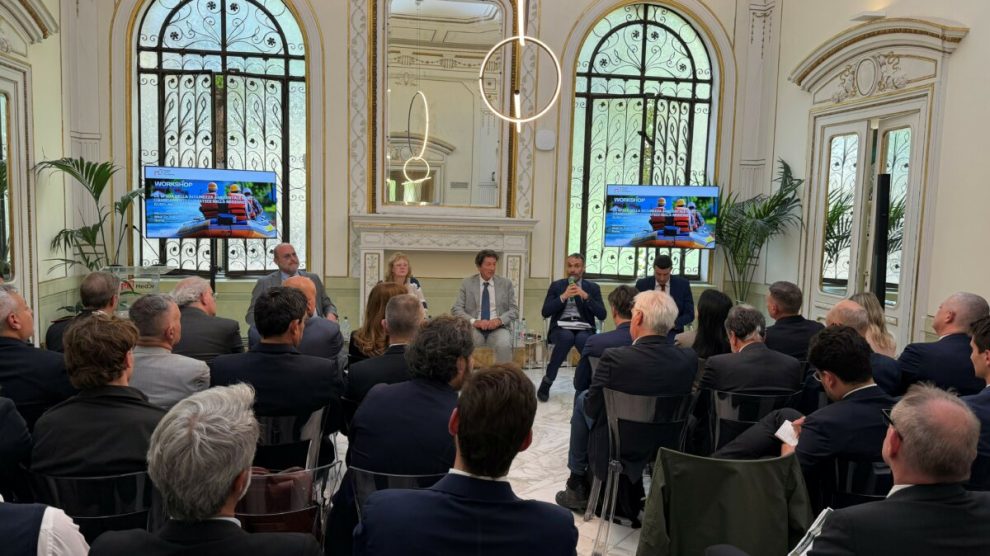
Climate security moves to the strategic core. Held on April 29 at Med-Or’s headquarters in Rome, the workshop brought together institutional representatives, scientists and industry leaders to examine how environmental pressures are reshaping risk, governance and stability across the Euro-Mediterranean space.
- The discussion reflected a broader shift in perspective: climate change is now embedded in an expanded definition of security that includes economic resilience, social stability and the protection of critical infrastructure.
Opening remarks: climate as a driver of instability. The opening session set the tone. Andrea Manciulli, Director of Institutional Relations at Med-Or Italian Foundation, framed climate dynamics as a driver of instability with direct implications for national and regional security. He pointed to the Sahel as a case in point, citing Mali to illustrate how water scarcity and the erosion of pastoral livelihoods among Fulani communities have contributed to conditions in which jihadist narratives can take root.
- Ettore Marchesoni, Advisor and Programme Manager of the NATO SPS Programme, joined remotely and underscored the Alliance’s growing focus on environmental security.
- Giovanni Fedele, First Secretary at the Permanent Representation of Italy to NATO, highlighted the strategic relevance of integrating climate considerations into transatlantic security frameworks.
Panel I: strategic implications and technological responses. The first panel, moderated by Tommaso Alberti of INGV, explored the operational and technological dimensions of climate-related risks.
- Enrico Casini, Director of Communications at Med-Or, described a widening security perimeter in which climate change intersects with food security, energy systems and crisis management.
- Maria Fabrizia Buongiorno, Director of the Environment Department at INGV, focused on the role of Earth observation and integrated services in monitoring and mitigating environmental risks.
- Sandro Carniel, Research Director at the Institute of Polar Sciences of the National Research Council (CNR), examined emerging threats in the Arctic
- Marco Anzidei, Research Director at INGV’s National Earthquake Observatory, addressed the exposure of critical infrastructure to sea-level rise, with direct implications for ports, energy networks and subsea connectivity.
- Taken together, these contributions outlined a landscape in which environmental pressures intersect with strategic geography and technological capability. The emphasis on data, satellite monitoring and predictive tools pointed to a growing convergence between environmental analysis and security planning.
Panel II: a “systemic” approach for the national framework. The second part of the workshop shifted the focus to policy and industrial perspectives. The roundtable, moderated by Emanuele Rossi, Senior Analyst at Decode39, was titled “Climate change and environmental security: challenges and priorities for the national system.” Its composition reflected a cross-sectoral approach.
- Marzia Ravanelli, Director of Quality and Sustainability at BF S.p.A., addressed the agricultural and food security dimension.
- Simone Nisi, Executive Vice President for Institutional Affairs, Regulatory and Climate Change at Edison, focused on the energy sector.
- Milena Lerario, Chief Executive Officer of e-GEOS, highlighted the contribution of geospatial intelligence and satellite services.
- Luca Baione, Brigadier General of the Italian Air Force and former Permanent Representative of Italy to the World Meteorological Organization, provided a defence and institutional perspective.
- The composition of the panel reflected the systemic nature of the challenge. Climate-related risks cut across sectors, linking environmental degradation to economic vulnerability and social instability. This interdependence requires coordination between public institutions, private actors and the scientific community, a theme that recurred throughout the discussion.
NATO, partnerships and the Euro-Mediterranean dimension The involvement of NATO through the SPS Programme added a further layer of significance.
- It signalled that environmental security is now embedded in the agenda of the world’s leading military alliance, as a factor shaping operational environments and long-term stability.
- The collaboration with Jordanian institutions, alongside Italian research bodies, also underscored the importance of partnerships across the Euro-Mediterranean region, where climate impacts are particularly acute.
From environmental issue to structural security variable. The workshop and the publication it presented form part of a broader effort to build a network of cooperation among institutions, research centres and industry.
- The objective is to strengthen resilience and improve crisis management capabilities in a context where environmental change is increasingly intertwined with geopolitical dynamics.
- The message that emerged in Rome was consistent across panels and interventions. Climate change has become a structural component of security analysis, influencing fragile regions, the resilience of infrastructure and the stability of economic and social systems.
- Addressing it requires an integrated framework that combines technological innovation, policy coordination and international cooperation.