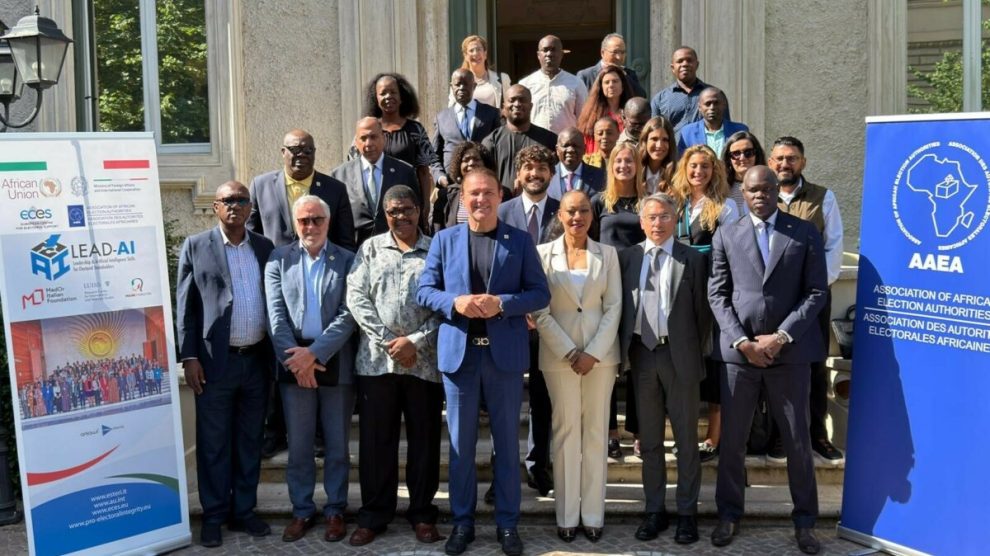
The event — part of the “Executive Peer Learning Mission – Italy Electoral Leadership, AI Governance & Cyber Resilience” organized by the European Centre for Electoral Support (ECES) — gathered representatives from electoral commissions across Africa, including countries identified as priorities under the Mattei Plan.
Why it matters: Italy is increasingly framing democratic resilience and institutional capacity as part of its Africa strategy.
- The initiative linked electoral governance to cybersecurity and AI-related risks.
- Rome appears to be positioning itself as a European platform for EU-Africa cooperation on governance and digital security.
- The focus reflects growing concern over how fragile democratic systems can create openings for destabilization and external influence.
The big picture: The Rome initiative went beyond technical electoral training.
- Italian officials and partner organizations increasingly present institutional resilience as a strategic pillar of long-term cooperation with African countries — alongside energy, infrastructure and economic development.
- That logic fits into the broader narrative of the Mattei Plan, Italy’s flagship Africa policy, which aims to promote what Rome describes as a more balanced partnership with African states.
- Within that framework, democratic governance is increasingly treated not only as a political issue, but also as a security and stability issue.
Zoom in: Elections, AI and cyber resilience. The session hosted by Med-Or focused on cybersecurity, protection of critical electoral infrastructure and the impact of emerging technologies — particularly artificial intelligence — on democratic processes.
- The broader training program held in Rome throughout the week aimed to strengthen “democratic governance,” “institutional resilience” and cooperation between Europe and Africa, according to the organizers.
- Participants included the African Association of Electoral Authorities (AAEA), which represents 45 members, alongside regional electoral networks from across the continent.
- The initiative was organized within the EU-backed Pro-Electoral Integrity program, funded by Italy’s foreign ministry and implemented by ECES in partnership with the African Union Commission, Luiss University and Imagine the Change Foundation.
Between the lines: The political subtext is difficult to miss.
- Across parts of the Sahel, democratic fragility and institutional weakness helped create conditions for military takeovers and opened space for external actors — including Russia — to expand influence through security partnerships.
- Recent instability in Mali has again highlighted the limits of heavily securitized approaches in the absence of stronger institutional and political frameworks.
- Against that backdrop, initiatives centered on electoral resilience and governance capacity are increasingly viewed in Rome and Brussels as part of a broader stabilization effort.
The Mattei Plan angle. Rome’s commitment reflects Italy’s growing position at the crossroads between the Mediterranean and Africa. This strategic positioning is evident in the development of the Mattei Plan.
- The support of players like Med-Or underscores Italy’s commitment to promoting international cooperation and sharing best practices on major global challenges, particularly in Europe-Africa relations. This commitment is a key theme of the entire Italian country-system.
The bottom line: Italy’s Africa strategy is evolving beyond economics and energy.
- The Rome initiative suggests that cybersecurity, AI governance and the protection of democratic institutions are becoming part of the wider geopolitical architecture Rome is trying to build with African partners.