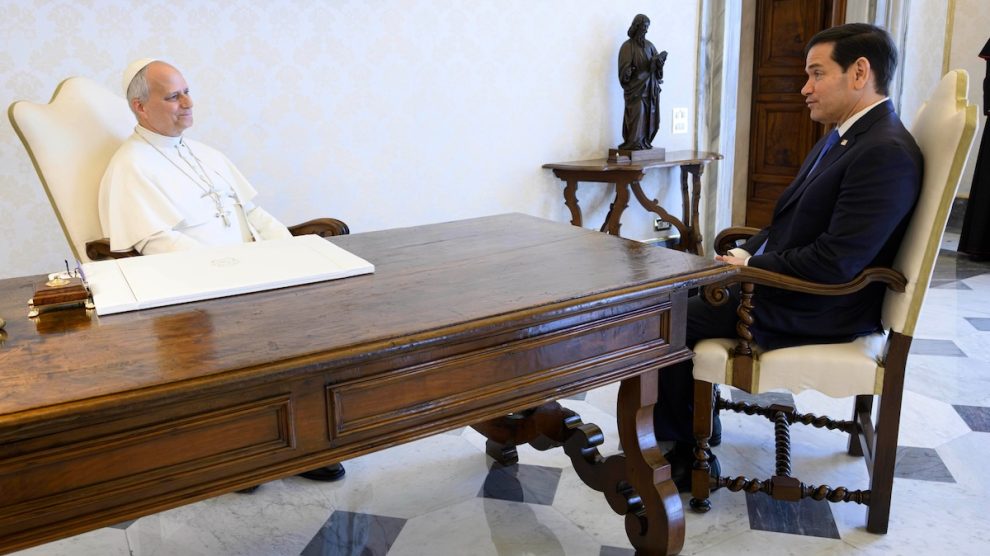
When U.S. Secretary of State Marco Rubio arrived at the Vatican, one word dominated both the official statements and the private conversations: peace.
The same word framed his meetings with Pope Leo XIV and Cardinal Pietro Parolin during a two-day visit balancing political diplomacy and Vatican diplomacy. The trip comes at a delicate moment for relations along the Washington–Rome–Holy See axis, after months marked by tensions linked to Donald Trump’s attacks against the Pope, the Vatican’s increasingly visible international role in global conflicts, and Italy’s positioning under Prime Minister Giorgia Meloniwithin Western dynamics.
Officially, the mission is focused on “efforts for a lasting peace,” particularly in the Middle East. Rubio himself, writing on social media after the meeting with the pontiff, referred to a “shared commitment to peace and human dignity.”
The expert’s analysis: Against this backdrop, our sister website Formiche.net interviewed Massimo Franco, journalist and analyst for the Corriere della Sera and author of the book “Papi, dollari e guerre. Il potere dell’America in Vaticano dai tabù del passato a Leone XIV.”
Q: Franco, what does Rubio’s Italian mission mean today in light of the Vatican meetings, the explicit calls for peace, and the political tensions running through the West?
A: It is a trip heavily conditioned by the room for maneuver Rubio still has inside the White House. Compared to other figures in the American administration, he was less exposed when it came to attacks against the Pope, and that now allows him to appear as a more balanced and less confrontational figure.
- At the same time, it remains unclear what mandate he actually received from Trump. The very fact that he was sent to Italy and the Vatican means Washington has understood the need to reopen a political and diplomatic channel.
Q: Does the shadow of Trump and JD Vance’s attacks against the Pope still weigh on relations?
A: Absolutely. Relations between the United States and the Vatican are going through a phase of profound redefinition. It is a transition deeply shaped by Trump’s personality.
- Paradoxically, the attacks by the American president have actually contributed to raising the Pope’s international profile. Before, there was a tendency to describe Leo as a low-profile pontiff; by attacking him, Trump strengthened both his symbolic and political role.
Q: What impact have these tensions had on Giorgia Meloni, who also became a target of Trump’s attacks?
A: In the short term, Trump almost did her a favor. He pushed her toward a much clearer European positioning than had previously appeared to be the case.
- It should be said clearly: it was Trump who broke with Meloni, not the other way around. This now places her in a stronger position vis-à-vis European allies because it consolidates her as a reliable interlocutor.
Q: Also domestically?
A: Yes. Meloni can argue that she kept the alliance with the United States intact and that, if anything, it was the Americans who changed their approach. From an electoral perspective, even being attacked by Trump could ultimately become an advantage.
- Of course, the opposition will remind her of the privileged ties she cultivated in the past with the Trumpian world, but the real problems for the prime minister come more from fractures within the governing coalition than from international controversies.
Q: Has Pope Leo’s pontificate surprised the Maga world?
A: Very much so. Pope Leo surprised the Maga world, and the American strike against Iran surprised it even more. Trump had promised not to wage wars but to solve them.
- Today, instead, not only are the United States fighting wars, but they are not even able to win them. This creates deep contradictions within the American conservative front itself.
Q: And how does the theme of peace, now central in the Vatican talks, fit into these contradictions?
A: In the United States the debate is completely open. The attacks against the Pope are even forcing the more Trumpian sectors to show solidarity with the pontiff, and this also applies to part of the Protestant world.
- In Italy, meanwhile, Catholics represent a very diverse reality and one that today has limited political influence.
Q: In the end, can this visit really help mend relations between Washington and the Vatican?
A: I do not believe in definitive ruptures between the United States and the Vatican. The positive element is that the Americans have understood they need to do something in order to return to a normalized framework of relations.