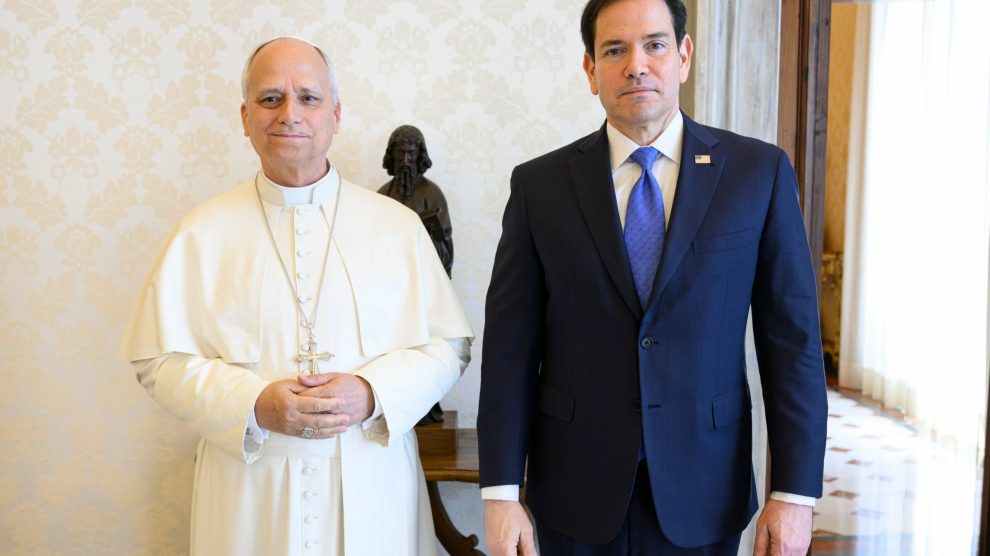
Monsignor Vincenzo Paglia, president emeritus of the Pontifical Academy for Life, views the meeting between U.S. Secretary of State Marco Rubio and Pope Leo XIV as a crucial step toward “mending” a world marked by wars and geopolitical tensions. For the Monsignor, relations between Washington and the Vatican have emerged strengthened, also thanks to the Pope’s Latin American sensitivity and the willingness to listen shown by the American secretary of state.
On the table were not only relations between Washington and the Vatican, but also the major fractures shaping today’s global landscape — from Cuba to international conflicts, as well as the role of Latin American Christianity in redefining new trajectories for dialogue.
Q: What political and symbolic significance did the meeting between Rubio and Pope Leo carry?
A: Pope Francis once said something extraordinary at Sant’Egidio: when people meet, the encounter itself prevails. I believe this is the first thing we should grasp. Meeting one another is always richer than the words that are spoken, because within an encounter there are also silences, intuitions, things understood without being explicitly said.
- There was a particular chemistry between them. Both speak English and Spanish, both have deep ties to North and South America. And both carry a universal responsibility on their shoulders, albeit in different ways.
- That said, I do not believe the core of the conversation was simply about repairing diplomatic relations. The real issue today is that we must mend peoples, mend the fractures of the world — a planet that is falling apart. We need to rebuild a shared dream.
Q: Peace was reportedly the first chapter of the meeting. What do you take away from the joint statements?
A: I believe their shared evangelical background — also shaped by a complex and deeply popular Latin American Christianity — brought to the forefront the primacy of peace and encounter over the logic of force.
- Naturally, I find it difficult to imagine there was total convergence on every issue. That would be unrealistic. But the mere fact that peace was placed at the center is already extremely significant.
Q: What are the current points of friction between the United States and the Vatican?
A: I think, for example, of Cuba. I believe there are still tensions there that need smoothing over. There should be greater respect for the Cuban population living on the island, which is distinct from the exile community that naturally holds a much harder line toward the current leadership in Havana. This remains a major issue to resolve.
Q: You have often referred to the figure of Felix Varela, whose cause you personally supported.
A: Yes, I served as postulator for his cause. Varela is an extraordinary figure, respected by all Cubans. He was one of the founders of the Diocese of New York and still represents a possible bridge between the United States and Cuba.
- Of course, the situation remains complex. Rubio is the son of Cuban exiles and grew up within a history of opposition to the Havana regime. But Pope Leo reopened the Augustinian convents in Cuba and knows that reality very well. His sensitivity suggests a focus on the Cuban people before political balances.
Q: Can the conversation between Rubio and the Pope strengthen relations between Washington and the Holy See?
A: I believe so. The relationship has certainly grown stronger. The phase of tensions experienced during the Trump years was dangerous. Today, I sense a different willingness emerging. Also because Rubio is not Trump. He has his own cultural and political autonomy.
- Moreover, the Pope’s pastoral experience in Latin America is extremely strong, and that greatly facilitates dialogue.
Q: What signal does it send that Rubio himself requested the visit?
A: It is a very significant element. It shows an urgency to listen. Perhaps to explain certain positions, but also to genuinely listen to the Vatican.
- And in a time like this, that is no small detail. Because the world needs leaders who are willing to listen to one another again.