
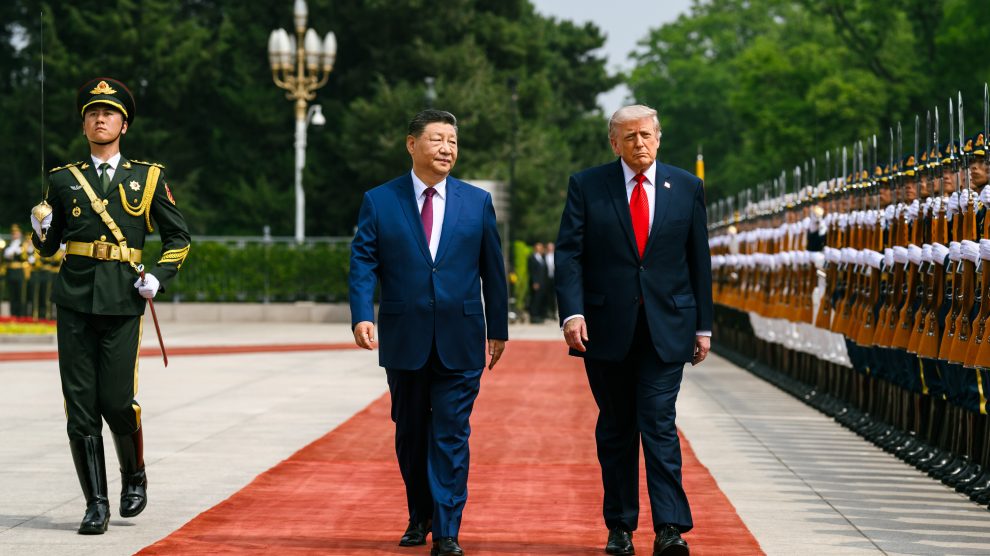
The Trump-Xi summit produced signals of tactical stabilization — from trade talks and rare earths to discussions on Iran and the Strait of Hormuz. But for Europe, the real concern goes beyond tariffs or export controls.
The deeper fear in Brussels is that the U.S. and China could gradually begin co-managing parts of the international system directly between themselves, leaving allies and middle powers with shrinking influence over the rules shaping trade, technology, security and industrial policy.
Why it matters: European officials broadly support efforts to stabilize U.S.-China relations, fearing further shocks to trade, energy and global supply chains.
- But a more structured U.S.-China “managed competition” also raises fears of European marginalization.
- The concern is not reconciliation between Washington and Beijing, but the possibility of selective co-ordination between the world’s two largest powers on key strategic dossiers.
- Europe risks finding itself caught between U.S. security dependence and deep economic exposure to China.
The big picture: Trump and Xi could find a way to move on technology, trade, industrial policy and security, managing frictions with selective solutions. But Taiwan remains the clearest red line.
- During the summit, Xi warned that the “Taiwan question” remained central to U.S.-China relations and could lead to “conflict” if mishandled. The warning underscored that any tactical de-escalation between Washington and Beijing does not alter the structural nature of their rivalry.
- Still, the two leaders also showed signs of a shared preference for transactional stability: strong state-centered visions of power, personalized leadership styles and increasingly pragmatic approaches to global affairs.
- By keeping Taiwan and values off the table, Beijing is signaling there is no reset — only pragmatic coexistence based on shared interests.
Between the lines: For Europe, the summit revived concerns around a possible return of “G2” dynamics.
- The concept emerged during the Barack Obama years through the Strategic and Economic Dialogue, when Washington and Beijing explored broader co-operation on global governance, trade and climate. Today, the idea would look very different.
- Rather than jointly managing liberal globalization, a modern G2 would revolve around the competitive co-administration of a fragmented and increasingly transactional international order. That possibility worries European officials.
The fear in Brussels is not simply the existence of U.S.-China rivalry. It is the prospect of being excluded while the two powers negotiate directly on issues affecting the rest of the system — from AI standards and supply chains to trade rules, critical minerals and regional security.
- Some analysts and officials also worried ahead of the summit that Beijing could seek concessions on Taiwan in exchange for co-operation on other strategic priorities, including Iran and maritime stability around the Strait of Hormuz.
- The White House later said the two sides agreed on the importance of keeping Hormuz open. The juxtaposition was notable for European observers.
- Trump left Washington for Beijing after publicly criticizing NATO, saying the alliance had been “very disappointing” and that the U.S. did not need it.
- For many in Europe, the sequence reinforced concerns that the Trump administration increasingly views international politics through direct great-power bargaining rather than traditional alliance management.
Zoom in: Europe’s dilemma. In her today’s op-ed in Il Messaggero, Valbona Zeneli, a member of Decode39’s advisory board and author of “Overviews”, argued that Europe has a strong interest in stabilizing U.S.-China relations while avoiding strategic passivity.
- The economic stakes for Europe are already significant.
- According to Zeneli, as U.S.-China decoupling intensified, larger volumes of Chinese exports have been redirected toward the European market, increasing pressure on European industries.
- The EU’s trade deficit with China reached nearly €360 billion in 2025, with Chinese exports to Europe almost double European exports to China.
Imbalance. A further hardening of U.S. restrictions on Chinese imports could deepen that imbalance, potentially turning Europe into the primary destination for Chinese overcapacity.
- At the same time, possible forms of “managed trade” between Washington and Beijing — including increased Chinese purchases of American goods — could directly disadvantage European exporters.
- Treasury Secretary Scott Bessent said the two sides discussed creating a “Board of Trade” and a “Board of Investment” to manage bilateral economic disputes and identify areas for commercial co-operation.
- For European policymakers, those mechanisms are being watched closely not only for their commercial implications, but also for what they signal about the architecture of future U.S.-China relations.
Critical materials and strategic autonomy. Zeneli also pointed to Europe’s dependence on critical raw materials as a major strategic vulnerability.
- The EU remains heavily dependent on China for rare earths, permanent magnets and strategic minerals essential for green technologies, digital infrastructure and defense industries.
- Temporary understandings between Washington and Beijing may reduce short-term tensions around export controls and supply chains. But European officials increasingly view industrial resilience as a long-term geopolitical necessity.
- That explains Brussels’ acceleration on industrial policy, defense co-operation, energy diversification and the Critical Raw Materials Act. The push is not only about strategic ambition.
- It reflects growing concern inside Europe that, in a system increasingly shaped by major powers, middle actors risk becoming rule-takers rather than rule-makers.
From Beijing to Rome, what we’re watching:
- Whether the U.S. and China extend their fragile trade truce.
- Progress on the proposed Board of Trade and Board of Investment.
- Possible co-ordination on Iran, energy security and maritime routes.
- Signals from Washington on Taiwan and regional deterrence.
- Whether Europe responds with greater industrial and strategic co-ordination.
The bottom line: The Trump-Xi summit is unlikely to produce a transformational agreement.
- But it may accelerate a more managed form of U.S.-China rivalry — one where selective co-operation helps stabilize trade, energy and geopolitical frictions. As Zeneli argues, Europe has a clear interest in that stability.
- The risk for Brussels is that a more structured U.S.-China relationship could also become a driver of agenda-setting on trade, technology, supply chains and industrial standards.
- Europe’s challenge is no longer only managing U.S.-China rivalry. It is avoiding a world where the rules are increasingly negotiated without it.
(Photo: X, @WhiteHouse)