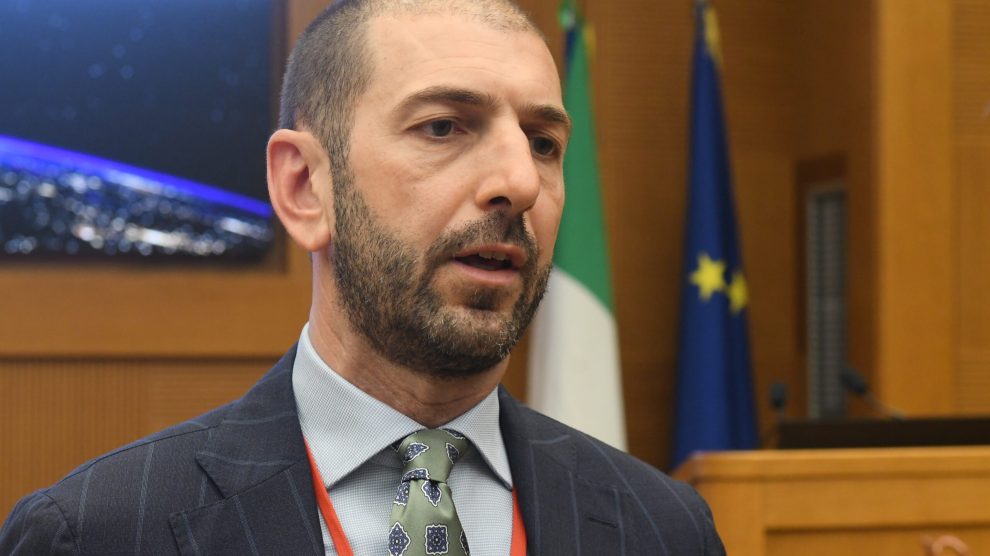
From Iceland to the Gulf states, a new awareness is gradually taking shape, Giangiacomo Calovini — member of the Foreign Affairs Committee of the Italian Chamber of Deputies and of the Italian delegation to the NATO Parliamentary Assembly — explains to Decode39: Mediterranean dynamics and the southern flank no longer affect only Mediterranean countries themselves, but now carry a 360-degree impact across the Alliance. As a result, NATO is increasingly obliged to recalibrate its policies and initiatives.
The issue has been at the centre of the Mediterranean and Middle East Special Group (GSM) Seminar hosted in Rome by the Italian delegation to the NATO Parliamentary Assembly during the group’s 30th anniversary. Read more…
Q: What is your assessment of these three days of discussions?
A: The initiative has been a major success, also because of Italy’s role within NATO and the Parliamentary Assembly. This is demonstrated by the presence of delegates not only from allied countries, but also from non-member states such as Algeria, Morocco, the United Arab Emirates, Saudi Arabia, Qatar and Israel, just to mention a few.
- I believe it is important to underline Italy’s centrality, as highlighted by Defence Minister Guido Crosetto, NATO Secretary General’s Special Representative for the Southern Neighbourhood Javier Colomina and the EU Special Representative for the Gulf Luigi Di Maio.
Q: Beyond Iran, Prime Minister Giorgia Meloni stressed in her message to the conference the strategic weight of cooperative security and the southern flank. How should this be integrated into NATO policies?
A: I had the honour of reading the Prime Minister’s message, in which she underlined the importance of the Parliamentary Assembly and parliamentary dialogue, especially at such a difficult and complex moment as the one we are experiencing today.
- One of the most interesting interventions came from an Algerian delegate, who called for stronger cooperation between NATO and Algeria on migration management — meaning border control, migration flows and the fight against illegal immigration — together with all the terrorism-related risks connected to these dynamics.
- I consider this a concrete example of how NATO’s future should be conceived: no longer solely as the defence of the Atlantic area, but as a guarantor of an increasingly strategic southern flank in a critical geographic space such as the Mediterranean.
- At this moment, Iran is not the only issue under NATO’s microscope. There are many other strategic challenges on the table, and we are convinced that both the NATO Parliamentary Assembly and NATO itself can play a decisive role.
Q: Speaking of future scenarios and stability, we have recently seen the arrival in Gibraltar of a US Ohio-class submarine, alongside the mystery surrounding the Ukrainian drone incident in Lefkada. How can NATO’s future strategic concept evolve in light of episodes in the Mediterranean that are no longer isolated?
A: First and foremost by leveraging Italy’s geographical position, which effectively makes the country a natural port placed at the centre of the Mediterranean.
- I would borrow the words of Defence Minister Crosetto, who has repeatedly stressed that defence is fundamental at this stage, even if politically it is not always an easy issue to communicate.
- Of course, everyone would prefer to allocate more resources to schools, healthcare or welfare. But without adequate defence, none of these things can ultimately exist.
- Because defence has once again become a strategic priority, we need to explain to citizens that the events we are witnessing are warning signs that cannot be ignored. Addressing them requires investment — not only economic investment, but political investment as well.
- What we are doing today is precisely that kind of investment, and the successful initiative currently taking place in Rome moves exactly in that direction.
Q: The seminar also included participants from non-Mediterranean countries such as Qatar and Finland. How does this contribute to strengthening attention toward the Mediterranean dimension and the increasingly strategic relationship between the Mediterranean, Northern Europe and the Middle East?
A: Qatar is obviously not a Mediterranean country, but in many ways it remains closely connected to us for historical, cultural and geographical reasons.
- At the Rome summit we also hosted delegates from Norway, Iceland and Finland. This demonstrates growing attention both toward Mediterranean issues and toward Italy’s centrality in the current international context.
- What is emerging is that the Mediterranean and the southern flank are no longer concerns limited to Italy, France, Spain, Greece or Cyprus. They are becoming part of a shared strategic perception.
- The stability of the Mediterranean is now clearly a scenario with consequences for a much broader number of countries.
Q: How useful could the reflections emerging from these discussions be ahead of the NATO summit in Ankara?
A: Very useful. This is my first parliamentary term, but I have clearly perceived — also in conversations with many other participants — that the relationship between NATO and the NATO Parliamentary Assembly is growing stronger than ever.
- Across NATO governments there is a continuous process of political change. Nevertheless, in many countries, including Italy, both governing parties and opposition forces continue to engage constructively, because in such a delicate and important international scenario, there must always be an effort to pursue common growth and shared national interests.
- I believe the national delegations to the NATO Parliamentary Assembly, as well as the Assembly itself, are working constructively in this direction.
- The ultimate objective is to positively and constructively influence government activity. Therefore, ahead of such an important summit as the one in Ankara, we hope Italy’s work will also be recognised as constructive and strategically valuable.