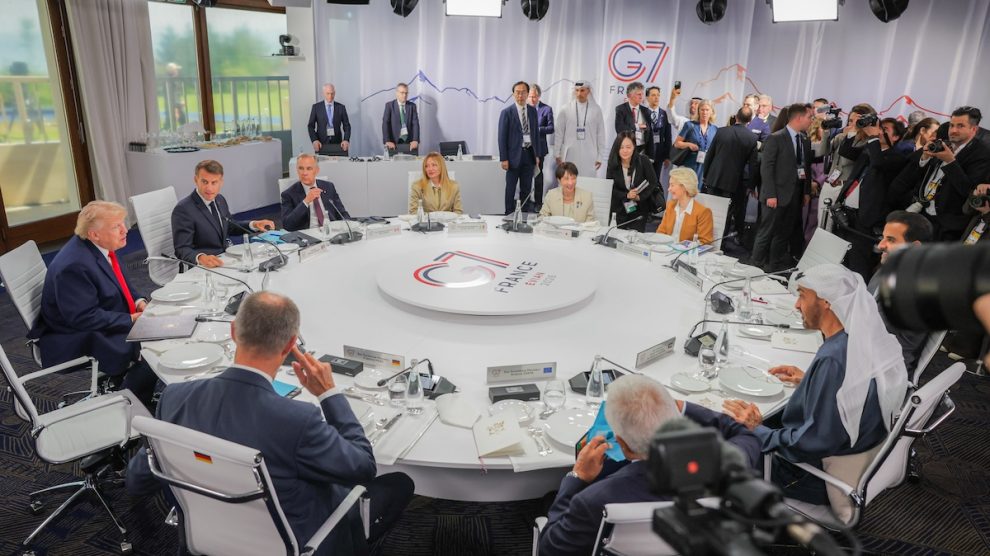
As G7 leaders gathered in Évian amid mounting geopolitical tensions and growing economic uncertainty, the challenge extends well beyond any single crisis. From Gulf security and regional diplomacy to critical minerals and supply-chain resilience, the ability of leading democracies to build consensus is increasingly being tested by a more fragmented international landscape.
Speaking to Decode39, Alessandro Politi, Director of the NATO Defense College Foundation, discusses the role the G7 can still play in fostering common ground on some of today’s most pressing strategic issues.
Q: Is the memorandum between Iran and the United States an endpoint or a starting point?
A: It is an endpoint because it should help resolve the Strait crisis and ease oil and gas prices, which have been placing significant pressure on all developed economies, including the United States. At the same time, it is a starting point because rebuilding a more stable security architecture in the Gulf requires negotiations that cannot be compressed into sixty days, particularly on the nuclear and missile issues.
- This also means addressing, in due time, the question of Middle East denuclearization. Egypt has advocated such a proposal for many years, and it remains a sensible one, especially before a wider nuclear proliferation dynamic becomes unavoidable. This is clearly a political issue. It is not merely unilateral; it is inherently multilateral.
- After five Gulf wars since 1980, the conditions appear to be in place to tackle this challenge in a serious and non-ideological manner.
Q: What contribution can the G7 make in this context?
A: The G7 is primarily a forum for consultation and coordination among the world’s leading industrialized nations. One could even argue that these discussions should be linked more closely to the G20, where countries such as Saudi Arabia and Spain participate as permanent guests.
Q: Why is this important?
A: Because these forums do not make operational decisions. Their role is to build consensus among countries that often struggle to find common ground. As we have seen in recent months, consensus has been under considerable strain. The G7 can therefore make a positive contribution, particularly if its members are able to agree on a series of practical compromises and a shared strategic direction.
Q: What role could Qatar and Pakistan play once the fighting truly comes to an end?
A: This is a particularly interesting dimension because Pakistan and Qatar share a number of common interests. I would also add another important actor: Oman. It often remains out of the spotlight, yet it has consistently played a crucial role in crisis prevention across the region, especially in relation to Iran.
- Pakistan is, of course, the country associated with the so-called Islamic bomb, while Qatar has long pursued a distinct political line linked to political Islam and the Muslim Brotherhood. The fact that these countries helped mediate or facilitate dialogue between Iran and the United States suggests that some of our traditional assumptions about regional alignments need to be revisited.
- In some cases, the countries often perceived as the most problematic are precisely those capable of contributing to solutions.
Q: Japan’s proposal in Rome to establish a common rare earth reserve reflects Europe’s search for new answers on industry, defense, and geopolitics. Is it the right approach?
A: It is a common-sense proposal. Whether it is fully feasible from a technical perspective is another matter.
- Too often, we forget that the rare earth problem is not fundamentally about access to raw materials. It is about refining capacity. China has built capabilities in this sector that came at a considerable environmental cost, but for now those capabilities remain unmatched.
- Even so, the proposal moves in the right direction. It could contribute to a more balanced market and reduce exposure to geopolitical risks in the future.
Q: The G7 summit features carefully curated playlists and a dinner at Versailles. Is this President Macron’s attempt to ease tensions among leaders?
A: I believe it is an effort to create a more positive atmosphere. National interests may remain convergent or divergent, but a less confrontational environment makes it easier, on a human level, to find accommodations and compromises.
- It is an honest attempt to foster a degree of initial cohesion at a time when international politics has become considerably more difficult.