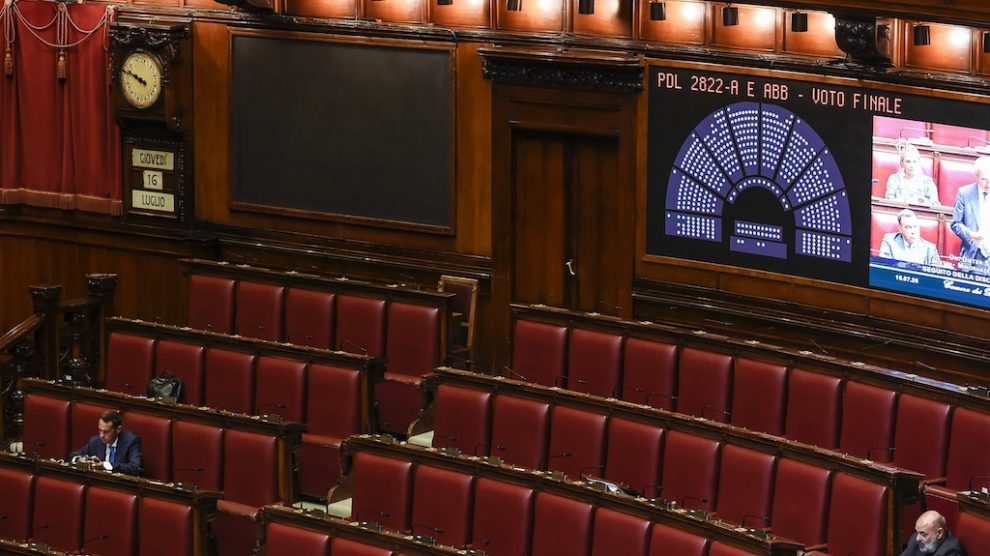
The war in Ukraine has long been the ultimate test for Italy’s centre-left coalition. The joint parliamentary motion presented today was meant to strike a balance on the alliance’s position, but instead it has brought internal divisions back to the surface — from support for Kyiv to Europe’s role in international security and the future of a common European defence.
According to Democratic Party MP Lia Quartapelle, the issue lies not only in the content of the text but also in the way it was drafted. The real danger, she says, is a retreat from a genuinely pro-European and government-ready political stance.
Q: The Ukraine resolution presented today was supposed to be a joint initiative. Why did it fail to convince you?
A: It is difficult for me to reconstruct how this document came about because the problem is first and foremost one of method, and then of substance.
- The real question we should ask ourselves is: what kind of alliance is one that cannot agree on a shared vision of Europe? Such an alliance is extremely fragile and risks concealing its divisions behind easy slogans.
- Anyone who genuinely wants peace in Ukraine must understand that achieving it requires preparing Europe for the challenges ahead. That awareness was missing from the text presented today.
Q: The most controversial issue concerns the reference to the SAFE fund and European defence.
A: SAFE cannot simply be rejected out of hand because it represents an important step toward building Europe’s security capacity.
- Anyone with governing responsibilities should recognise that the risks facing every European country have increased.
- If every other country is strengthening its defence capabilities, we will not become safer by imagining that we can remain outside a common defence framework.
- If we want to provide greater security for our citizens, there is no credible alternative to European security.
Q: Do you believe this reference was also necessary to make the line outlined by Dems’ leader Elly Schlein in her recent interview with Il Foglio more coherent?
A: That interview was courageous and I agreed with it. But political positions must eventually be translated into concrete choices.
- This document should have contained a strong commitment to making use of SAFE funds because they could become the first building block of a common European defence.
- The absence of such a reference — together with the idea that one can simultaneously oppose war while rejecting the tools needed to deal with the new international environment — made the resolution impossible for us to support.
Q: Has the Ukraine issue reopened a deeper fracture within the centre-left coalition? Is this a matter of substance or of method?
A: It is both. This resolution risks becoming a precedent, both in terms of its content and in the way it was produced. I would not want a drift toward populist positions to become the defining feature of this coalition.
- The Five Star Movement is putting the credibility of the entire project at risk because it has repeatedly postponed opportunities to address the coalition’s fundamental political differences.
- As a result, we arrive unprepared when major parliamentary decisions have to be taken, as happened today, and we end up lurching from one crisis to another.
Q: Dialogue with Giuseppe Conte appears increasingly difficult. Do you see more room for cooperation with the leftists of Green and Left Alliance (AVS)?
A: Yes, I do. I see a different attitude from AVS. Unlike the Five Star Movement, they seem genuinely committed to finding compromises and building a shared political framework that can help us defeat the right while preserving significant political differences where they exist. That is a far more constructive approach to coalition-building.
Q: Does this episode also raise broader questions about how the centre-left coalition should be built ahead of future political challenges?
A: Absolutely. The method followed in drafting this resolution risks marginalising smaller but essential allies such as Italia Viva and +Europa. But the issue is even broader than that. We also need to open a dialogue with Azione.
- We must work toward a common vision for Italy that we can present to voters, and we need to do so as soon as possible.
Q: What role should the Democratic Party play at this stage?
A: The Democratic Party should play a different role — not one of chasing every position that emerges within the coalition, but of building a credible political alternative.
- The Five Star Movement continues to postpone essential political clarifications and then forces the issue at decisive moments, as happened with this resolution. Our challenge is to build a European, progressive and government-ready vision that is capable of speaking to the country.