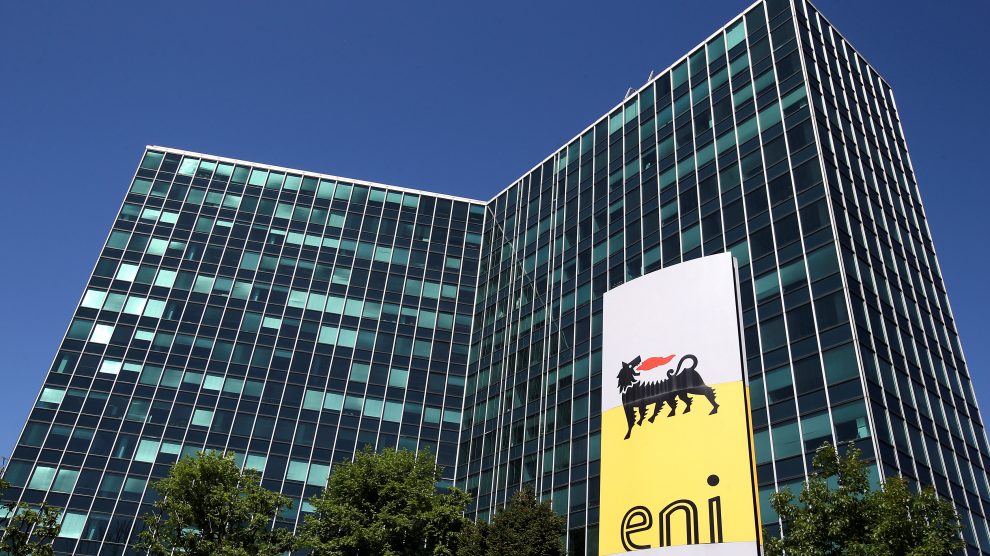
ROME — Eni has secured exclusive operatorship of Venezuela’s giant Junín-5 heavy oil field, giving the Italian energy group direct responsibility for a 35 billion-barrel resource in the Orinoco Belt as Caracas seeks to revive its oil and gas sector.
The 25-year agreement with state-owned PDVSA significantly expands Eni’s operational role in a country where it has maintained a presence since 1998.
Why it matters: The deal moves Eni from minority partner to operator of one of Venezuela’s major oil assets, while adding oil to a Venezuelan portfolio currently driven largely by natural gas.
- Junín-5 holds 35 billion barrels of certified oil in place and currently produces about 12,000 barrels per day.
- Eni becomes the exclusive operator, taking responsibility for the project’s technical, financial and commercial management.
- The agreement was signed during a visit to Venezuela by U.S. Energy Secretary Chris Wright, putting the transaction against the backdrop of renewed U.S. attention to the country’s energy sector.
- Eni already produced 64,000 barrels of oil equivalent per day in Venezuela in 2025, mainly from the offshore Perla gas field.
Zoom in: A new operating model. Eni and PDVSA signed a 25-year Contrato de Participación Productiva de Hidrocarburos, or CPPH, with an option to extend it.
- The contract completes a process launched with an April 28, 2026 head of terms and replaces the previous Petrojunín joint-venture model, under which PDVSA held 60% and Eni 40%.
- The new contractual framework was introduced under Venezuela’s Organic Hydrocarbons Law approved by the country’s assembly in January 2026.
The key change is operational. Eni now takes direct control of the management of Junín-5.
- The field sits onshore in Venezuela’s Orinoco Belt and contains heavy crude.
- According to the additional information provided, the new structure is intended to support a production ramp-up toward 400,000 barrels per day by the end of the decade, requiring investment of about $1.5 billion annually by the joint venture.
- Those production and investment figures were not included in Eni’s announcement of the agreement.
The political backdrop. The guest list underscored the level of political attention surrounding the deal.
- Eni CEO Claudio Descalzi and PDVSA CEO Héctor Obregón signed the agreement in the presence of Venezuela’s acting President Delcy Rodriguez, Hydrocarbons Minister Paula Henao and U.S. Energy Secretary Chris Wright, who was visiting the country.
- The agreement itself follows negotiations between Eni and PDVSA and is separate, according to the material provided, from the agreement announced by the U.S. administration.
- Still, Wright’s presence places the signing within a broader moment of renewed attention in Washington toward Venezuela’s energy sector.
What they’re saying. Descalzi framed the deal around both Venezuela’s recovery and global energy security.
- “This agreement represents a new pillar for the relaunch of the country’s oil and gas sector,” he said, pointing to the importance of abundant resources and diversified supplies for global energy security.
- He also described the operatorship as recognition of Eni’s ability to execute complex projects and of its longstanding presence in Venezuela.
Energy first. Junín-5 is only one part of Eni’s Venezuelan footprint. The company’s biggest contribution to current production comes from natural gas. Through Cardón IV, owned 50-50 with Spain’s Repsol, Eni operates the Perla field — described by the company as the largest offshore gas field discovered in Latin America.
- Perla accounts for about 35% of Venezuela’s total gas consumption, according to Eni.
- Cardón IV has also recently signed a Sustainability Agreement aimed at sustaining and relaunching Perla production, increasing volumes for Venezuela’s domestic market and setting conditions for additional future gas exports.
- That gives Eni two potentially complementary tracks in Venezuela: expanding its role in heavy oil through Junín-5 while consolidating its position in natural gas through Perla.
The big picture. Eni has operated in Venezuela since 1998 and holds six licenses across offshore areas in the Gulf of Venezuela and Gulf of Paria and onshore acreage in the Orinoco region.
- Its other interests include a 26% stake in PetroSucre, alongside PDVSA’s 74%, which operates the offshore Corocoro oil field, as well as a participation in methanol producer Supermetanol.
- Eni says it maintained its presence in the country even during periods of acute geopolitical difficulty.
What we’re watching: The central test now is how quickly Eni can translate its new operating authority at Junín-5 into higher production.
- The field’s current output — roughly 12,000 barrels per day against 35 billion barrels of oil in place — shows the scale of the resource, but also the size of the industrial task ahead.
The bottom line: Junín-5 gives Eni something it did not have under the previous joint-venture structure: direct operational responsibility for one of Venezuela’s giant oil fields.
- Combined with its existing gas position at Perla, the deal deepens the Italian group’s role in the country just as Venezuela’s energy sector is returning to the international agenda.