

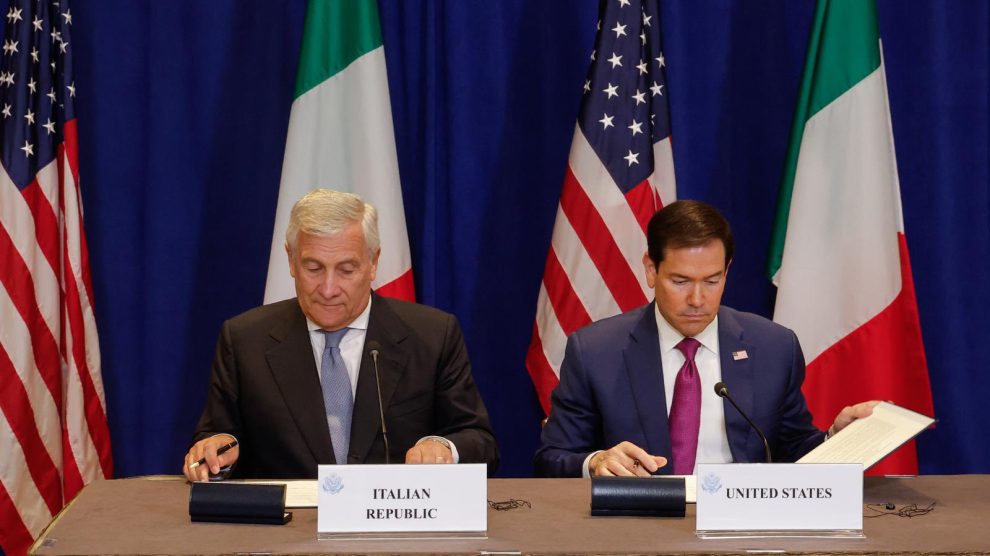
Countering China’s dominance, Italy and the US signed a Memorandum of Understanding on Cooperation in the Critical Minerals Sector in New York. US Secretary of State Marco Rubio and Italian Foreign Minister Antonio Tajani signed the agreement.
Tajani emphasized the importance of raw materials for Europe’s second-largest industrial power. China’s dominant position necessitates creating an alternative market to enhance product competitiveness. Italy’s agreement with the US follows a similar agreement with Argentina.
What are the benefits for Italy?. “The benefits for Italy are significant,” Gianclaudio Torlizzi, founder of T-Commodity and adviser to the Italian Defence Minister, tells Decode39.
- “But on one condition: that the Memorandum does not remain a diplomatic exercise and is translated into projects, offtake agreements and investments. Italy is Europe’s second-largest manufacturing economy, but its domestic mineral base is insufficient to meet the needs of its industry. We therefore find ourselves in the most uncomfortable position: we process large quantities of raw materials, but we control neither their extraction nor, in many cases, their refining.”
- He adds: “The agreement with Washington offers an opportunity to become part of a supply network built around reliable countries, reducing exposure to disruptions, export restrictions and geopolitical coercion. The technical working group envisaged by the Memorandum could facilitate information-sharing and mobilise public and private resources for extraction, processing and recycling — an area in which Italy has significant expertise.”
From diplomacy to industrial projects. “The real step change would be to enable Italian companies to participate directly in mining and refining projects abroad, securing shares of production through long-term offtake agreements. SACE [Italy’s Export Credit Agency] could provide guarantees for these contracts, while Cassa Depositi e Prestiti could finance the projects or take equity stakes alongside companies. This would finally connect foreign policy with industrial policy.”
- For this reason, “cooperation on price-setting mechanisms is also important. Many Western projects fail to get off the ground because they have to compete with Chinese state-supported production entering the market at prices capable of discouraging new investment.”
The battle over prices. “Creating more transparent pricing and economically sustainable conditions means making alternative mines and facilities financially viable. The advantage, therefore, does not simply lie in buying minerals from the United States, but in positioning Italian industry within the West’s new raw-materials architecture.”
Securing the entire supply chain. How does all this intersect with supply-chain security, including within the framework of the Pax Silica initiative? According to Torlizzi, supply-chain security does not mean simply buying the same raw material from a different country.
- “It means securing the decisive stages: extraction, refining, processing, recycling, logistics, financing and offtake agreements. For years, the West looked only at the final price, transferring entire industrial segments to China. Beijing thus built dominant positions, particularly in the intermediate stages of processing — precisely those capable of bringing a production chain to a halt.”
From minerals to AI and defence. “The connection is clear: without gallium, germanium, graphite, rare earths and other strategic materials, there can be no semiconductors, data centres, power grids or defence systems,” Torlizzi says. “Cybersecurity protects data and networks; mineral security protects the physical foundation on which they are built. Separating the two would be a mistake.”
- “To make the strategy credible, we need stockpiles, alternative suppliers, refining capacity, long-term agreements and financial instruments capable of protecting new facilities from Chinese price-based competition. All this will come at a cost, but resilience is an insurance premium against production shutdowns.”
The risk of replacing one dependency with another. “Italy must avoid participating in Pax Silica merely as a buyer of American technology. It should position itself as a European platform for recycling, materials processing and industrial technologies. Otherwise, we will simply replace one dependency with another, without rebuilding domestic production capacity.”
Rome and Washington increasingly intertwined. Critical minerals and rare earths, which are fundamental to the development of strategic technologies, are one element of the longstanding cooperation between Italy and the United States on AI, semiconductors and cybersecurity. How, then, does this strengthen the relationship between Rome and Washington?
- According to Torlizzi, the relationship between Rome and Washington is strengthened because it is expanding from the political and military spheres into the now decisive field of economic and industrial security.
- “Today, an alliance is also measured by its ability to jointly secure raw materials, semiconductors, digital infrastructure and sensitive technologies. The Memorandum therefore adds a material foundation to cooperation on artificial intelligence, microelectronics and cybersecurity.”
No technological sovereignty without raw materials. “There can be no technological sovereignty without security of supply. Artificial intelligence depends on data centres; data centres depend on semiconductors and power grids; all of them, in turn, depend on the availability of critical minerals and rare earths.”
- “With the Memorandum and Italy’s participation in Pax Silica, Rome and Washington recognise this continuity between raw materials, industrial capacity and end technology. For Italy, this opens up the possibility of being seen not merely as a political ally or a market for US technologies, but as an industrial partner.”
- “Our country can offer expertise in industrial plant engineering, recycling, materials processing, electronics and cybersecurity. The United States can offer access to a broader network of projects, capital, technologies and producer countries. The bilateral working group could provide operational continuity to the relationship.”
Italy as a bridge between the US, Europe and Africa. He concludes: “The agreement also strengthens Italy’s role as a bridge between the United States, the European Union, the Mediterranean and Africa. But Rome must come to the table with a strategy and clearly defined industrial objectives.”
- “Political alignment is not enough: in return for Italy’s participation in the West’s new technological architecture, there must be access to projects, offtake agreements, investment and transfers of expertise. The relationship will become genuinely stronger and more balanced only if Italy moves from being a customer to becoming an industrial co-protagonist. Alliances endure when they produce shared capabilities, not when they are limited to declarations of principle.”
(Photo: X, @AntonioTajani)