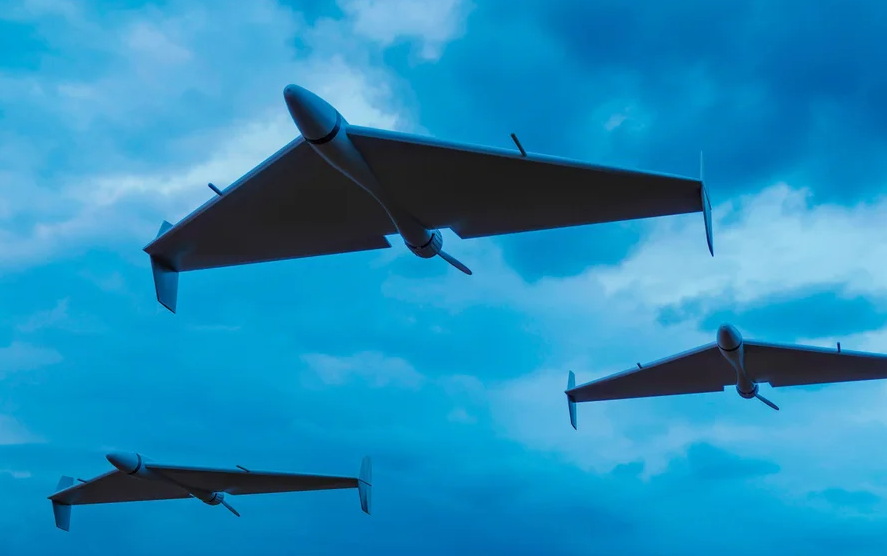
The most consequential part of a reported U.S. intelligence warning over possible Russian drone operations against Mediterranean Europe may not be the drones themselves. It is the possibility of turning ordinary commercial shipping into concealed, mobile launch platforms.
That is the scenario outlined by Antonio Teti, cybersecurity adviser at Italy’s National Cybersecurity Agency (ACN), in an analysis for our website Formiche.net, examining what such a threat could mean for Italy and the wider Mediterranean.
Why it matters: A relatively cheap drone launched from a container aboard a merchant vessel could bring the threat much closer to European territory — while making detection, attribution and response significantly harder.
- Spanish newspaper El Mundo reported that U.S. intelligence had gathered information about a possible Russian escalation targeting Mediterranean countries, particularly Italy, France and Spain, and shared it with European governments. But the Italian government says it has received no confirmation of the alert and is calling for calm and careful handling of information at a particularly sensitive moment for European security, threatened by Russia.
- Teti stresses that an intelligence warning does not mean a final operational order exists or that an attack is imminent. Public information comes from media reports citing anonymous sources, rather than a publicly available CIA document.
Zoom in: Gerbera. The reported drone is the Gerbera, a relatively inexpensive Russian UAV also used to saturate and confuse air defenses.
- But for Teti, the strategically significant element is the logistics. A commercial vessel concealing UAVs and launching equipment could reduce the distance between the drone and its target while continuously changing the potential launch point.
- The merchant ship would effectively shift from being a means of transporting a weapon to becoming, temporarily, an advanced platform for projecting it.
The Italy angle: Geography makes the scenario particularly relevant for Rome.
- Italy’s long Mediterranean coastline puts ports, airports, refineries, energy facilities, logistics hubs, telecommunications infrastructure and military sites along or close to the sea.
- A drone with a range of several hundred kilometers, launched offshore, could therefore theoretically reach a significant portion of Italian territory, Teti argues.
- But the objective would not necessarily be large-scale destruction.
Between the lines: The operative logic could instead be to disrupt. A small UAV entering the airspace around a major airport, for example, could force flight suspensions, diversions, security deployments and emergency procedures even without causing casualties.
- That creates an asymmetric equation: a comparatively inexpensive system could trigger economic, security and psychological costs far greater than the value of the weapon itself.
- Teti places that dynamic within the broader logic of hybrid warfare, where limited tactical actions can generate strategic effects.
Then comes attribution: A drone launched from a merchant vessel could also blur responsibility.
- The ship might be operating in international waters; the container might have crossed several countries; intermediaries, front companies or proxies could be involved; and the crew itself might not necessarily know the full nature of the operation.
- Even recovering the drone’s debris could establish its technological origin without necessarily proving who ordered the operation.
Teti compares the dilemma to the cyber domain. The attack can take minutes, while reaching sufficient certainty over attribution for a political response can take much longer.
- The result, he writes, could resemble a “kinetic cyberattack” — physical effects combined with ambiguity over the perpetrator.
The cognitive layer: The operation might not end when the drone hits. Images of an evacuated airport, social-media videos, competing claims about responsibility and narratives about the state’s inability to protect its territory could become a second phase of the operation.
- In Teti’s formulation, the drone’s real payload could therefore include not only explosives, but fear — with the information ecosystem amplifying the physical event.
What we’re watching: Counter-drone systems around sensitive sites would address only the final stage of such a threat.
- Teti argues that defense would have to begin much earlier, combining preventive intelligence, maritime domain awareness, port controls, container analysis, commercial-route information, radar, signals intelligence, satellite intelligence and UAV identification.
- For Italy, that would also require coordination among the Navy, Air Force, intelligence services, law enforcement, port authorities and the private sector.
The bottom line: The immediate question is not whether Russia will actually launch drones from a merchant ship against Mediterranean Europe — something the publicly available information does not establish.
- The broader question raised by Teti is whether Italy and Europe are prepared for a form of hybrid conflict in which a container, a commercial ship, a low-cost drone and an information campaign can be combined into a single weapon system.