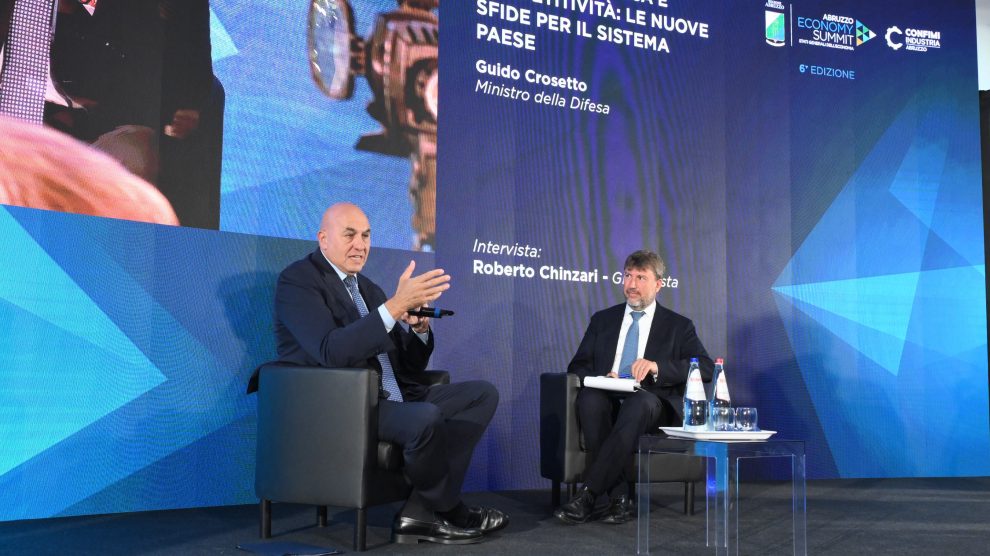
ROME — Italy’s Defense Minister Guido Crosetto linked economic security to the protection of physical and digital flows, arguing that defense must increasingly anticipate threats to the infrastructure, routes and chokepoints underpinning economic growth.
Speaking at the Abruzzo Economy Summit 2026 in Pescara, Crosetto said the traditional separation between economics and security no longer reflects the vulnerabilities facing modern economies.
Why it matters: Crosetto’s remarks frame defense not only around territorial security, but also around protecting the networks that allow goods, raw materials, energy, information and data to move.
- “Security does not produce prosperity and wealth on its own, but it creates the conditions for them to be produced,” Crosetto said.
- Modern economies, he argued, depend on physical and digital flows running through infrastructure, networks, routes and chokepoints — precisely where vulnerabilities tend to concentrate.
- Disruption at those nodes can quickly reach businesses and households, with Crosetto pointing to the Strait of Hormuz and Bab el-Mandeb as clear examples.
The big picture: The remarks reinforce a broader Italian security debate increasingly focused on the Mediterranean and on the connection between maritime security, economic resilience and strategic infrastructure.
- Italy’s security challenge is changing across the Mediterranean as instability and competition increasingly affect the maritime routes and infrastructure on which the country depends.
- The economic dimension is also becoming harder to separate from national security. As Kaush Arha (president of the Free and Open Indo-Pacific Forum) has explored in its analysis of a possible “G4” for economic security, technology, industry, and economic resilience are increasingly part of the same strategic equation.
What we’re watchingg Crosetto said defense must be able to “read scenarios in advance” and protect the conditions for economic growth.
- His message was broader than maritime security alone: tomorrow’s competition, he said, will also be “technological, industrial and economic” — with consequences for “prosperity, democracy and freedom.”
(Photo: X, @MinisteroDifesa)