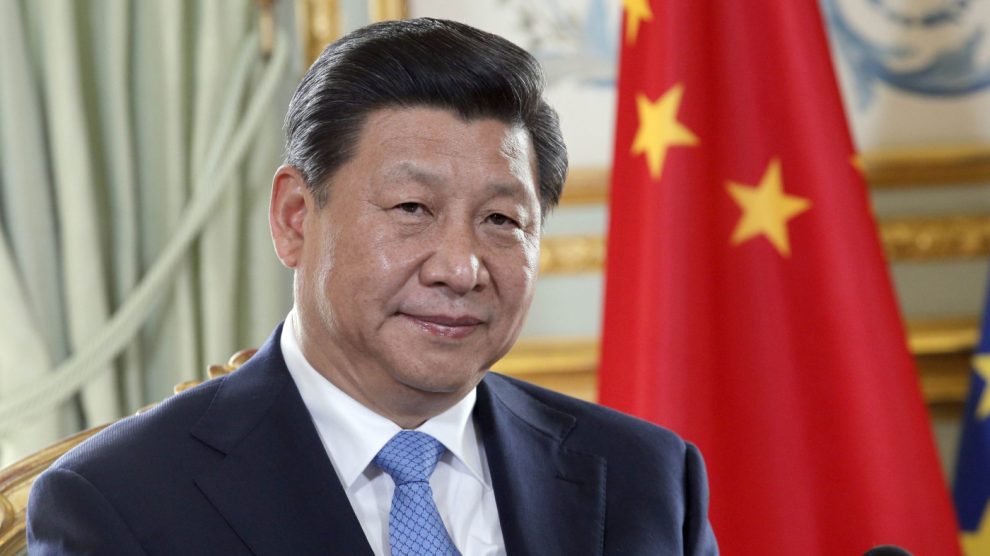
After the AI’s “red phone,” the red carpet awaits Chinese leader Xi Jinping at Joint Base Andrews in Prince George’s County, Maryland, just outside Washington. This location has become both a focal point and a source of controversy for his visit.
The politics of the red carpet. Footage of US servicemen meticulously rolling it out and smoothing away every imperfection has circulated widely on social media. Chinese and anti-western propaganda accounts have seized on images of American military personnel bending over the carpet, presenting them symbolically as US forces bowing before the arrival of Chinese power.
- Critics of Donald Trump have joined in from a different direction, casting the spectacle as a consequence of the president’s transactional approach: a preference for pragmatic deals — particularly economic and commercial ones — over the longer-term strategic dimension of the relationship.
- The choreography may therefore attract almost as much attention as the substance of the visit, whose immediate results may prove less dramatic.
Xi is arriving in the US with the full ceremony of a state visit. There is also uncertainty over whether senior figures from China’s technology giants will take part. That question captures another of the contradictions surrounding the relationship: Washington sees some of these companies as integral to the strategic competition with China and is wary of conferring on their executives an excessively prominent diplomatic role, even as it wants channels of communication with them to remain open.
- The contradiction, however, is only apparent. Indeed, it may provide the best starting point for understanding the summit.
- After years in which tariffs, export controls, technology restrictions and economic-security policies have pushed the US and China towards increasingly explicit confrontation, Washington and Beijing now appear interested not in ending their competition but in establishing its boundaries.
Strategic stability. Tobias Gehrke, Senior Policy Fellow at the European Council on Foreign Relations, describes this as the “strategic stability” proclaimed by Trump and Xi when they met in Beijing earlier this year.
- “The Washington summit likely extends the ‘strategic stability’ proclaimed by both Trump and Xi in Beijing earlier this year,” Gehrke says, calling it “a usefully ambiguous term to help manage the rivalry at the top, while selective decoupling is continuing underneath.”
Managing competition, not resolving it. That distinction also helps make sense of Washington’s red-carpet treatment.
- The trade truce has already been extended, the first significant result surrounding the summit and one that has, for now at least, removed one immediate source of pressure. Yet virtually none of the structural causes of US-China competition has disappeared.
- Washington continues to challenge China’s industrial model, distortions in market access and the technological advance of Chinese companies. Beijing wants greater access to the advanced chips needed to develop artificial intelligence and objects to US restrictions in sectors ranging from automobiles to robotics. Looming over the relationship is China’s control of rare earths, which has become one of Beijing’s most consequential sources of economic leverage.
- The summit, then, appears to be less about resolving the competition than about managing it.
- That raises a second question: what is the balance of leverage as Trump and Xi sit down at the negotiating table?
Politically, there is a clear asymmetry. Trump is looking towards the midterm elections and has little incentive to trigger another round of trade confrontation that could carry economic costs at home. Xi faces no comparable electoral constraint and is preparing to consolidate his position at the top of the Chinese Communist party, with its five-yearly congress due next year.
- Yet reducing the balance of power to their respective political calendars would miss a more important development. The past few years have exposed the limits of Washington’s ability to increase economic pressure unilaterally without incurring significant costs of its own.
- “Behind the red carpet and glitzy photographs lies a more sobering reality for the Trump administration,” Gehrke says. “When Washington escalated tariffs in 2025, Beijing’s rare-earth restrictions forced the White House to back down and seek accommodation. Beijing showed that it can set a ceiling on Trump’s escalation.”
The limits of economic coercion. This is one of the most important legacies of the latest phase of US-China competition.
- The US retains formidable instruments of economic power: the scale of its domestic market, the centrality of its financial system and its dominant position in critical segments of the technological frontier. But Beijing has meanwhile consolidated choke points of its own, particularly across critical-mineral supply chains.
- The result increasingly resembles a form of mutual economic deterrence. The two sides’ capabilities are not symmetrical. But each now possesses sufficient instruments to make escalation costly for the other.
- Eight years of trade conflict provide a basis for assessing the strategy’s achievements: “After eight years of trade war, China’s economic fundamentals remain intact,” Gehrke says. “Tariffs have changed the routes Chinese goods take to America, but China’s industrial model and trade surplus keep on growing.”
That does not mean US pressure has been inconsequential. Supply chains have changed, some trade flows have been redirected through third countries, and Washington has progressively restricted Chinese access to technologies it regards as particularly sensitive.
- But the strategy has not dismantled China’s industrial model, nor has it prevented Beijing from becoming an increasingly credible technological competitor.
Artificial intelligence provides one measure of that ambition. According to estimates cited by The New York Times, Chinese state-led funds invested more than $184bn in AI companies between 2000 and 2023, while the government and state-owned banks have subsequently pledged hundreds of billions more.
- That effort carries domestic costs, particularly for an economy struggling with weak consumption and employment pressures. But it also demonstrates how deeply technological competition has become embedded in China’s economic strategy.
- The Washington red carpet does not interrupt that competition. It may instead be part of what allows it to continue without letting it spiral out of control.
Taiwan and the politics of linkage. There is, however, one issue on which this architecture remains particularly fragile: Taiwan.
- Xi is expected to press Trump to continue delaying a proposed $14bn package of US arms sales to the island. Trump has already described the package as a “very good negotiating chip” — and the wording matters.
- It is particularly significant because Washington simultaneously wants Beijing to exert greater pressure on Iran to help secure the reopening of the Strait of Hormuz.
This points to an important characteristic of the Trump-Xi relationship: the linkage between dossiers that might otherwise be treated separately.
- Trade, technology, Taiwan, rare earths, agriculture and Iran can all become components of a broader negotiation conducted directly at leader level. That can create room for compromise, but it also introduces unpredictability. Leverage deployed in one area can be used to seek concessions in another.
The uncomfortable view from Europe. It is precisely this exchange of leverage that makes the Washington summit particularly relevant for Europe.
- While Washington and Beijing have spent years identifying, building and testing each other’s economic vulnerabilities, the European Union is entering its own season of decisions on China from a more difficult position.
- “Europeans may watch this summit with some dismay,” Gehrke says, as the EU enters “its own autumn of China decisions with an even weaker hand. A wide-open market, deepening dependencies, fragmented alliances and little willingness to use leverage.”
The lesson is not necessarily that Europe should imitate Trump. Eight years of trade conflict have also demonstrated the limitations of a strategy built primarily around tariffs.
- Instead, Gehrke argues that European policymakers should pay closer attention to Beijing’s approach.
- “Rather than copy the Trump playbook, European leaders should look at Beijing’s,” he says. “Where China closes and distorts markets, invokes security, and favours domestic firms, Europe should radically enforce reciprocity at home, not plead for change in Beijing.”
- It is here that the Washington summit acquires significance beyond whatever immediate agreements Trump and Xi may reach.
The big picture: Economic interdependence has not prevented strategic rivalry between the US and China. It has itself become one of the arenas in which that rivalry is conducted: vulnerabilities to be reduced, dependencies to be exploited and leverage to be accumulated.
- Trump and Xi may therefore leave Washington without sweeping agreements. That would not make the summit inconsequential. Its most important result may instead be a necessarily provisional understanding of how much competition both sides believe the relationship can sustain — and where each has learnt that escalation needs to stop.
The bottom line: From this perspective, “strategic stability” is not the opposite of strategic competition. Increasingly, it is one of the mechanisms through which that competition is managed.
- For Europe, the conclusion is more uncomfortable. As Gehrke puts it: “without collective leverage, any talks with China will fall flat.”