“The CNR’s White Paper on the Arctic is an excellent initiative and will provide a good starting point for the second Conference that Undersecretary of Defence Senator Isabella Rauti will hold on October 29. On that occasion, the geopolitical dimension will be central: namely, analysing the polar environments as a whole and, therefore, putting down in writing a broader and more unified strategy for these environments.”
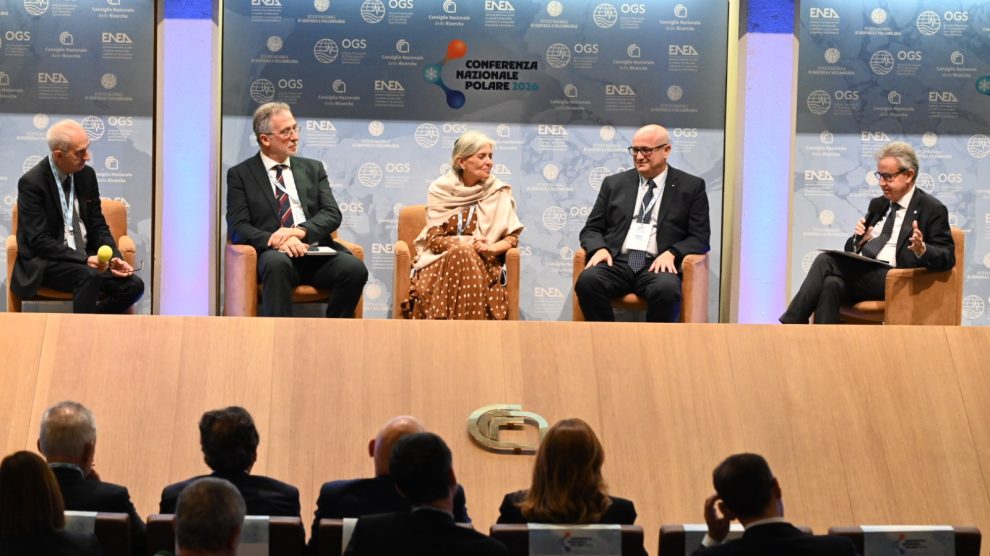
This is what General Carlo Di Somma, Chairman of the Joint Steering Committee for the Arctic, Sub-Arctic and Antarctic Environments, told Decode39 on the sidelines of the National Polar Conference, conceived and coordinated by the CNR in collaboration with ENEA, INGV and OGS. A three-day event of analysis and reflection, illustrating how Italy is fully aware of the extent to which this region of the world represents a strategic area in global balances, and how government action is intertwined with the best practices of the stakeholders involved.
Q: The Arctic, new routes, science: how do these three elements intersect with Italy’s geopolitical objectives?
A: Italy has always been present in the region, beginning with the early explorations of the late nineteenth century by the Duke of the Abruzzi, and later with Umberto Nobile and his two missions: the Norge and the Italia airships. It was an important initiative in which all the armed forces participated alongside the scientific research community.
- We have therefore maintained a constant presence in those regions and carry out observation and research activities that are strategic for defence. Knowledge means being able to plan. Therefore, even at a time when there were no geostrategic tensions, Italy was able to maintain its awareness, knowledge and the preparedness of its armed forces to operate in those regions.
Q: Prime Minister Giorgia Meloni has repeatedly stressed that the issue must be addressed within NATO. So how should we proceed today, when attention and geostrategic tensions are increasing?
A: We feel that we need to focus even more attention on this scenario, always in cooperation with our European partners and NATO. The Italian armed forces participate in all deterrence operations and, together with the wider community and the relevant ministries, seek to maintain a significant presence.
- As you rightly pointed out, routes have become a primary issue following the retreat of the ice. Clearly, therefore, the balance will change compared with the past, and for us it is important to understand what will happen so that we can organise ourselves and plan our possible interventions as effectively as possible.
Q: Critical raw materials and cybersecurity: what are we doing, and above all, what more could we do in the Arctic?
A: These are central issues, together with the other domain, the cognitive one, because they go hand in hand, and the current geostrategic competition in that environment makes these two domains particularly central. At those latitudes, one can sense the background noise of things happening in the shadows, such as attacks on underwater infrastructure: these make it necessary for us to organise ourselves as effectively as possible to address this type of threat.
- I would point out that Italian defence, with the initiative of the National Underwater Hub, is very advanced in this respect, and from this perspective we are trying to close the technological gap that currently makes it difficult for us to intervene promptly and provide deterrence to defend critical underwater infrastructure.
- The Minister of Defence, Guido Crosetto, announced this in the dedicated draft law: we are trying to establish governance structures that will help us become even more effective at the joint-service and interministerial levels, because in those environments, with highly complex scenarios, nothing can be done alone: either we cooperate with the entire national system or we cannot manage this type of threat.
Q: How will the White Paper on the Arctic presented by the CNR fit into the government’s action?
A: The White Paper is an operational document that will implement Italy’s national Arctic policy, which was presented last January by Ministers Crosetto, Tajani and Bernini, expanding it to include the section dedicated to Antarctica and the so-called Third Pole, with an even broader vision.
- There is a strongly held belief, which we also share, in the need to view this complexity as a whole, even though the geostrategic situations are very different. However, in terms of climate, security, international cooperation, and scientific and technological research, these three environments are all closely interconnected.
- Therefore, the CNR’s White Paper is an excellent initiative and will provide a good starting point for the second Conference that Undersecretary of Defence Senator Isabella Rauti will hold on October 29. On that occasion, the geopolitical dimension will be central: namely, analysing the polar environments as a whole and, therefore, putting down in writing a broader and more unified strategy for these environments.