
As Ukraine braces for what may be its harshest winter since the full-scale invasion, ECFR’s Jana Kobzova sets out what EU leaders should secure in Brussels: cheaper air defence, a plan for the Black Sea and fresh momentum on accession.
The move: In light of European Council, Jana Kobzova, senior policy fellow at the European Council on Foreign Relations, paints a familiar but heavy picture. Russian strikes keep hitting Ukraine’s energy grid and economy, air defences are running short, and contacts between the Trump administration and Moscow cast a shadow over everything.
- In this context, Europe remains Kyiv’s “strongest and indispensable partner,” she argues. It has already funded winter preparations and will cover Ukraine’s most urgent year-end financial needs, provided the Ukrainian government approves the agreed reforms this week.
- The condition is not incidental: the draft summit conclusions stress those reforms, on which billions in 2026 aid depend. Leaders will also hold an exchange with President Volodymyr Zelensky.
Why it matters: On ballistic missiles, Kobzova has no illusions: there is no quick fix. But Russia’s jet-powered drones are a more manageable threat. Countering them requires:
- short- and medium-range interceptor systems that Europeans can supply;
- new investment in Ukraine’s own defence industry;
- smarter use of scarce assets, since a Patriot fired at a drone is one interceptor fewer when an Iskander arrives.
The Black Sea front: Kobzova argues the Black Sea should top the agenda. Most of Ukraine’s exports transit through it, and with routes closed, Kyiv risks losing its capacity to finance itself in 2026. A prolonged blockade, she warns, would drag down other sectors of the economy as well.
The bigger picture: The stakes extend well beyond the region. If Ukrainian grain stays in port and Russia cannot ship fertilizers and cereals, global food markets pay the price, at a moment when they are already strained by the closure of Hormuz and the arrival of a super El Niño.
- Here Europe holds a diplomatic card: working with Global South countries on an arrangement modelled on the 2022 grain deal brokered by Turkey and the United Nations.
Political fault lines: The most delicate front is political, as the spectre of a Washington-Moscow understanding reached over the heads of Ukrainians and Europeans returns. One step forward came with the opening of accession negotiating clusters 2 and 3, previously blocked by Budapest.
- Hungary lifted its veto after Kyiv amended its law on education in minority languages. European Council President António Costa now aims to open the remaining clusters by December.
What it signals: Europe, Kobzova writes, “can and must keep the lights on for Ukraine”. Its leverage is increasingly conditional, tying money to reforms, but its strategic message is unambiguous.
- For Ukrainians, the accession track confirms that their future lies in the EU, however dark the present moment.
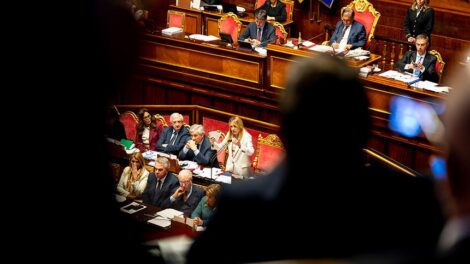
The Italian angle: Speaking before the Italian Senate on Wednesday, ahead of the October 15–16 European Council, Prime Minister Giorgia Meloni reaffirmed Italy’s commitment to supporting Kyiv, maintaining pressure on Moscow and preserving transatlantic unity. She also warned that Russia is increasingly targeting civilian infrastructure and exploiting Ukraine’s energy vulnerabilities, echoing Kobzova’s concerns over the coming winter.
- Meloni’s main political message concerned European diplomatic coordination. She questioned whether the E3 format — France, Germany and the United Kingdom — should pursue negotiations on Ukraine without a broader European mandate.
- Rome’s position is that any restricted diplomatic format must represent a shared European stance, rather than the priorities of individual powers. As the prospect of a Washington-Moscow understanding raises concerns about Europe being sidelined, Italy is also insisting that European partners should not be excluded from decisions taken in their name.