

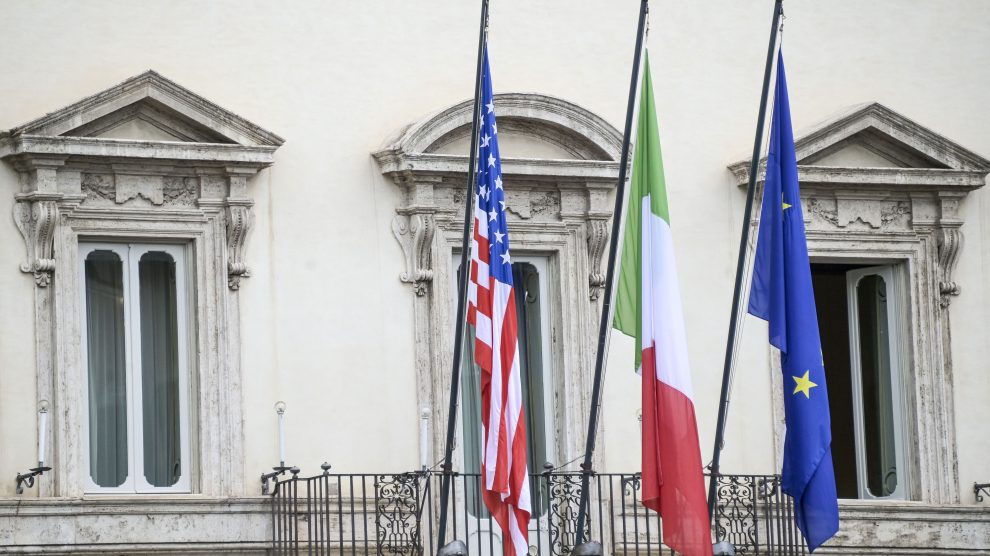
The initiative takes center stage at the third US-Italy Dialogue on Trusted Technologies for Democracies, held in Washington on October 15–16, bringing together senior officials from both governments, technology companies, financial institutions and research organizations.
The big picture: The US-Italy Trusted Tech Accelerator aims to turn growing diplomatic alignment into concrete industrial partnerships, connecting the two countries’ innovation ecosystems and facilitating technology transfer, investment and commercialization.
- Supported by the Krach Institute for Tech Diplomacy at Purdue University, the initiative seeks to establish partnerships between American and Italian industrial and research networks.
- Its broader objective is to mobilize capital and strengthen cooperation across strategic sectors, including artificial intelligence, quantum technologies, robotics, cybersecurity and advanced computing.
- The accelerator also provides a potential framework for connecting specialized Italian technological capabilities with American financing, industrial scale and market access.
Why it matters: Trusted technologies are becoming a central pillar of the relationship between Rome and Washington, reflecting a broader convergence between economic security, industrial policy and national security.
- The initiative builds on the diplomatic work of Italy’s Ambassador to the United States, Marco Peronaci, whose embassy has been strengthening bilateral connections around technological innovation, strategic industries and economic security.
- A central figure in this effort is Roberto Baldoni, Senior Advisor for Technology and Innovation at the Italian Embassy, who has helped drive the dialogue from both a technical and policy perspective.
- The accelerator is designed to develop partnerships connecting capital, industry, research centers and startups in Italy and the United States.
Catch up quick: The Washington dialogue follows a series of developments that have progressively placed technological security at the center of US-Italy relations.
- Italy’s accession to the Pax Silica Declaration reinforced Rome’s participation in the US-led effort to build trusted technology value chains, spanning semiconductors, artificial intelligence and critical minerals.
- A subsequent bilateral agreement on critical minerals added an industrial dimension to this strategic alignment.
- The broader US-Italy relationship has increasingly connected political cooperation under President Donald Trump and Prime Minister Giorgia Meloni with economic and technological priorities.
- The Washington initiative adds an operational layer to this process, moving beyond shared strategic objectives toward mechanisms designed to generate industrial cooperation.
Who’s involved: The participation of senior US administration officials underscores how technological cooperation now cuts across diplomacy, defense, energy and industrial policy.
- Jacob Helberg, Under Secretary of State for Economic Affairs and a key architect of Pax Silica, joins Ambassador Peronaci for a discussion on building a trusted technology ecosystem.
- Joseph Jewell, Assistant Secretary of War for Science and Technology, brings the defense innovation dimension.
- The Department of Energy is represented by William Schirano, Deputy Assistant Secretary for Multilateral Engagement and Market Development, and Hal Finkel, Associate Director for Advanced Scientific Computing Research.
- Officials from the State and Commerce Departments, including Nicole Johnson, Brad McKinney and David Fogel, further highlight the administration’s engagement.
On the Italian side, participants include Giorgio Mulè, Vice President of the Chamber of Deputies, and Alessio Butti, Undersecretary to the Presidency of the Council of Ministers for Technological Innovation, who contributes through a video address.
- Lombardy President Attilio Fontana and Lazio President Francesco Rocca also participate, alongside representatives of the Ministry of University and Research and the Ministry of Enterprises and Made in Italy.
- Their involvement reflects the importance of connecting regional innovation ecosystems with American industrial and research networks.
Zoom in — The quantum opportunity: Quantum technologies represent a particularly interesting area for deeper bilateral cooperation, given Italy’s established scientific capabilities and the potential complementarity with the American innovation ecosystem.
- Italy’s expertise in quantum physics, photonics, sensing, and secure communications stems from universities, research institutions, and national programs.
- Its 2025 National Quantum Technologies Strategy aims to strengthen the link between scientific research, technology transfer, and industrial development.
- These capabilities complement the US strengths in financing, technological infrastructure, and commercialization, especially in quantum-enabling components, materials, measurement systems, and specialized applications.
The catch: Scientific excellence does not automatically translate into industrial competitiveness.
- Italy’s challenge is to scale promising technologies and connect research capabilities with companies and investment networks capable of bringing them to market.
- The accelerator could help address that gap by creating structured connections between Italian research and industrial expertise and American capital, development capabilities and commercial opportunities.
- Quantum cooperation would therefore be less about competing for technological leadership across the entire value chain and more about identifying areas of specialization where the two ecosystems can generate mutual value.
Follow the money: The dialogue also explores the creation of a Transatlantic Investment Facility designed to mobilize private capital with public support.
- The proposed financing structure envisages 20% public participation, equally divided between Italy and the United States, with the remaining 80% coming from private industrial and financial investors.
- The involvement of financial institutions including SACE, Cassa Depositi e Prestiti, Intesa Sanpaolo and the Export-Import Bank of the United States reflects the ambition to connect technological cooperation with investment instruments.
- The broader framework aims to facilitate partnerships across artificial intelligence, physical AI, robotics, quantum computing, high-performance computing, cybersecurity and life sciences, with energy serving as a critical enabling infrastructure.
Between the lines: The initiative reflects a broader shift in how advanced economies approach technological sovereignty. Access to strategic technologies increasingly depends not only on domestic innovation but also on trusted international networks connecting supply chains, research institutions, capital and industrial capabilities.
- This is the logic of trusted interdependence: strengthening national technological resilience through cooperation among reliable partners rather than pursuing complete technological self-sufficiency.
- For Italy, the opportunity lies in connecting its manufacturing base, specialized technological expertise and scientific research to American investment and innovation networks.
- For Washington, cooperation with Italy offers access to a major European industrial economy and specialized capabilities that can contribute to more resilient technology supply chains.
What to watch: The accelerator’s significance will ultimately depend on whether diplomatic convergence produces sustainable industrial partnerships.
- The immediate challenge is to identify projects that can attract investment, generate technology transfer and develop into commercially viable initiatives.
- As Rome and Washington deepen cooperation under Pax Silica, the launch of the US-Italy Trusted Tech Accelerator signals how trusted technologies are becoming both a strategic pillar of the bilateral relationship and a practical instrument of transatlantic industrial cooperation.