
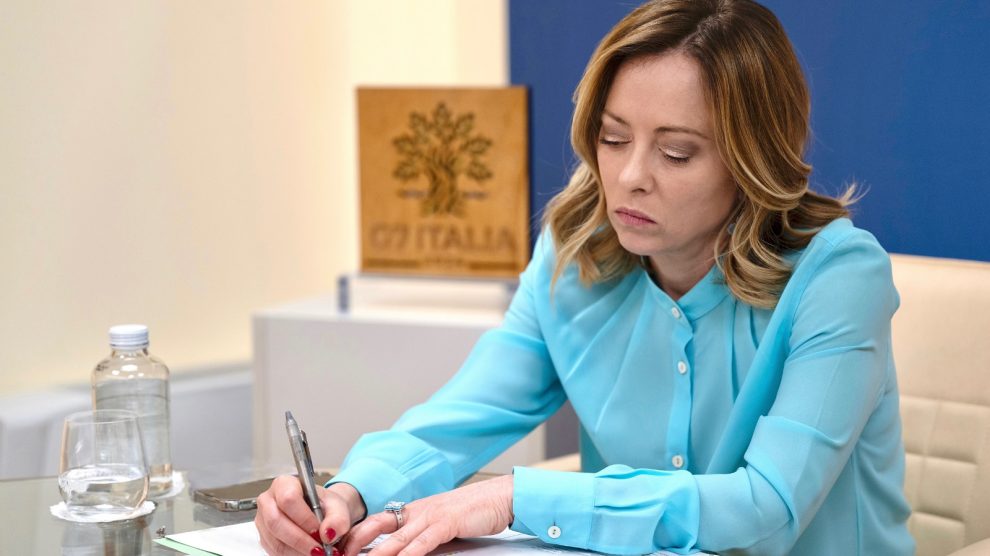
Italian Prime Minister Giorgia Meloni is visiting Kuwait on Friday, October 23, completing a diplomatic milestone: she will become the first Italian head of government to visit all six Gulf Cooperation Council (GCC) countries during a single term in office.
What’s happening: The trip marks Meloni’s 13th visit to a Gulf country since taking office, reflecting Rome’s growing engagement with a region central to global energy markets, maritime security and international trade.
- In Kuwait City, Meloni is scheduled to meet Emir Sheikh Mishaal Al-Ahmad Al-Jaber Al-Sabah, alongside Crown Prince Sheikh Sabah Al-Khalid Al-Sabah and Prime Minister Sheikh Ahmad Al-Abdullah Al-Ahmad Al-Sabah.
- The visit follows a longstanding invitation from the Emir and builds on Italy’s participation in the GCC summit in Manama in December 2025.
Why it matters: Italy is increasingly treating the Gulf as a strategic partner in strengthening economic resilience, securing energy supplies and developing alternative trade routes.
- Kuwait occupies a distinctive position in this approach, combining substantial investment capacity with longstanding political and security ties to Rome.
The economic dimension: The two countries aim to expand investment flows in both directions through an agreement between the Italian Trade Agency (ICE) and the Kuwait Direct Investment Promotion Authority.
- Kuwaiti investments in Italy already span tourism, real estate, advanced technologies and energy. One of the most visible examples is Q8, whose Italian operations include approximately 3,000 fuel distribution outlets, alongside investments in refining and biofuel production, including partnerships with Eni.
- The discussions will focus on critical infrastructure resilience, supply-chain diversification and the development of regional and intercontinental connectivity corridors.
The security dimension: Defense cooperation remains a central pillar of bilateral relations, rooted in Italy’s participation in the international coalition that liberated Kuwait following Iraq’s 1990 invasion.
- A bilateral defense cooperation agreement entered into force on October 12, providing a renewed framework for military ties.
- Rome and Kuwait also plan to formalize a memorandum of understanding between Italy’s Carabinieri and the Kuwaiti National Guard.
The bigger picture: Kuwait’s relevance to Italy extends beyond bilateral trade and investment. Its position in the northern Gulf, proximity to Iraq and Iran, and exposure to disruptions affecting regional energy and maritime networks make it an important partner in Rome’s wider Gulf strategy.
- For Italy, closer relations with Kuwait also fit into an effort to connect energy security with infrastructure resilience and the diversification of commercial routes.
- The underlying calculation is that investments, industrial cooperation and security partnerships can help reduce vulnerabilities shared by European and Gulf economies.
Between the lines: Kuwait has already provided a practical example of how Italy’s Gulf diplomacy can translate into domestic economic benefits.
- As Decode39 reported in September, Q8 joined an Italian fuel-price containment initiative alongside Eni and IP, illustrating how established energy relationships can support Rome’s response to economic pressures.
- Former Italian ambassador Gabriele Checchia interpreted Kuwait’s participation as evidence that sustained diplomatic engagement with Gulf partners is beginning to deliver tangible results.
- The Kuwait visit now offers an opportunity to extend that approach from energy-price management to longer-term investments, infrastructure and strategic connectivity.
What’s next: The visit will see the adoption of a 2027–2030 bilateral Action Plan, establishing priorities for cooperation over the coming years.
- Regional diplomacy will also feature prominently, with discussions expected to cover Iran, Yemen, freedom of navigation, EU-GCC relations, the Israeli-Palestinian conflict and Lebanon.
The bottom line: The broader significance of Meloni’s Gulf outreach lies in its continuity. Rome is seeking to turn sustained diplomatic engagement into long-term economic and security partnerships across all six GCC countries.