
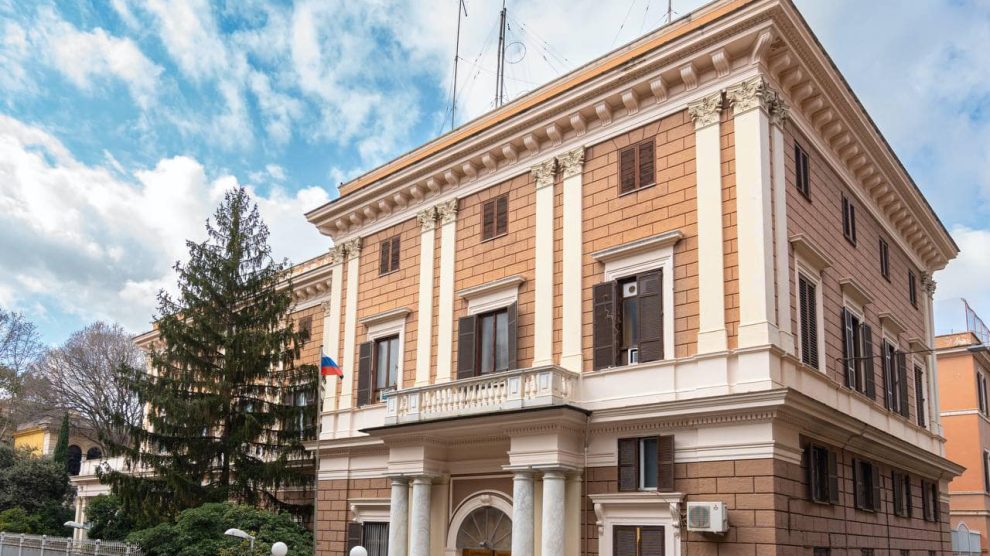
Russia’s Ambassador to Rome, Alexey Paramonov, has formally offered the assistance of Russian authorities to help Italian law enforcement identify the perpetrators behind the November 11 mass email bomb threats targeting thousands of schools across Italy.
Delivered via the Embassy’s official social media channels, the gesture appears designed less as a viable intelligence offer and more as a strategic cognitive operation aimed at shaping public perception.
The big picture: Empathy as a geopolitical lever. In his statement, Paramonov expressed solidarity with Italian families, students, and teachers, invoking the trauma of the 2004 Beslan school siege to establish emotional resonance and project Moscow as a committed partner in global counter-terrorism.
- The diplomatic pitch: The Russian Embassy emphasized that protecting civilians — particularly children — is a core priority of Moscow’s foreign policy, stating that Russian agencies stand ready to provide “necessary assistance” to their Italian counterparts.
- Emotional framing: By referencing Italian memorials dedicated to the 334 victims of the Beslan tragedy and existing municipal ties between Beslan and Italian towns, the message seeks to bypass institutional skepticism against Russia linked to the aggression of Ukraine, and appeal directly to Italian civil society.
What they’re saying:
“Relevant Russian authorities are ready to provide Italian colleagues with the necessary assistance to identify the individuals involved in sending the threats. Our country knows from bitter experience the tragic consequences that attacks against schools can lead to,” said Paramonov.
Between the lines: The paradox of the offer. Paramonov’s outreach unfolds against a stark geopolitical contradiction. For Rome and the broader European Union, Russia is widely assessed as the primary state actor driving the sustained wave of hybrid pressure — spanning cyberattacks, disinformation campaigns, and infrastructure disruption — that has targeted European democracies for years and intensified markedly in recent months, weeks – and years.
- Cognitive reframing: Offering investigative aid in a domestic security crisis allows Moscow to project a constructive, humanitarian posture while softening institutional mistrust around the broader landscape of hybrid destabilization.
- Strategic ambiguity: By entering the public conversation surrounding the school hoaxes — which featured a Russian-sounding alias (“Mikhail Andropov”) alongside a foreign domain — the gesture introduces diplomatic noise and complicates public perceptions around attribution during a sensitive moment.
- Narrative positioning: Stepping directly into a high-profile domestic debate enables the Embassy to actively shape the surrounding narrative and influence public sentiment amid heightened civic concern.
Why it matters: As Italian and European leadership coordinate joint responses to daily hybrid interference, Moscow’s diplomatic maneuver illustrates how cognitive warfare operates in real time—using humanitarian solidarity and historical memory to blur accountability and test institutional cohesion across Europe.