
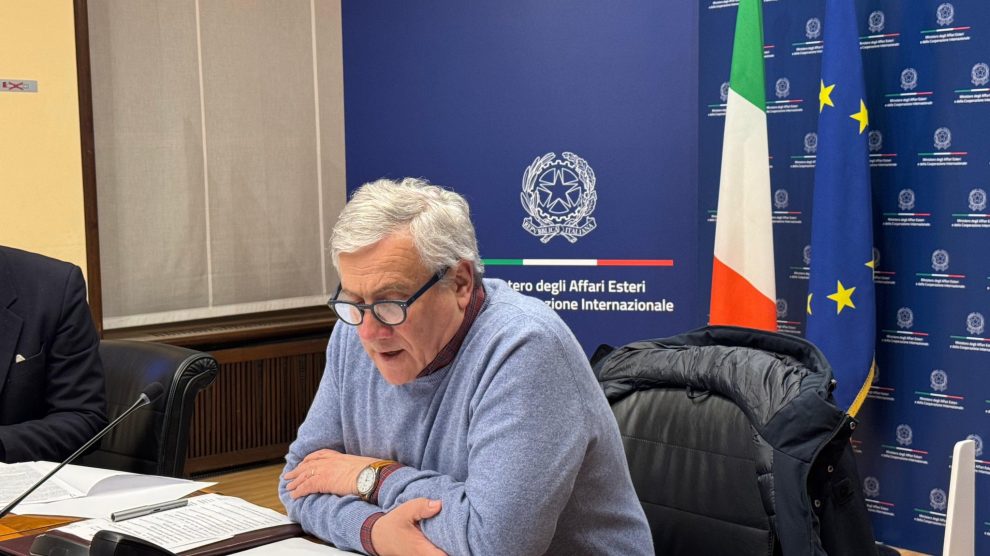
Late Tuesday (Italian time), G7 foreign ministers held a conference call focused on Venezuela and Ukraine.
Rome’s POV: Italy was represented by Deputy PM and Foreign Minister Antonio Tajani.
- Tajani emphasised the importance of a peaceful transition in Venezuela and the protection of the large Italian community in the country.
What Tajani said: “During the meeting, I insisted on the importance of freeing our fellow citizens detained in Venezuelan prisons, starting with Alberto Trentini, Mario Burlò, Luigi Gasperin and Biagio Pilieri.”
- “In line with the Pope’s message, Italy considers the needs of the civilian population the primary objective.”
- Rome is ready to support humanitarian initiatives and “do whatever is necessary to achieve a peaceful transition.”
From Washington: U.S. Secretary of State Marco Rubio reiterated support for the release of political prisoners.
- “Rubio welcomed our positions,” Tajani said.
- “For Italy, without stabilisation there can be neither growth nor transition.”
Between the lines: The G7 call came as talks were wrapping up in Paris at the Élysée Palace among the so-called “Coalition of the Willing.”
- Around 30 Western leaders attended, along with two U.S. envoys, Steve Witkoff and Jared Kushner.
- Italy’s Prime Minister Giorgia Meloni took part in the meeting.
- According to Palazzo Chigi, discussions were “constructive and concrete,” confirming a high level of convergence among Ukraine, the U.S., Europe and other partners on negotiations toward a just and lasting peace.
Zoom in: Our Hemisphere. According to Beniamino Irdi (Atlantic Council), U.S. action in Venezuela represents a first, concrete application of what he defines as the “Trump corollary” to the Monroe Doctrine, consistent with the new U.S. National Security Strategy.
- The core driver is security: rolling back Russian and Chinese penetration in the Western Hemisphere.
- Energy matters, but Venezuela’s degraded production capacity and a saturated heavy-crude market make oil an insufficient explanation on its own.
- The broader signal: in Washington’s “home neighbourhood,” alignment matters — even at the cost of forcibly removing hostile outposts.
Zoom out: The message for Europe. In an op-ed on our sister website, Formiche, former Ambassador Giovanni Castellaneta analyses Venezuela as part of a broader warning for Europe.
- The international system is moving away from rules and toward power and deterrence.
- Europe risks strategic marginalisation unless it develops a credible, autonomous deterrence capacity.
- President Trump’s activism — from Caracas to potential moves in the Arctic — could strain transatlantic cohesion if not carefully managed.
- Italy, Castellaneta argues, can play a stabilising role thanks to its pragmatic posture and its deep historical and political ties to the U.S.
What we’re watching:
- Whether the new power structure in Venezuela proves stable — and how tightly it aligns with Washington.
- How the internal U.S. debate evolves between interventionists and the more isolationist MAGA wing.
- Whether Europe responds with strategic cohesion — or remains stuck defending norms without power to enforce them.
(Photo: X, @antonio_tajani)