Iran‑linked militias and organisations across the Middle East — and beyond — are increasingly on edge. U.S. military manoeuvres and mounting European pressure on Tehran are doing little to reassure. A U.S. strike remains a plausible option — one in which, as Emanuele Ottolenghi has noted, other allies could also end up indirectly involved.
The channel. A potential diplomatic channel does exist, suggests Laurence Norman, a Wall Street Journal journalist and long‑time Iran watcher, and it runs through Turkey.
- Iran’s foreign minister is currently in Ankara. At the same time, Turkish President Recep Tayyip Erdoğan has held phone talks with his Iranian counterpart, Massoud Pezeshkian, to facilitate a three‑way conversation — for now by phone — that could eventually include Donald Trump.
- According to Iran’s foreign ministry, the message conveyed in Turkey is twofold. Tehran signals openness to talks, but only on conditions it has consistently upheld: no negotiations under threat, no externally dictated outcomes, and what Iranian officials describe as “dignified” talks — shorthand for preserving the Islamic Republic’s core red lines.
- At the same time, discussions with mediators are ongoing on the scope, format, and potential venue of any future engagement.
Peace dealer or regime change? Trump, who has a personal relationship with Erdoğan and places great value on his image as a global peace broker, may be open to such an exchange.
- The central question, however, remains unresolved: how much real power does Pezeshkian actually wield within a theocratic system undergoing an extreme stress test, following fresh protests crushed violently by a regime that perceives its own survival to be at stake?
- The domestic dimension is crucial. According to U.S. sources cited by Reuters, the White House has discussed the possibility of creating conditions for “regime change” after a crackdown that crushed a nationwide protest movement, killing thousands.
- In this context, can Pezeshkian genuinely serve as a gateway into Iran’s power structure, or is he ultimately marginal to the regime’s hard core? The alternative path — increasingly discussed in Western and Israeli debates — would be direct strikes on Iran’s military infrastructure to weaken the regime.
- Tehran’s response has been unequivocal. A political adviser to the Supreme Leader publicly warned that the notion of a “limited strike” is an illusion: any U.S. military action would be regarded as the start of an all‑out war, triggering an immediate and unprecedented response, including strikes against Tel Aviv and against all those supporting the aggressor.
- If this scenario poses an existential threat to the Islamic Republic, it is even more destabilising for the organisations operating within its orbit.
The role of Iran’s proxies. The most delicate case remains Lebanon. Hezbollah is paying a steep price for an ongoing disarmament process that risks translating into political collapse, as Middle East analyst Zvi Bar’el has written in Haaretz.
- Some Lebanese parliamentarians linked to the organisation have already publicly signalled their readiness to retaliate should Iran be attacked: Israel would be the primary target. Still, U.S. bases across the region could also be drawn into the line of fire.
- Assessments by the Alma Research and Education Centre add a further layer of complexity. Despite heavy damage and leadership losses, Hezbollah is recovering at a significant pace.
- It is still believed to possess up to 25,000 rockets and missiles, a high daily launch capacity, a growing drone arsenal, and tens of thousands of fighters. The Radwan Unit, though degraded, is being rebuilt.
- In other words, Hezbollah remains capable of joining a broader regional confrontation, should Tehran make that strategic decision.
- In Iraq, the tone is even more explicit. Kataib Hezbollah and Harakat al‑Nujaba’a are treating a potential U.S. strike on Iran as a certainty rather than a contingency, openly calling on volunteers to join their ranks in defence of the Islamic Republic and organising recruitment networks across multiple Iraqi cities.
- The Critical Threats project at the American Enterprise Institute confirms that several members of the Axis of Resistance — including Hezbollah, the Houthis, and Iran‑backed Iraqi militias — have threatened retaliation if the United States attacks Iran.
- These actors are closely watching debates in Western and Israeli media about the costs and risks of a prolonged Middle Eastern conflict and appear eager to exploit any hesitation by signalling their willingness to expand the battlefield.
Focus: the Houthis. It is in the maritime domain that this convergence becomes most tangible. As the shipping industry cautiously weighs a return to the Suez Canal after two years of Red Sea diversions, and while EU and India are pushing for new geoeconomic relations, as Valbona Zeneli analyses, the combination of renewed Houthi threats and an expanding U.S. military presence risks shattering fragile hopes of stabilisation.
- Martin Kelly of EOS Risk Group explains on gCaptain how that the Houthi propaganda machine has been reactivated, with the release of “chilling” footage showing attacks in the Red Sea and the Gulf of Aden, accompanied by a single word: “soon.”
- Pro‑Houthi figures have explicitly declared solidarity with Iran in the event of U.S. or Israeli strikes. At the same time, the group’s spokesman reiterated Yemen’s readiness to stand alongside any Arab or Islamic country targeted.
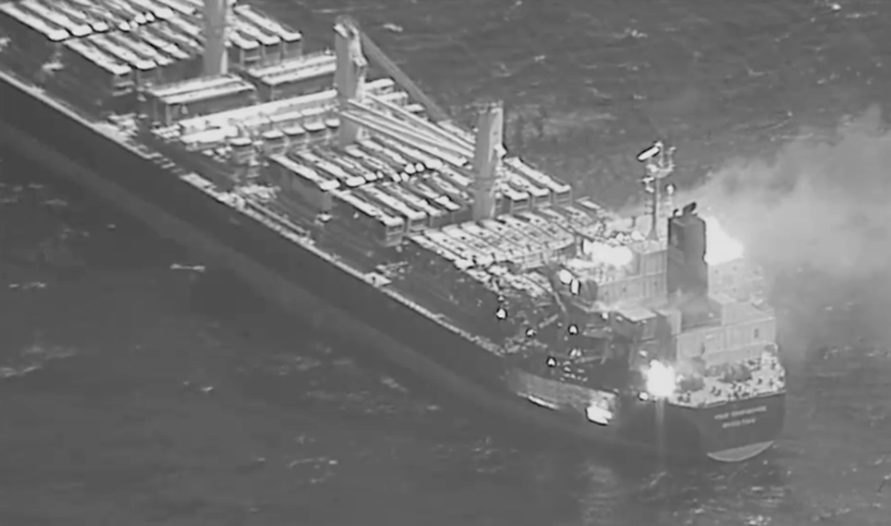
- The context could hardly be worse. The January 2024 missile strike on the tanker Marlin Luanda — hit in the Gulf of Aden and saved only thanks to the intervention of U.S., French, and Indian naval forces — remains a turning point in the Red Sea crisis.
- Since November 2023, more than one hundred merchant vessels have been targeted: some sunk, others seized, with casualties among seafarers. Even the October 2025 Gaza ceasefire failed to restore lasting normality.
- Today, the revival of Houthi threats coincides with a visible U.S. military buildup: carrier strike groups, destroyers, fighter jets, and air-defence systems deployed under U.S. Central Command. Trump has openly spoken of an “armada” heading toward Iran, while expressing hope he will not have to use it.
- The economic fallout is already visible. Maersk attempted an initial return to the Suez Canal, while CMA CGM abruptly reversed course, rerouting some of its major services back around the Cape of Good Hope.
- Such contradictory decisions risk further eroding confidence among operators, precisely when supply chains are most in need of predictability.
Indo‑Med under strain. Completing the picture is a broader strategic signal. According to Iranian sources, Tehran’s navy is preparing to hold drills with China and Russia in the Sea of Oman and the Indian Ocean. It is a reminder that the Indo‑Mediterranean theatre is no longer compartmentalised.
- Maritime pressure in the Red Sea, proxy mobilisation across the region, Iran’s internal instability, and great‑power involvement are converging into a single escalation dynamic.
- The bottom line: Some members of the Axis of Resistance still face domestic constraints that may limit their freedom of action. But overall, the signal is clear: Iran’s network is bracing for impact.
- Whether the next move is diplomatic or military — or a combination of both — the system is already behaving as if a critical threshold has been crossed, and as if stepping back once it is breached will be exceedingly difficult.