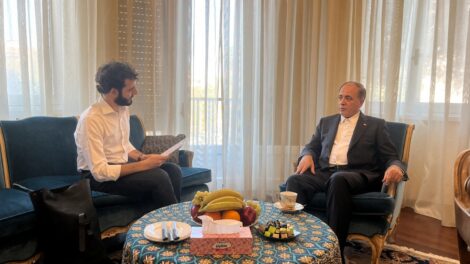
Italy’s Prime Minister Giorgia Meloni will be in Baku in a few days, another stop on her energy tour that has seen her visit Algeria and the Gulf countries. Decode39 spoke with Elchin Amirbayov, Representative of the President of the Republic of Azerbaijan for Special Assignments, who noted that the strategic importance of energy cooperation between Azerbaijan and Italy has become even more evident following the Hormuz crisis.
Furthermore, thanks to TAP, the Southern Gas Corridor has already become one of the main diversification routes for Europe, especially at a time when the continent is seeking reliable alternatives and secure land-based supply routes.
Q: Thanks to the TAP pipeline, Italy and Azerbaijan have solid energy relations. Are they even more important after the Hormuz crisis?
A: Yes, absolutely. The strategic importance of Azerbaijan–Italy energy cooperation has become even clearer after the Hormuz crisis. In times of geopolitical instability, the central issue is not only access to energy, but the reliability and security of delivery routes. In this respect, Azerbaijan has long been a trusted partner for Italy. In 2025, Azerbaijan supplied 9.5 billion cubic meters of gas to Italy via TAP, covering roughly 16% of Italy’s total gas imports. Since the start of TAP’s commercial operation, more than 42 billion cubic meters of Azerbaijani gas have been delivered to Italy. This makes TAP not just a commercial success, but a strategic pillar of Italy’s energy resilience.
- At the same time, the significance of this partnership goes well beyond the bilateral level. Azerbaijan today plays an important role in Europe’s overall energy security. It supplied 12.5 billion cubic meters of natural gas to EU member states in 2025, which was 53.8% higher than in 2021. This shows that the Southern Gas Corridor has already become one of the key diversification routes for Europe, especially at a time when the continent is seeking reliable alternatives and secure overland supply channels.
- The recent tensions around Hormuz have once again reminded everyone how vulnerable global energy markets remain to geopolitical shocks. Against that background, Azerbaijan’s role becomes even more valuable. So yes, after the Hormuz crisis, Azerbaijan–Italy energy relations are not only more important for our two countries, but also more relevant for Europe as a whole.
Q: Is it possible to double the pipeline?
A: Yes, in principle, it is possible. And importantly, this is not a new idea. When European Commission President Ursula von der Leyen visited Baku in July 2022, the EU and Azerbaijan signed a Memorandum of Understanding on a Strategic Partnership in the Field of Energy, which explicitly envisaged doubling Azerbaijani gas supplies and expanding the Southern Gas Corridor to deliver at least 20 billion cubic meters annually to the EU by 2027.
- This process is already underway and we are steadily moving towards that goal. The first-level expansion of TAP became operational from January 2026, adding 1.2 billion cubic meters of annual capacity to Europe. Of this additional volume, 1 billion cubic meters is allocated to Italy. This is a concrete indication that the corridor is not static, but continues to grow in response to Europe’s energy needs.
- At the same time, there is clear potential to do more. Azerbaijan has repeatedly stated that it is ready to increase gas supplies to Europe, but this requires further expansion of the Southern Gas Corridor infrastructure which entails new investment in upstream development and building additional pipeline infrastructure. In today’s environment of geopolitical uncertainty, expanding this capacity is increasingly in Europe’s own strategic interest. And, therefore, financing is essential. As Europe continues its efforts to diversify energy supplies, European institutions can play an important role in helping create the financial conditions for the necessary investments.
Q: How could the TAP pipeline also impact Euro-Mediterranean stability?
A: It can do so in a very practical sense: by strengthening energy security, reducing vulnerability to external shocks, and reinforcing the secure infrastructure and resilient supply chains on which economic predictability depends. In that respect, TAP is a strategic infrastructure, and through the Southern Gas Corridor, Azerbaijani gas contributes to a more diversified and reliable energy supply for Europe.
- For Italy in particular, this matters because Italy is not only a consumer market, but also one of the central energy gateways between Europe and the Mediterranean. The more resilient Italy’s energy position is, the stronger is its ability to contribute to wider regional stability, including in Southeast Europe and the Mediterranean basin. TAP already connects Greece, Albania and Italy, while the Southern Gas Corridor is extending its reach further into Europe through interconnected transmission networks. This broader stabilizing role is also reflected in the fact that Azerbaijani gas now reaches 10 EU member states, most recently adding Germany and Austria.
- There is also a broader geopolitical point. TAP helps anchor stability not only by reducing overdependence on more vulnerable supply routes, but also by creating long-term interdependence among producer, transit and consumer countries. Its impact on Euro-Mediterranean stability is therefore wider than energy alone: it supports resilience and fosters a more secure and interconnected regional environment. In today’s geopolitical context, that is an important contribution to stability.
Q: Are Rome and Baku also united by mine clearance?
A: This issue has indeed become an important humanitarian dimension of our bilateral relationship. For Azerbaijan, demining is essential for saving lives, enabling the safe return of former internally displaced persons to their homeland, and rebuilding liberated territories. In this context, Italy’s support is appreciated, namely its €1.5 million contribution to demining operations in Azerbaijan and ongoing discussions on possible further cooperation in areas such as technical assistance and equipment support. This cooperation has also gained greater public visibility in Italy: on 14 April 2026, a conference dedicated to Azerbaijan’s mine problem was held in the Italian Senate, reflecting growing awareness of the humanitarian and reconstruction dimensions of this issue.
- The scale of the problem is enormous. According to the latest figures, the estimated contaminated area in Azerbaijan stands at 11,667 square kilometres, or around 13.4% of the country’s total territory. Since the end of the 44-day war in November 2020, 422 people have become mine victims, including 73 killed and 349 injured. Of these, 171 were civilians, including 14 children and youth, and 3 women. At the same time, Azerbaijan has made substantial progress in demining despite the scale of the challenge, having already cleared 22.7% of the total contaminated area. The Azerbaijani government has allocated $566.6 million for demining since November 2020, while foreign assistance has amounted to $24 million, which underlines the importance of continued international support.
- So yes, mine clearance is one of the areas that increasingly unites Rome and Baku. This demonstrates that the Azerbaijan–Italy multidimensional strategic partnership extends beyond politics and economics to practical solidarity on issues that directly affect human lives and long-term recovery.
Q: Black Sea, Caspian Sea, Mediterranean Sea: how can relations between Italy and Azerbaijan foster a new geopolitical alignment between the three seas?
A: I would frame it less as a formal geopolitical bloc and more as a new connectivity-based alignment built around shared strategic interests. Italy and Azerbaijan are well placed to foster such an alignment because our partnership already connects the Caspian to the Mediterranean in energy terms, while the Black Sea is becoming increasingly relevant through new electricity, transport and digital connectivity projects. In that sense, the geography is already taking shape: Azerbaijan is not only a key Caspian actor, but also a natural bridge to Central Asia, with which it has developed particularly strong strategic ties in recent years, while Italy serves as a natural gateway to the Mediterranean and wider Europe.
- The next step is to turn that geography into a broader strategic framework. This can happen in at least three areas.
- First, energy: the Southern Gas Corridor has already become a strategic artery linking the Caspian to Europe.
- Second, green electricity: the Caspian–Black Sea–Europe Green Energy Corridor is intended to bring renewable power from Azerbaijan and Central Asia to Europe, and Italy’s CESI company is playing a leading role in the feasibility work for both the Caspian–Black Sea–Europe and Central Asia–Azerbaijan green corridor projects.
- Third, transport and logistics: the Middle Corridor is making the Caspian-Black Sea-Mediterranean space more economically interconnected, which is increasingly important in a period of global supply-chain disruption, significant market volatility and ongoing geopolitical turbulence.
- In this context, the emerging peace in the South Caucasus between Azerbaijan and Armenia, when formalized with the signature of the relevant peace agreement, will create new opportunities.
- As transport links reopen, the region can become even more integrated: construction of the first part of the Zangezur corridor in Azerbaijani territory is nearing completion; through Armenia, the corridor linking mainland Azerbaijan with its Nakhchivan Autonomous Republic is being developed under the Trump Route for International Peace and Prosperity; and on the Nakhchivan side, Azerbaijan is advancing cooperation with the EU and the EBRD on the project of railway reconstruction.
- Taken together, these three elements can reinforce the Middle Corridor and add a further European dimension to the region’s growing connectivity architecture.
- So the real opportunity is this: to build a three-seas alignment not against anyone, but around connectivity, resilience and mutual benefit in a « win-win » logic.
- When the Caspian provides resources and access to Central Asia, the Black Sea provides a strategic corridor for connectivity, and the Mediterranean provides entry to wider European and global markets. Azerbaijan and Italy can help connect not only the three seas, but also the broader regions around them into a more coherent geopolitical and geoeconomic space.