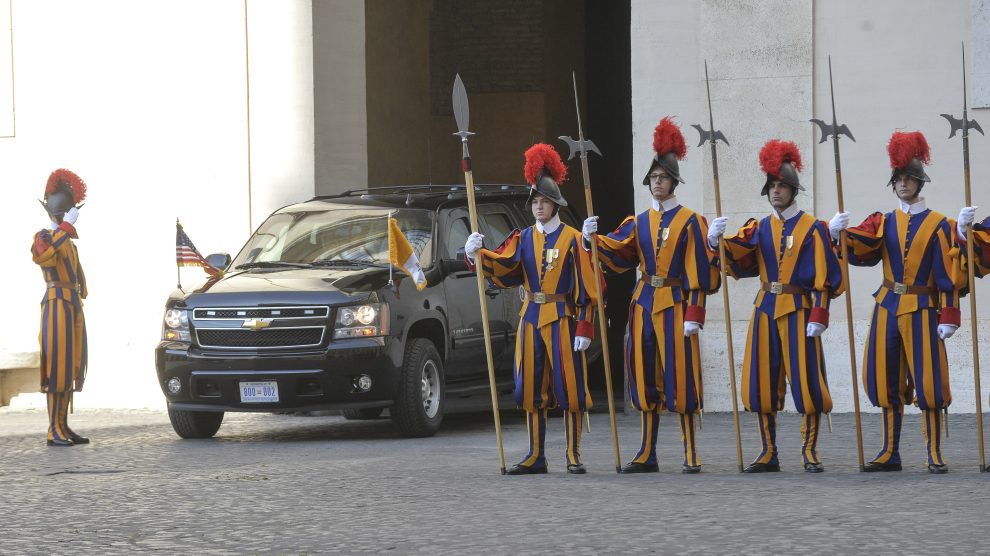
U.S. Secretary of State Marco Rubio is expected in Rome this week for high-level meetings with Vatican officials, in what is shaping up to be a carefully managed diplomatic reset after weeks of friction between the White House and the Holy See.
Rubio will meet Cardinal Pietro Parolin, the Vatican’s top diplomat, and could also hold talks with Pope Leone — though the latter remains uncertain.
Driving the news: The visit follows public tensions triggered by President Donald Trump’s attacks on the Pope over his criticism of U.S. policies, including strikes in Iran and Lebanon and hardline migration measures.
- The Vatican, while signaling openness to dialogue, has not softened its stance: Leone has repeatedly warned against civilian casualties and the moral framing of war.
- Despite the rhetoric, both sides appear intent on avoiding a full diplomatic rupture.
Between the lines: Rubio’s trip reflects a dual objective:
- Contain political fallout from the Trump–Leone confrontation.
- Preserve strategic channels with the Vatican, which remains influential on global humanitarian and diplomatic issues.
- The Holy See has a long tradition of engaging even with governments it disagrees with. That logic seems to hold here: the Vatican has accepted the meeting request and is framing it as an opportunity to keep dialogue open rather than escalate tensions.
What’s on the agenda:
- Conflicts in Iran and Lebanon: The Pope has sharply criticized the escalation, calling for restraint and protection of civilians.
- Migration: Another flashpoint, with Leone opposing restrictive U.S. policies.
- Cuba and Latin America: The Vatican is reportedly concerned about U.S. posture and may raise the issue.
The tone: open, but firm. Italian reporting suggests a calibrated Vatican approach:
- “An outstretched hand” toward Rubio, signaling willingness to engage.
- “Firmness on peace,” particularly on war ethics and civilian protection.
- Leone has also pushed back against accusations of political interference, stressing that his interventions are grounded in moral principles rather than partisan positioning.
Flashback: Rubio last met the Pope in May 2025, alongside Vice President JD Vance, shortly after Leone’s election — a markedly more cordial moment compared to today’s strained context.
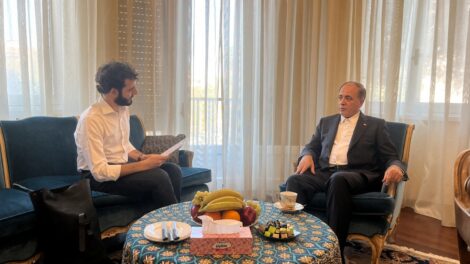
Analysis: Mending Fences. As noted by sinologist Francesco Sisci, director of the Appia Institute, the current tensions should not be read as a simple bilateral dispute but as part of a broader structural divergence between political power and moral authority.
- In his view, the Vatican’s posture reflects a long-term effort to preserve its role as a global ethical actor, especially at a time when major powers are increasingly framing conflicts in strategic rather than humanitarian terms.
- This makes friction with Washington — particularly under a more assertive and transactional U.S. foreign policy — not an anomaly, but a recurring feature of the relationship.
The bottom line: Rubio’s Rome stop is less about breakthroughs and more about damage control. The U.S. and the Vatican are unlikely to align on key issues — but both sides have strong incentives to keep the relationship functional, especially as conflicts in the Middle East and beyond continue to escalate.