Italy’s Prime Minister Giorgia Meloni has wrapped a two-stop trip to Yerevan and Baku, pairing political messaging in Armenia with concrete deals in Azerbaijan — and signaling a more active Italian role along Europe’s eastern and southern periphery.
Why it matters: Italian officials have increasingly framed the country as a “bridge” across different regions and dossiers — in this case between Europe and Eurasia, with energy at the core.
- The back-to-back visits signal an attempt to stay balanced in a fragile region while upgrading ties with Azerbaijan.
- The trip fits into a broader push to anchor Italy within a more strategic EU posture in the “wider Mediterranean.”
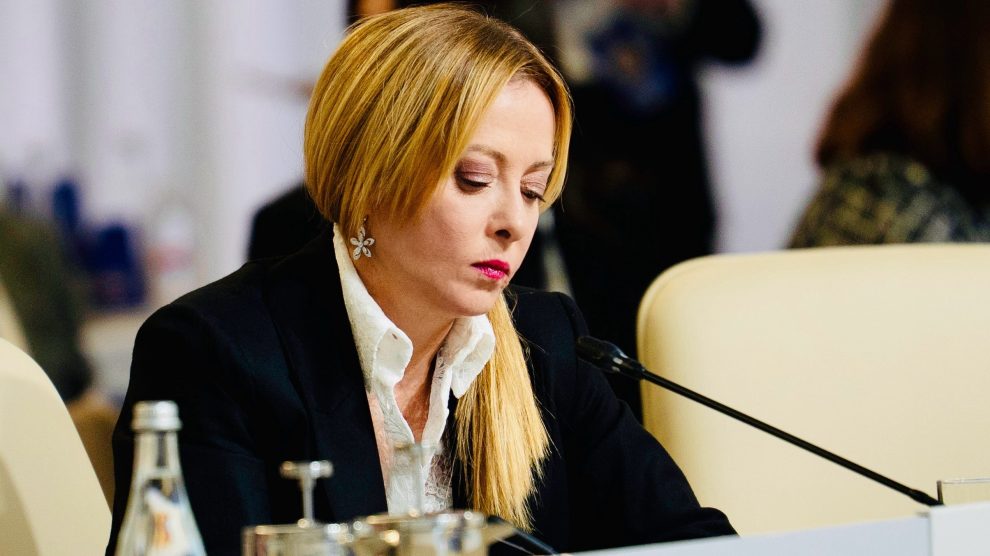
The big picture: At the European Political Community summit in Yerevan, Meloni leaned heavily on the transatlantic axis.
- She reaffirmed Italy’s alignment with the U.S. and NATO, pushing back against any reduction of American military presence in the country.
- At the same time, she urged Europe to move beyond crisis management toward a long-term strategic posture — especially on energy, migration and security.
- Her framing: the EU needs a clearer focus on its geographic neighborhood, starting with the Mediterranean and its extensions.
The Caucasus contest. Yerevan hosted dozens of leaders as a new geopolitical contest takes shape in the South Caucasus — a corridor linking Europe to Asia while bypassing Russia, and a gateway to Central Asia’s energy and mineral resources.
- The region’s importance is rising amid instability in Iran and shifting great-power attention.
- The U.S. is expanding its footprint, including a joint project with Armenia to manage a transport corridor linking Azerbaijan to its exclave of Nakhchivan, with potential extensions to energy and digital infrastructure.
- Turkey and Iran are also asserting influence in a region long dominated by Moscow.
- Russia is pushing back, reminding Armenia of its reliance on Russian energy and maintaining a military presence in the country.
- European leaders used the EPC summit to signal continued engagement, with security concerns tied to Russia’s war in Ukraine. Armenia is simultaneously deepening ties with the EU while remaining in a Moscow-led customs framework — a balancing act that underscores the stakes.
- The summitry may be brief, but competition over the Caucasus — its routes, resources and alignments — is set to endure.
Zoom out: What happened in Yerevan. The Armenia stop set the political and multilateral frame of the trip.
- On migration, Meloni — together with U.K. Prime Minister Keir Starmer — backed a joint declaration signed by more than 30 countries committing to stronger cooperation against illegal migration.
- On the sidelines, she met Swiss President Guy Parmelin, securing a political commitment that Italian families affected by the Crans Montana tragedy would not be charged for hospital care.
- She also held talks with Canadian Prime Minister Mark Carney, focusing on G7 priorities including critical minerals supply chains, migration and broader coordination on global crises.
- Meloni also co-chaired with French President Emmanuel Macron a meeting of the European Coalition Against Drugs (ECAD), aimed at strengthening cooperation against trafficking, including synthetic drugs.
Zoom in: The Baku’s centrality. The stop in Baku delivered the most concrete outcomes.
- Standing alongside President Ilham Aliyev, Meloni described the visit as politically significant — the first by an Italian prime minister in 13 years.
- “For me, today has a significant political value for the relations between our nations,” she said, adding that it was “necessary to fill this gap.”
- Aliyev called Italy a “strategic partner,” stressing that “our political relations are at the highest level.” Both sides agreed to move toward a permanent political coordination framework, signaling a step-up in the relationship.
Energy first. Energy remains the backbone — but the scope is expanding.
- The Trans Adriatic Pipeline (TAP) continues to anchor bilateral ties.
- Azerbaijani supplies have been “decisive” for Italy’s energy security since Russia’s invasion of Ukraine.
- The focus is now shifting toward industrial partnerships across the energy value chain, not just volumes.
- Meloni framed energy and connectivity as “two sides of the same coin,” pointing to Azerbaijan’s role as a hub between Europe and Asia, with Italy as a gateway into the EU market.
Follow the money. Economic ties are scaling up alongside energy:
- Azerbaijani investments in Italy total about $3 billion.
- Roughly 30 Italian companies operate in Azerbaijan, including in Karabakh.
- A business forum planned for 2026 aims to translate political alignment into commercial deals.
- Aliyev said he would like to see the number of Italian companies grow, noting their “great success” in the country.
Defense and tech. Security cooperation is also expanding.
- Aliyev pointed to a “new page” in military ties, including areas where “there are Italian technologies.”
- Italy is focusing on aerospace, maritime security, protection of critical infrastructure and advanced technologies, with an emphasis on long-term industrial cooperation.
The regional angle. Meloni maintained a calibrated line on regional dynamics.
- She reiterated Italy’s support for normalization between Azerbaijan and Armenia, calling it a potential “historic turning point,” and discussed the Iran crisis, thanking Baku for assisting Italy during evacuation and diplomatic operations.
Between the lines: The trip ties together several elements of Italy’s foreign policy: energy diversification, industrial partnerships and a stronger diplomatic presence in regions where infrastructure and geopolitics intersect.
What we’re watching:
- Whether Italy can translate political coordination with Baku into expanded energy flows and industrial projects.
- Progress on Azerbaijan–Armenia normalization, which would unlock regional connectivity.
- How Rome positions itself inside EU debates on energy, migration and neighborhood policy after this trip.
The bottom line: Meloni’s South Caucasus tour combined political messaging in Yerevan with concrete agreements in Baku. The result: a clearer Italian push to deepen energy, economic and security ties in a region increasingly relevant for Europe.
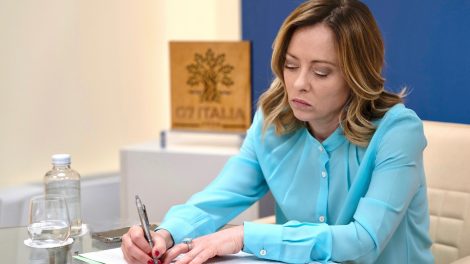
(Photo: governo.it)