At Kigali, for two days, the word repeated most often was not simply “growth.” It was “scale.” The 2026 Africa CEO Forum, held on May 14–15 in the Rwandan capital, chose a blunt, almost definitive title: “Scale or Fail.” Scale up or remain trapped in fragmentation. Build continental champions or continue depending on isolated projects. Attract patient capital or remain exposed to the volatility of an increasingly selective global financial system.
Within this narrative, the climate issue — particularly in relation to the internationalization of Italian companies — emerged simultaneously as a constraint, an opportunity, and a criterion for investment selection. Because today, in Africa, talking about growth also means talking about accessible energy, resilient networks, climate-adaptive agriculture, infrastructure capable of withstanding environmental shocks, as well as digital technologies and artificial intelligence applied to productivity, water management, and risk forecasting. All crucial elements for Italian companies seeking to establish long-term partnerships across the Continent.
The Italian participation. Italy’s participation unfolded within the framework of the Mattei Plan, with the objective of strengthening a more structured economic presence in sectors where the relationship between business, development, and climate resilience is most evident: energy, infrastructure, agribusiness, manufacturing, digital technologies, and advanced services.
- Ahead of the Forum, the Italian Ministry of Foreign Affairs (MAECI), with the support of the Italian Trade Agency (ICE), organized dedicated initiatives aimed at promoting the “Sistema Italia,” with particular attention to industrial machinery, infrastructure, and construction supply chains. But Kigali also raised a deeper political question: who decides the trajectory of African growth?
- Rwandan President Paul Kagame stressed the need for Africa to better defend its own strategic interests, while the organizers repeatedly emphasized the concept of shared ownership — the sharing of capital, risk, elements of governance, and common values between African and international actors.
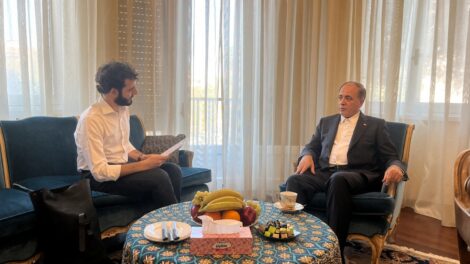
To better understand what truly emerged from both the panels and the informal discussions throughout the Forum, we interviewed Fabrizio Lobasso, former Italian Ambassador to Khartoum, Sudan, and head of the Italian delegation in Kigali. Together with him, we sought to assess — from the perspective of someone representing the Italian system abroad — the opportunities and risks shaping today’s relationship between Africa, innovation, and investment.
Q: The Africa CEO Forum in Kigali adopted a very direct title: “Scale or Fail.” But I would like to shift the focus toward Italy. What did it concretely mean to be present in Kigali as a country system, rather than as individual institutional or industrial actors?
A: Kigali made one thing abundantly clear: Africa is not looking for occasional interlocutors, but for partners capable of accompanying long-term growth processes. For this reason, Italy’s presence could not be limited to institutional participation or a commercial showcase. We needed to present ourselves as a system, bringing together institutions, associations, businesses, development finance, guarantee instruments, technology, and industrial capabilities.
- This is precisely the point. If Africa must scale, Italy must also operate at scale. The success of a single company, however excellent, is no longer sufficient. What is needed is a recognizable industrial ecosystem capable of providing solutions, training, structuring, credit, local partnerships, and continuity.
- In Kigali, we sought to convey a clear message: Italy can be a reliable partner not because it imposes a model, but because it knows how to build industrial relationships, adapt its expertise to local contexts, and work alongside African actors through a logic of intercultural co-design.
Q: The Mattei Plan is often interpreted primarily as a political framework. After Kigali, can we say that it is also becoming an operational instrument for the internationalization of Italian companies? And what concrete returns can we expect from a mission such as the one in Rwanda?
A: Among its many strengths, the Mattei Plan stands out for its ability to translate into projects, industrial relationships, and measurable opportunities. The political dimension is fundamental because it builds trust and opens institutional channels. It acts as a catalyst, enabling us to generate partnerships, financial agreements, industrial presences, and shared supply chains. In this regard, MAECI is carrying out important work of refinement and unwavering support.
- The returns should not be interpreted only in immediate terms. A mission such as the one in Kigali generates contacts, reputation, market knowledge, relationships with local institutions, dialogue with funds and development banks, as well as opportunities for industrial associations and companies. This is the patient work of growth diplomacy.
- It does not always produce results within weeks, but it creates the conditions for Italian companies to be present when projects mature and when our African counterparts, recognizing our excellence, seek us out again.
Q: UCIMA was also present in Kigali, with a focus on industrial machinery and packaging technologies. Why bring this sector to the Africa CEO Forum? What does it reveal about Italy’s potential presence in Africa?
A: UCIMA’s presence was highly significant because it represents an essential component of Italian strength. When we speak about African industrial development, we are not referring only to major infrastructure projects or large-scale energy investments. We are also talking about the ability to build productive supply chains, process raw materials, strengthen agro-industry, improve packaging, ensure product traceability, and guarantee export suitability.
- Italian industrial machinery is particularly well suited to this transition. It does not simply provide machines. It provides expertise, the ability to adapt products to local demands, technical assistance, and training. It offers the flexibility to operate across different production systems and evolving industrial contexts.
- In many African countries, the issue is not merely importing technology, but building sustainable local productive capacity. In this sense, industrial machinery becomes a development tool, not just an exported product.
- The seminar with UCIMA demonstrated exactly this value. It presented African stakeholders — and international ones as well — with a tangible and operational component of industrial Made in Italy: not rhetorical, not decorative, but directly connected to the growth of supply chains. If Africa aims to industrialize further and retain more value locally, Italian industrial machinery can naturally become part of that path.
Q: In Kigali, Cassa Depositi e Prestiti also played an important role through the agreement linked to the Italian Climate Fund and the Banque Rwandaise de Développement. How important is it, for the credibility of Italy’s presence, to accompany economic diplomacy with concrete financial instruments?
A: It is absolutely crucial. Companies alone often struggle to enter complex markets unless there is an adequate institutional and financial framework capable of opening doors and preparing the ground for partnerships.
- In Africa, many projects require long time horizons, structuring capacity, guarantees, blended public-private finance instruments, and dialogue with local and multilateral banks. The presence of CDP, alongside other actors of the Italian system such as SACE in this case, serves precisely this purpose: transforming political and industrial interest into concrete operations.
- The agreement with Rwanda is important because it demonstrates a transition from declarations to actual project implementation. Clean energy, electric mobility, and urban resilience are not abstract concepts. They are areas that require infrastructure, technology, services, expertise, and companies. If public finance succeeds in mobilizing high-impact investments, it also creates a more solid environment for private-sector participation and for a mutually beneficial sharing of advantages between Italian and local companies.
- For Italy, this is a decisive point. We should not seek to compete solely on financial scale against larger or more deeply entrenched actors. But we can compete on project quality, industrial capability, proximity to local businesses, and the integration of credit, technology, and training. We can prevail in terms of reliability and negotiating resilience.
- In this perspective, finance is not an accessory element. It is what makes the Italian presence credible and scalable.
Q: Let me return to Rwanda. What is the strategic rationale behind choosing Kigali as the location for a system mission and as a vantage point for observing Africa? And what should happen next to ensure that this presence does not remain episodic?
A: Rwanda is a small country, but one with a strong ambition to position itself as a hub for millions of consumers across neighboring countries and beyond the sea. It has invested heavily in institutional structuring, investment attraction, innovation, urban sustainability, technology, and the construction of its own regional hub function.
- This is why Kigali is such an interesting place. It offers a lens through which to observe some of the Continent’s deeper trends — urban growth, digitalization, energy demand, and the development of productive supply chains — with a particularly appropriate perspective and with energies ready to be translated into concrete projects. Without forgetting the growing demand for skills and for more sophisticated industrial partnerships, areas in which Italy is exceptionally well positioned.
- The real issue, however, is what comes afterward. A system mission only makes sense if it is followed by structured and coordinated work. We need to map the contacts gathered, distinguish mature opportunities from exploratory ones, support industrial associations, involve genuinely interested companies, and use the instruments of ICE, SACE, CDP, SIMEST, and MAECI in a coordinated way while building sector-specific follow-up initiatives with substantive creativity.
- Kigali should not be considered an isolated stop. It can become a method — a model for commercial and financial engagement. Entering African markets with a clear industrial proposal, a cohesive institutional presence, adequate financial tools, and a genuine capacity to listen.
- This is the deepest meaning of growth diplomacy: building pathways for a stable, credible, and mutually beneficial presence.
Q: Ambassador, thank you very much for your insights. If you had to summarize in one sentence the political and economic message Italy takes away from Kigali, what would it be?
A: I would say that Italy has come to understand more clearly that Africa is not simply a market to be monitored or an area to support. It is a continent with which to build shared trajectories of growth.
- Kigali reminded us that scale does not emerge from sporadic engagement, but from continuity, trust, and the ability to bring together businesses, institutions, finance, and expertise. This is where Italy can play an important role: not “for” Africa, but “with” Africa.